Guide 05
Tax sale surplus funds after Tyler v. Hennepin County
4 min read · updated October 27, 2026
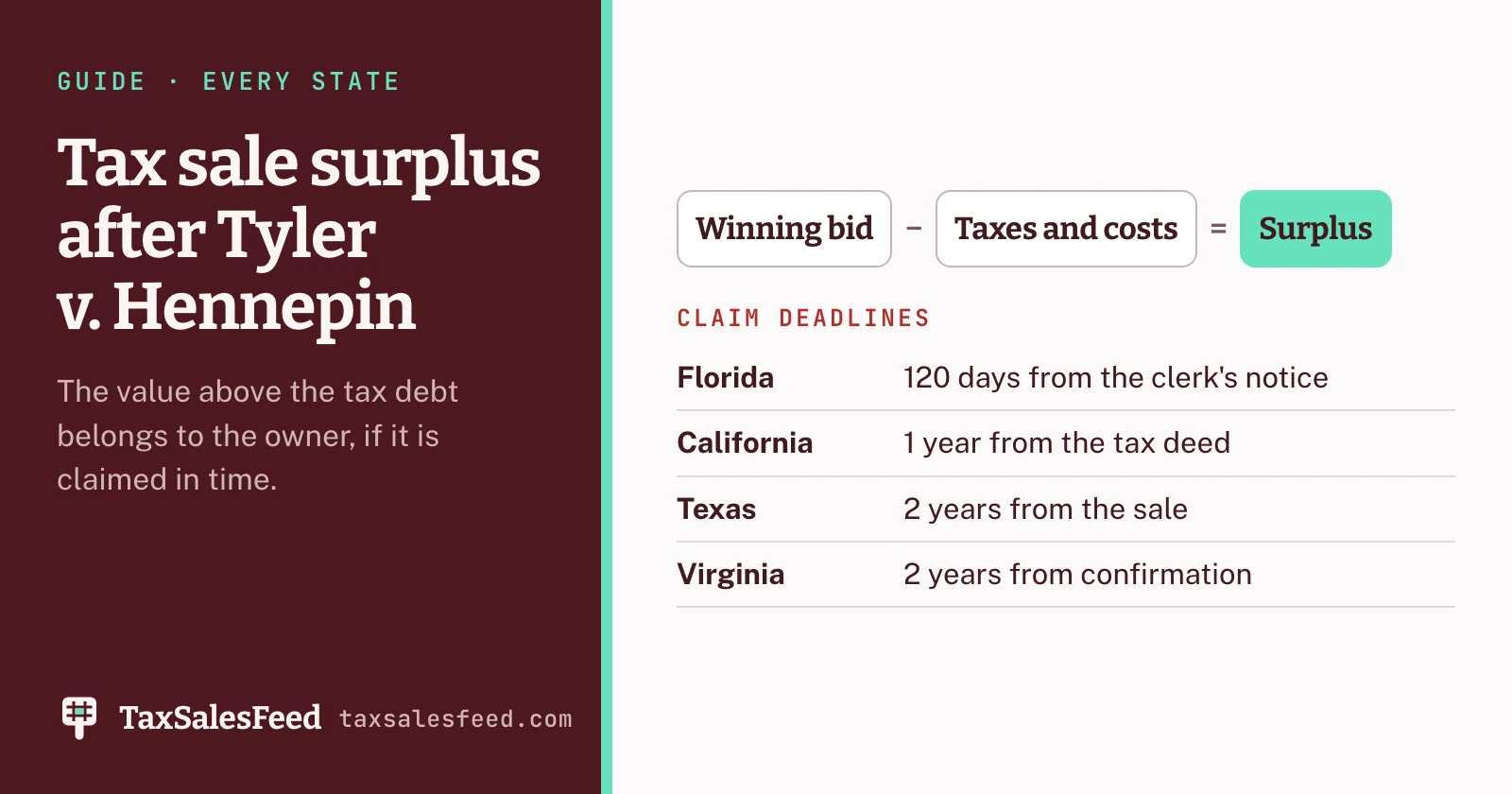
When a county sells a property for unpaid property tax, the price is set at auction, and it is often more than the tax owed. For years some states let the county keep the difference. In 2023 the Supreme Court said that has to stop. The money above the debt, the surplus, now goes back to the people who had an interest in the property. But it does not arrive by itself: each state has a claim process and a deadline, and an unclaimed surplus can be lost. This guide covers what the case decided, who can claim, and how and by when in the states where most tax sales happen.
What Tyler v. Hennepin County decided
Tyler v. Hennepin County held that a government may sell a home to collect unpaid property tax but may not keep the sale proceeds above what is owed: that surplus belongs to the owner.
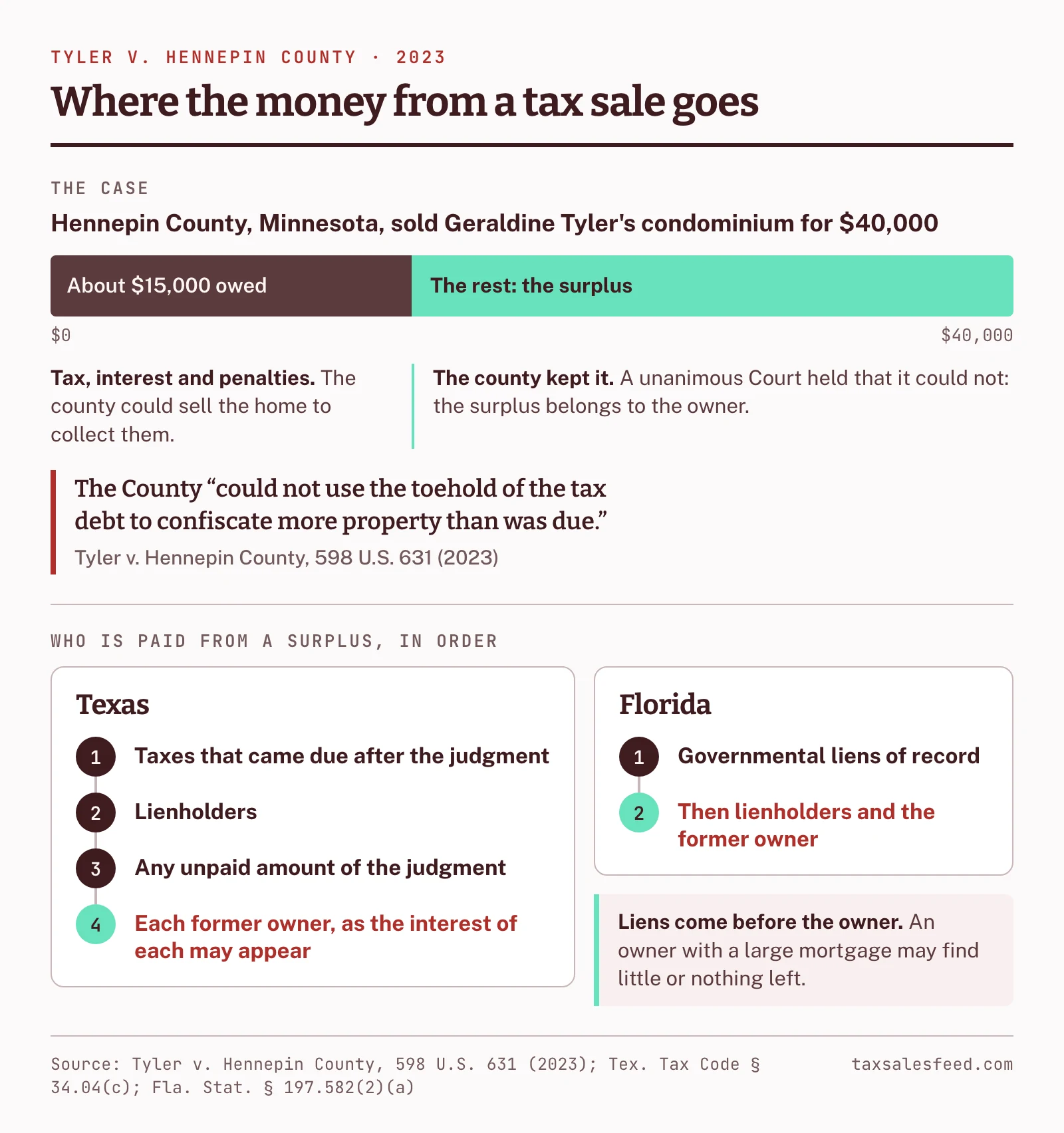
Hennepin County, Minnesota, sold Geraldine Tyler's condominium for $40,000 to collect about $15,000 in tax, interest and penalties, and kept the rest. A unanimous Court held: "The County had the power to sell Tyler’s home to recover the unpaid property taxes. But it could not use the toehold of the tax debt to confiscate more property than was due." [1] It also noted that this was already the majority rule: "Today, most States and the Federal Government require excess value to be returned to the taxpayer whose property is sold to satisfy outstanding tax debt." [2]
The states that did not return surplus have been rewriting their laws since; the state-by-state guide lists those changes. This guide is about the claim itself.
Who can claim, and by when
The surplus is claimed by the former owner and anyone else who had an interest in the property before the sale, through the clerk, the county or the court, by a deadline that ranges from months to two years.
| State | Who can claim | Deadline | Where |
|---|---|---|---|
| Florida | Governmental liens first [3], then lienholders and the former owner | 120 days from the clerk's notice [4] | The clerk of court |
| California | "Any party of interest," in proportion to its interest | One year from the recording of the tax collector's deed [5] | The county |
| Texas | Any person, including a taxing unit, by petition [6]; former owners last [7] | Two years from the sale [8] | The court that ordered the sale |
| Michigan | Former owners and interest holders, by notice on the Treasury form | By the July 1 after the foreclosure [9] | The foreclosing governmental unit |
| New York | Anyone with an interest before the foreclosure judgment [10] | Set by the court's process | The court |
| Minnesota | Interested parties | Six months from the county's first notice [11] | The county |
| Virginia | The former owner or heirs | Two years from the court's confirmation [12] | The court |
| South Dakota | The prior owner of record [13] | Not stated in the statute quoted; ask the county | The county |
In Wisconsin the county must notify the former owner by certified or registered mail that they "may be entitled to a share of the proceeds of a future sale" [14]. In Maine a town selling tax-acquired property must "Pay to the former owner any sale proceeds in excess of" the taxes and costs [15].
Unclaimed money does not wait forever. In California, excess proceeds nobody claims "may be transferred to the county general fund" [16].
Liens are paid before the former owner
A surplus pays the debts against the property before the former owner: governmental liens, then mortgages and other recorded liens, then the owner.
Florida's clerk pays governmental liens of record first [3]. Texas sets a strict order: taxes that came due after the judgment, then lienholders, then any unpaid amount of the judgment, and only then "each former owner of the property, as the interest of each may appear" [7]. An owner with a large mortgage may find little or nothing left.
Selling your claim to a recovery service
Surplus recovery services buy or work claims for a share of the money, and some states restrict how: California allows an assignment only in a dated, written instrument that says so.
California's rule is that a party "may assign their right to claim the excess proceeds only by a dated, written instrument that explicitly states that the right to claim the excess proceeds" is being assigned [17]. Most claims can be filed without help, by the deadlines above. Read the state's rule and the fee before signing anything.
What it means for bidders
For a bidder, Tyler changes nothing at the auction: the sale still happens and the price is still set by bidding; it changes only where the money above the debt goes.
A surplus exists only when the winning bid is above the tax, interest and costs owed. Florida's rules for distributing it are in after a Florida tax deed sale, and the liens that survive the deed in liens that survive a Florida tax deed sale.
The tax sale lists carry every upcoming sale we read, county by county, with the opening bid where the notice prints it, which is the starting point for judging whether a sale is likely to leave a surplus.
Sources
- [1]Tyler v. Hennepin County, 598 U.S. 631 (2023) — Supreme Court of the United States“The County had the power to sell Tyler’s home to recover the unpaid property taxes. But it could not use the toehold of the tax debt to confiscate more property than was due.”
- [2]Tyler v. Hennepin County, 598 U.S. 631 (2023) (syllabus) — Supreme Court of the United States“Today, most States and the Federal Government require excess value to be returned to the taxpayer whose property is sold to satisfy outstanding tax debt.”
- [3]Fla. Stat. § 197.582(2)(a) — Florida Legislature“The clerk shall distribute the surplus to the governmental units for the payment of any lien of record held by a governmental unit against the property”
- [4]Fla. Stat. § 197.582(3) — Florida Legislature“has 120 days from the date of the notice to file a written claim with the clerk for the surplus proceeds”
- [5]Cal. Rev. & Tax. Code § 4675(a)(1) — California Legislature“Any party of interest in the property may file with the county a claim for the excess proceeds, in proportion to that person’s interest held with others of equal priority in the property at the time of sale, at any time prior to the expiration of one year following the recordation of the tax collector’s deed to the purchaser.”
- [6]Tex. Tax Code § 34.04(a) — Texas Legislature (Texas Legislative Council)“A person, including a taxing unit and the Title IV-D agency, may file a petition in the court that ordered the seizure or sale setting forth a claim to the excess proceeds.”
- [7]Tex. Tax Code § 34.04(c)(5) — Texas Legislature (Texas Legislative Council)“to each former owner of the property, as the interest of each may appear”
- [8]Tex. Tax Code § 34.04(a) — Texas Legislature (Texas Legislative Council)“The petition must be filed before the second anniversary of the date of the sale of the property.”
- [9]Mich. Comp. Laws § 211.78t(2) — Michigan Legislature“by the July 1 immediately following the effective date of the foreclosure of the property, a claimant seeking remaining proceeds for the property must notify the foreclosing governmental unit using a form prescribed by the department of treasury.”
- [10]N.Y. Real Prop. Tax Law § 1197 — New York State Senate“Any person who had any right, title, interest, claim, lien or equity of redemption in or upon a parcel immediately prior to the issuance of the judgment of foreclosure may file a claim with the court having jurisdiction for a share of any surplus resulting from the sale of such property.”
- [11]Minn. Stat. § 282.005, subd. 6(a) — Minnesota Office of the Revisor of Statutes“Interested parties are entitled to make a claim for surplus proceeds under this subdivision if they file a claim within six months from the date the notice is first mailed to the interested parties.”
- [12]Va. Code § 58.1-3967 (amended 2025, c. 267) — Virginia General Assembly (LIS)“if no claim for such surplus is made by such former owner or his heirs, devisees, successors, or assigns within two years after the date of confirmation of such sale”
- [13]SDCL § 10-25-39 (amended SL 2024, ch 38; SL 2025, ch 49) — South Dakota Legislature (LRC)“Any surplus proceeds of the tax deed sale that remain after payment of the taxes, penalty, interest, county liens and other costs, must be returned to the prior owner of record.”
- [14]Wis. Stat. § 75.36(2m)(a) (2023 Wis. Act 207) — Wisconsin Legislature“the county treasurer shall notify the former owner, by registered mail or certified mail sent to the former owner’s mailing address on the tax bill, that the former owner may be entitled to a share of the proceeds of a future sale”
- [15]36 M.R.S. § 943-C(3)(C) (P.L. 2023, c. 640) — Maine Legislature (Office of the Revisor of Statutes)“Pay to the former owner any sale proceeds in excess of”
- [16]Cal. Rev. & Tax. Code § 4674 — California Legislature“any excess proceeds not claimed under Section 4675 may be transferred to the county general fund of the county by the county auditor”
- [17]Cal. Rev. & Tax. Code § 4675(b) — California Legislature“may assign their right to claim the excess proceeds only by a dated, written instrument that explicitly states that the right to claim the excess proceeds is being assigned”
Questions
What did Tyler v. Hennepin County decide?
In May 2023 a unanimous Supreme Court held that Hennepin County, Minnesota, could sell Geraldine Tyler's condominium to collect about $15,000 in unpaid tax, interest and penalties, but could not keep the rest of the $40,000 sale price. Keeping value above the debt is a taking under the Fifth Amendment, so the surplus belongs to the owner.
Who can claim surplus funds after a tax deed sale?
The former owner and anyone else who held an interest in the property before the sale, such as a mortgage lender or another lienholder, in the order the state's law sets. Governmental liens and recorded liens are usually paid before the former owner.
How long do I have to claim tax sale surplus funds?
It depends on the state. Florida gives 120 days from the clerk's notice, California one year from the recording of the tax collector's deed, Texas two years from the sale, Virginia two years from the court's confirmation, and Minnesota six months from the county's notice. Michigan requires notice by the July 1 after the foreclosure.
Does Tyler v. Hennepin apply in tax lien states?
It applies wherever a government ends up taking or selling the property for the tax debt. In a lien state the investor buys the debt, not the house, so the question arises only if an unredeemed lien turns into a deed. Several lien states have since added a public auction or an equity claim at that step.
Can I sell or assign my right to claim the surplus?
In some states, with conditions. California allows it only by a dated, written instrument that explicitly says the right is being assigned. Read the state's rule before signing with a surplus recovery service.
Where next
- Florida tax deed sale calendarEvery county's upcoming sale days, with parcel counts and start times.
- Tax sale guidesHow to buy at a tax sale, which states sell deeds or liens, and Florida, Texas, Georgia, Pennsylvania and California step by step.
- Tax certificate holdersThe funds applying for tax deeds, with every county they are active in.
- Tax sale glossaryTax certificate, tax deed application, opening bid, redemption — every term a notice uses.
General information about tax sale law across the states, not legal advice. Each state's law and each county's sale terms differ, and statutes change; confirm with the county office holding the sale before bidding.