Guide 03
Which states sell tax deeds, tax liens or redeemable deeds
16 min read · updated October 25, 2026
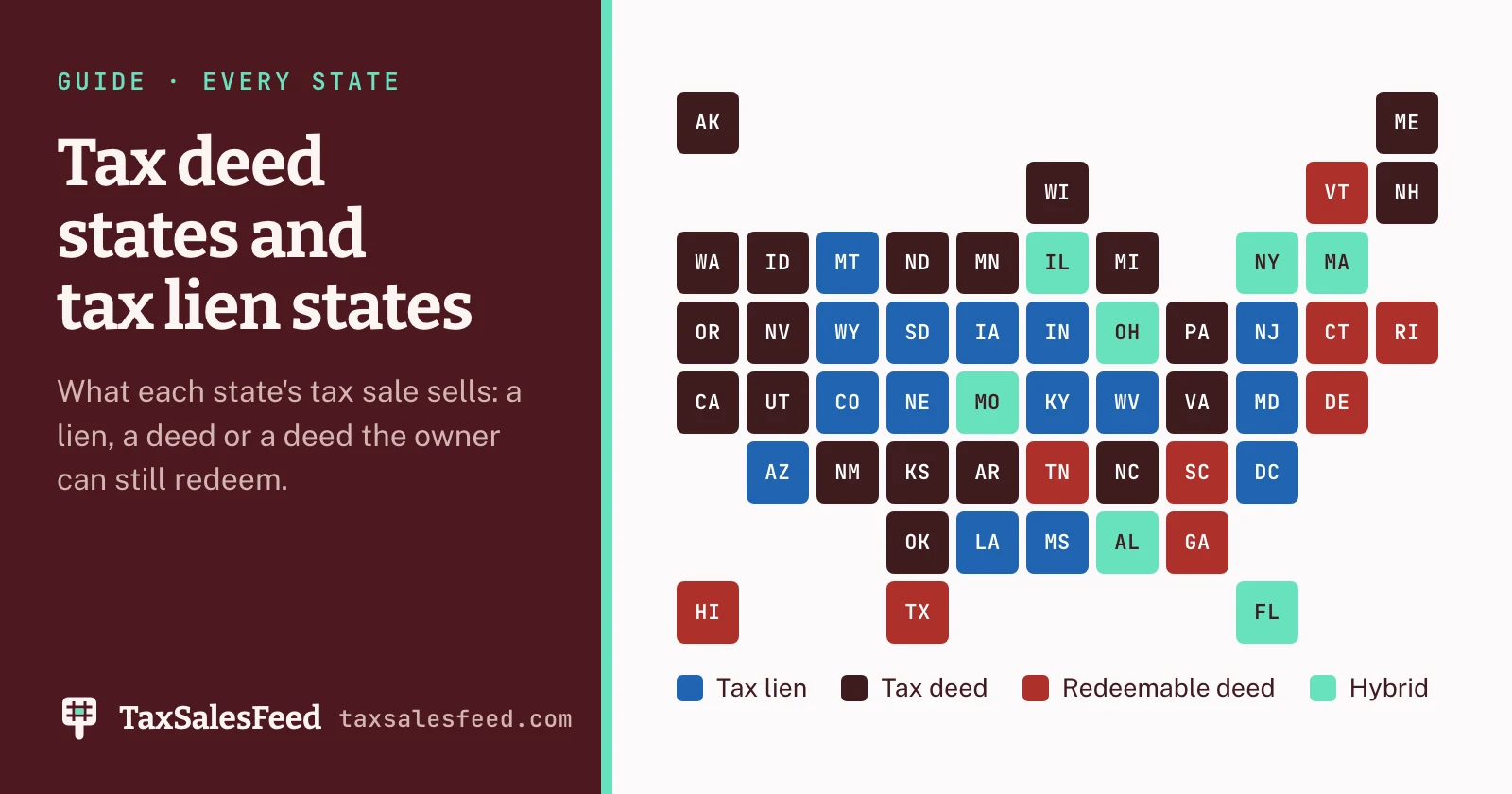
Every state collects unpaid property tax by selling something, but not the same thing. In some, the county auctions the debt and the buyer earns interest. In others it auctions the property itself. In a third group it auctions the property but lets the owner buy it back. Which one a state does decides what you are bidding on, when you might own anything, and what you can earn, so it is the first thing to know about any tax sale. This guide sorts all 50 states and the District of Columbia, each with the statute or official source behind it.
Four kinds of tax sale state
A tax lien state sells the tax debt as a certificate that earns interest; a tax deed state sells the property outright; a redeemable deed state sells the property subject to the owner's right to buy it back; and a hybrid state does more than one, in sequence or county by county.
- Tax lien states. The county sells a tax certificate: its claim for the unpaid tax. The buyer pays the tax and is repaid with interest or a penalty when the owner redeems. Most owners do. If one never does, the holder can apply for a deed or foreclose, years later.
- Tax deed states. The county, the state or a court sells the property, and the owner's right to redeem ends at or before the sale. In many of them the government takes title first and then sells what it took.
- Redeemable deed states. The property is sold, but the former owner can still buy it back for a set period after the sale, by repaying the price plus a premium fixed by statute. Until that period ends you hold a deed you may have to give back.
- Hybrid states. Florida sells a lien first and a deed years later; some states let each county choose; New York sells deeds in most counties and liens in a few places.
Tax deed, tax lien and redeemable deed sales explains each kind of purchase. This guide is about where each is sold.
Every state at a glance
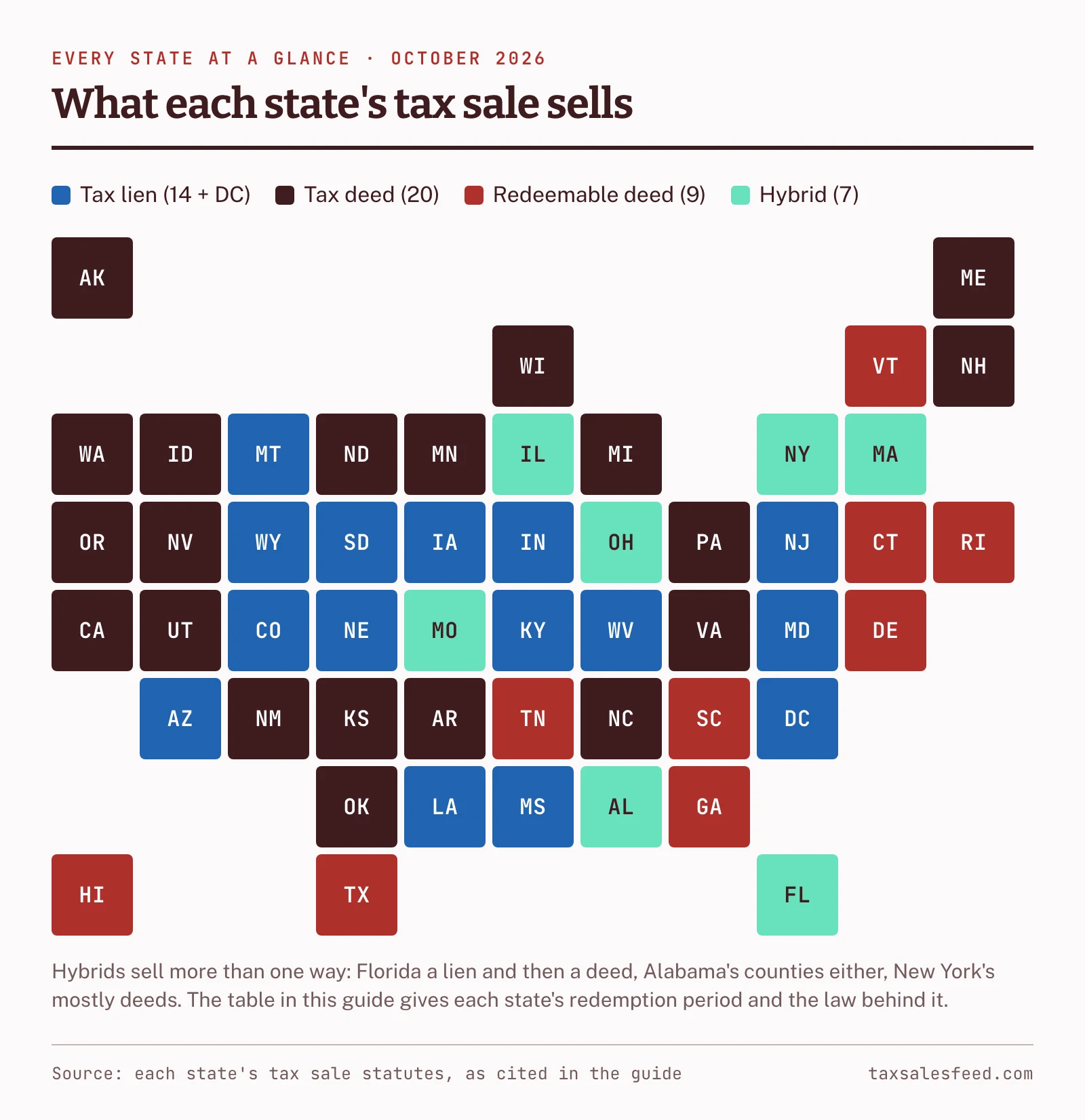
By our count, fourteen states and the District of Columbia sell liens, twenty sell deeds, nine sell redeemable deeds and seven are hybrids that sell more than one way. Most hybrids are lien-then-deed states or let each county choose.
The table reads the law as it stands in October 2026. "Owner can redeem" is how long the owner can still pay and keep or recover the property; "buyer's return" is the interest, penalty or premium a buyer earns if the owner does. The last column counts the sales in our records for each state, and links to them.
| State | What the sale sells | Owner can redeem | Buyer's return | Sales in our records |
|---|---|---|---|---|
| Alabama | Hybrid: each county sells liens or the property [1] | Until foreclosure on a lien; three years on a property sale [2][3] | Up to 12%, bid down [4] | — |
| Alaska | Deed, after the borough or city takes title [5][6] | At least a year after the foreclosure judgment [7] | — | — |
| Arizona | Lien [8] | Until the treasurer's deed; foreclosure from three years [9] | Up to 16%, bid down [10][11] | — |
| Arkansas | Deed, after the state takes title [12] | Until the business day before the sale [13] | — | — |
| California | Deed [14] | Until the business day before the sale [15] | — | 31 upcoming |
| Colorado | Lien, ending in a public auction [16] | Until the deed; deed application after August 1 of the third year [17] | Discount rate + 9 points (13% in 2026) [18][19] | 6 upcoming |
| Connecticut | Redeemable deed (towns may sell liens instead) [20][21] | Six months after the sale [22] | 18% a year [23] | 81 upcoming |
| Delaware | Redeemable deed, at a sheriff's sale [24] | 60 days after the court approves the sale [25] | 15%, flat [26] | 43 upcoming |
| District of Columbia | Lien [27] | Until foreclosure, which can start after six months [28][29] | 1.5% a month [30] | — |
| Florida | Hybrid: a lien, then a deed sale [31] | Until the tax deed; deed application after two years [32][33] | Up to 18%, bid down [34][35] | 3,082 upcoming |
| Georgia | Redeemable deed [36] | 12 months, then until the buyer bars it by notice [37][38] | 20% the first year, 10% each year after [39] | 218 upcoming |
| Hawaii | Redeemable deed, county by county [40][41] | One year [42] | 12% a year [43] | — |
| Idaho | Deed, after the county takes title [44][45] | Until the county sells, at most 14 months after its deed [46][47] | — | — |
| Illinois | Hybrid: a lien, then a court-ordered deed auction [48][49] | Three years (one for vacant and commercial property) [50] | Up to 9% per six months, bid down [51][52] | — |
| Indiana | Lien [53] | One year [54] | 10% of the minimum bid, 15% after six months [55] | — |
| Iowa | Lien [56] | 90 days after a notice served from one year nine months [57][58] | 2% a month [59] | — |
| Kansas | Deed, by court foreclosure [60][61] | Until the sheriff's sale [62] | — | — |
| Kentucky | Lien, sold at face value [63] | Until a court foreclosure sale; suit allowed after a year [64] | 12% a year [65] | 24 upcoming |
| Louisiana | Lien (since January 2026) [66][67] | Until the lien is enforced; suit allowed after three years [68] | Up to 1% a month, bid down [69] | — |
| Maine | Deed, after the town takes title [70] | 18 months from the town's lien [71] | — | — |
| Maryland | Lien [72] | Until foreclosure, allowed after six months [73] | Set by each county, 6% by default; 10% cap on owner-occupied homes [74][75] | — |
| Massachusetts | Hybrid: the town takes title, and may sell its tax titles [76][77] | Until the Land Court forecloses, allowed after 12 months [78] | 8% a year since November 2024 [79] | — |
| Michigan | Deed, after the county takes title [80][81] | Until March 31 after the foreclosure judgment [82] | — | 337 upcoming |
| Minnesota | Deed, after the state takes title [83][84] | Generally three years, before forfeiture [85] | — | 88 upcoming |
| Mississippi | Lien, maturing into a deed [86] | Two years from the sale [87] | 1.5% a month plus 5% damages [88] | — |
| Missouri | Hybrid: certificates, then deeds at later offerings [89][90] | One year, then until the buyer takes the deed [91] | Up to 10% a year [89] | past sales |
| Montana | Lien, assigned over the counter [92] | Three years from the lien [93] | 10% a year plus a 2% penalty [94] | — |
| Nebraska | Lien [95] | Until a deed application, allowed from three years [96] | 14% a year [97] | — |
| Nevada | Deed, after the county holds it in trust [98] | Two years, then until three business days before the sale [99][100] | — | — |
| New Hampshire | Deed, after the town takes title [101][102] | Two years from the town's lien [103] | — | — |
| New Jersey | Lien [104] | Until foreclosure, which can start after two years [105] | Up to 18%, bid down, plus a 2–6% penalty [106][107] | — |
| New Mexico | Deed, sold by the state [108] | Before the sale only [109] | — | 104 upcoming |
| New York | Hybrid: most counties sell deeds, some places sell liens [110][111] | Two years after the lien date, in most counties [112] | Nassau County liens: up to 10% per six months [113] | 13 upcoming |
| North Carolina | Deed, by court or in rem foreclosure [114][115] | Until the court confirms the sale [116] | — | 26 upcoming |
| North Dakota | Deed, after the county takes title [117][118] | Until the October 1 foreclosure date [119] | — | — |
| Ohio | Hybrid: foreclosure sales, and liens where a county chooses [120][121] | Until the court confirms the sale [122] | Liens: up to 18%, bid down [123] | 331 upcoming |
| Oklahoma | Deed (no lien sales since 2008) [124][125] | Until the resale auction starts [126] | — | — |
| Oregon | Deed, after the county takes title [127] | Two years after the county's judgment [128] | — | past sales |
| Pennsylvania | Deed (sheriff's sales in Philadelphia and Allegheny) [129][130] | Until the sale; occupied homes after a sheriff's sale, nine months (three in Allegheny) [131][132][133] | — | 839 upcoming |
| Rhode Island | Redeemable deed [134] | Until foreclosure, which can start after a year [135][136] | 10%, then 1% a month after six months [137] | — |
| South Carolina | Redeemable deed [138][139] | 12 months [140] | 3–12% of the bid, by quarter [141][142] | 12,024 upcoming |
| South Dakota | Lien, ending in an auction [143][144] | Until the tax deed; proceedings from three years [145][146] | Up to 10%, bid down [147] | — |
| Tennessee | Redeemable deed, by court sale [148] | Up to a year after the court confirms the sale [149][150] | 12% a year [151] | 92 upcoming |
| Texas | Redeemable deed [152][153] | 180 days; two years for homesteads and farmland [154][155] | 25% the first year, 50% the second [156] | 579 upcoming |
| Utah | Deed [157] | Until the sale [158] | — | — |
| Vermont | Redeemable deed, town by town [159][160] | One year [161] | 1% a month [162] | — |
| Virginia | Deed, by court sale [163][164] | Until the sale [165] | — | 187 upcoming |
| Washington | Deed [166][167] | Until the day before the sale [168] | — | 14 upcoming |
| West Virginia | Lien, sold by the State Auditor [169] | Until the tax deed [170] | None on the bid [171] | — |
| Wisconsin | Deed, after the county takes title [172][173] | Until the county takes title, from two years [174] | — | — |
| Wyoming | Lien [175][176] | Until a deed application, four to six years [177][178] | 3% plus 15% a year [179] | — |
Tax lien states
Fourteen states and the District of Columbia sell tax liens: Arizona, Colorado, Indiana, Iowa, Kentucky, Louisiana, Maryland, Mississippi, Montana, Nebraska, New Jersey, South Dakota, West Virginia and Wyoming. The buyer earns interest or a penalty, set by bidding in most and by statute in a few, and reaches the property only if the owner never pays.
In a lien state the auction is a contest over return, not price. Most of them let bidders compete by accepting a lower rate: Arizona sells to whoever "offers to accept the lowest rate of interest" [10], under a 16% cap [11]; Florida awards each certificate to the bidder who "will demand the lowest rate of interest" [35], from a maximum of 18% [34]; New Jersey certificates "can earn interest of up to 18 per cent, depending on the winning percentage bid" [106]. A few fix the return by statute instead. Iowa charges "two percent per month" [59], Nebraska 14% a year [97], Wyoming a 3% penalty plus 15% a year [179]. Louisiana is the newest lien state: on January 1, 2026 it stopped selling the property and began auctioning liens, bid down from "a maximum bid of one percent per month" [69]. West Virginia is the exception that pays nothing: since 2022 its State Auditor sells the liens, and the Auditor says the change removed the interest buyers used to earn [171].
The lien that ripens into a free house is disappearing. In the last three years several lien states have put a public auction between an unredeemed lien and the deed, so the value above the debt reaches the owner rather than the lienholder:
- Colorado required one in 2024 and rewrote it in 2026: SB 26-144 "repeals and reenacts, with changes, the public auction process established in 2024 that is required prior to the issuance of a treasurer's deed" [180].
- South Dakota, since 2024, makes any holder but the county that takes a tax deed offer the property at public auction [144], and the surplus "must be returned to the prior owner of record." [181]
- Illinois, since July 2026: "The selling officer shall proceed to a public tax deed auction, offer the real estate for sale, and sell the real estate to the highest bidder." [49]
- Nebraska allows a treasurer's deed only where the owner's equity is $25,000 or less; above that the holder must foreclose [182].
- New Jersey lets the owner demand a sheriff's sale or online auction "in order to preserve any equity that may exist in the property being foreclosed" [183].
- Arizona lets the owner ask for a court-ordered sale whose remaining proceeds go "To the property owner whose right to redeem was foreclosed" [184].
The lien still earns what it always earned. What changed is the end of the road for the rare lien that is never paid.
Tax deed states
Twenty states sell the property itself, and in nearly all of them the owner's right to redeem ends at or before the sale: Alaska, Arkansas, California, Idaho, Kansas, Maine, Michigan, Minnesota, Nevada, New Hampshire, New Mexico, North Carolina, North Dakota, Oklahoma, Oregon, Pennsylvania, Utah, Virginia, Washington and Wisconsin.
There are two ways a deed state gets there.
The county sells after notice or a court judgment. California's tax collector auctions property five years into default [185], Washington's treasurer, once the foreclosure judgment is in, must "proceed to sell the property as provided in this chapter to the highest and best bidder" [166], and Utah's auditor deeds the property "in fee simple" to the buyer [157]. In Virginia, North Carolina and Kansas a court orders the sale and a commissioner or the sheriff conducts it. Pennsylvania's tax claim bureaus sell at an upset sale, then a judicial sale that clears liens: "the purchaser at such sale shall take and thereafter have an absolute title to the property sold free and clear of all tax and municipal claims, mortgages, liens" [186]. Oklahoma once sold liens; since 2008 it sells only at its June resale [124].
The government takes title first, then sells what it took. In Idaho, Michigan, North Dakota, Oregon and Wisconsin the county takes title by tax deed or judgment; in Arkansas and Minnesota the state does; in Alaska, Maine and New Hampshire the borough, city or town does. Michigan's forfeited property passes absolutely to the county once "All redemption rights to the property expire on the March 31 immediately succeeding the entry of a judgment foreclosing the property" [82], and the county then auctions it. The public buys at the government's later sale. Wisconsin is explicit that no investor can stand in the county's place: the county cannot sell or assign its tax certificate [187]. Arkansas ended the last remnant of redemption after its auctions in 2023: owners can now redeem "until 4 p.m. the last business day prior to the sale date. Sales are final." [13]
For a bidder, a deed state is the simplest purchase to understand and the hardest to get right. The sale is usually final, the competition is on price, and every question about title, survivors and possession has to be answered before the gavel. The Pennsylvania, California, Virginia and Michigan pages list the sales in those states.
Redeemable deed states
Nine states sell the property but let the owner buy it back after the sale: Connecticut, Delaware, Georgia, Hawaii, Rhode Island, South Carolina, Tennessee, Texas and Vermont. If the owner redeems, the buyer is repaid with a premium or interest; if not, the buyer keeps the property.
| State | Owner can redeem | Premium or interest |
|---|---|---|
| Connecticut | Six months after the sale [22] | 18% a year [23] |
| Delaware | 60 days after the court approves the sale [25] | 15%, flat [26] |
| Georgia | 12 months, then until the buyer bars it by notice [37][38] | 20% the first year, 10% each year after [39] |
| Hawaii | One year [42] | 12% a year [43] |
| Rhode Island | Until foreclosure, which can start after a year [135][136] | 10%, then 1% a month after six months [137] |
| South Carolina | 12 months [140] | 3–12% of the bid, by quarter [141][142] |
| Tennessee | Up to a year after the court confirms the sale [149][150] | 12% a year [151] |
| Texas | 180 days; two years for homesteads and farmland [154][155] | 25% the first year, 50% the second [156] |
| Vermont | One year [161] | 1% a month [162] |
The premium is the attraction and the waiting is the cost. During the redemption period you own a deed you may have to hand back, and you usually cannot do much with the property: in Georgia, "While the successful bidder receives a tax deed, they have no immediate control over the property." [36] In South Carolina the buyer does not get the deed until the year is up: the tax title is made "within thirty days or as soon after that as possible" after redemption fails [139]. If the owner redeems, you get your money back with the premium; if not, you keep the property.
South Carolina is the largest market in our records, with 12,024 upcoming sales, and Texas and Georgia are listed too.
Hybrid states
Seven states sell more than one way, either a lien first and a deed later or a different method county by county: Alabama, Florida, Illinois, Massachusetts, Missouri, New York and Ohio.
- Florida sells a lien first. Each year "the tax collector shall commence the sale of tax certificates on the real property on which taxes have not been paid" [31], and two years after April 1 of the year a certificate was issued its holder may apply for a tax deed [33], which sends the property to the clerk's auction. How Florida tax deed sales work covers both stages.
- Alabama lets each county choose: "Alabama Code § 40-10-180 vests the taxing official of the county with the authority to use either the sale of a tax lien or the sale of property to collect delinquent property taxes each year." [1]
- Illinois sells liens at its annual sale, where "Tax sale" means "the transfer of a property tax lien or tax certificate" [48]. Since July 2026 an unredeemed lien no longer becomes a deed directly: a court-ordered public auction comes first [49].
- Massachusetts takes delinquent land for the town ("the collector may take such land for the town" [76]), and the treasurer may sell the town's tax titles to investors at auction [77]. A tax title now earns "interest at 8 per cent upon the original sum" [79], down from 16% before November 2024 [188].
- Missouri sells certificates of purchase at its first and second offerings, earning up to 10% a year [89], and immediate deeds with no redemption after a third [90]. Counties that opt into the Land Tax Collection Law, historically Jackson County, foreclose through the courts instead [189].
- New York forecloses in most counties and sells the property [110], but places that kept their own tax laws in 1993 are outside that system [111]. Nassau County auctions liens [113], and New York City, which sells its liens in bulk to a trust, is not holding a lien sale in 2026 [190].
- Ohio forecloses and sells the property at sheriff's sales [120], but a county treasurer may pick parcels whose liens it sells as tax certificates instead [121], with bidding starting "at eighteen per cent per year simple interest" [123].
Since Tyler v. Hennepin County, the surplus goes to the owner
Since the Supreme Court's 2023 decision in Tyler v. Hennepin County, a government that sells a home for unpaid tax cannot keep the value above the debt, and many of the states that let it have since rewritten their laws to return the surplus.
Geraldine Tyler's condominium was sold by Hennepin County, Minnesota, for $40,000 to cover about $15,000 in tax, interest and penalties, and the county kept the rest. A unanimous Supreme Court held that she had a claim under the Takings Clause: "The County had the power to sell Tyler’s home to recover the unpaid property taxes. But it could not use the toehold of the tax debt to confiscate more property than was due." [191] Most states already paid the surplus out: "Today, most States and the Federal Government require excess value to be returned to the taxpayer whose property is sold to satisfy outstanding tax debt." [192] Others have rewritten theirs, Michigan just before the decision and the rest since:
- Arizona (2024): an owner facing foreclosure of a lien can ask for a court-ordered sale, whose remaining proceeds go to the owner [184].
- Colorado (2024, rewritten 2026): a public auction before any treasurer's deed [180].
- Illinois (2026): a public tax deed auction before any tax deed [49].
- Maine (2024): a town selling tax-acquired property must list it with a broker and "Pay to the former owner any sale proceeds in excess of" the taxes and costs [193].
- Massachusetts (2024): after a foreclosure the property must be sold through a broker or "with an auctioneer licensed in the commonwealth" [194], and the former owner is paid the excess equity.
- Michigan (2020, after its own Supreme Court's decision in Rafaeli): former owners claim the remaining proceeds by notice "by the July 1 immediately following the effective date of the foreclosure" [195].
- Minnesota (2024), Geraldine Tyler's own state: a county must first auction forfeited land, and "Interested parties are entitled to make a claim for surplus proceeds" [196].
- Nebraska (2023): a treasurer's deed only where the owner's equity is $25,000 or less [182].
- New Jersey (2024): the owner can demand a sheriff's sale or online auction to preserve the equity [183].
- New York (2024): anyone with an interest before the foreclosure judgment "may file a claim with the court having jurisdiction for a share of any surplus resulting from the sale" [197].
- North Dakota (2023): a new rule on the "disposition of proceeds from tax lien foreclosures" [198], paying the surplus to the former owner.
- Oregon (2025): a former owner's home is listed with a real estate broker rather than auctioned [199], and auctions of other property must exceed the taxes and costs owed [200].
- South Dakota (2024): a tax deed holder must auction the property, and the surplus "must be returned to the prior owner of record." [181]
- Wisconsin (2023): the county must tell the former owner "that the former owner may be entitled to a share of the proceeds of a future sale" [201].
For a bidder this changes less than it seems. The sale still happens and the price is still set at auction. What changed is where the money above the debt goes, which is to the former owner and the lienholders, through a claim, as Florida's and California's surplus rules already provided. In a few lien states it also changed the end of the lien, as above. Who can claim the surplus, and by when in each state, is in Tyler v. Hennepin County and tax sale surplus.
Which kind of state suits which buyer
Lien states suit buyers who want a return on cash and can wait years, deed states suit buyers who want property and can do the title work, and redeemable deed states pay a premium for patience, with the property as the alternative.
- For a return on cash: lien states. Most liens are redeemed, and the buyer earns interest without owning or managing anything. The price of that is competition: in bid-down states the rate a buyer actually earns is set by everyone else's bids, not by the statute's cap, and a lien on worthless land is worth little.
- For property: deed states. The auction sells the land, usually without a redemption period afterwards. The work is all before the sale: what the property is, what survives the deed, and whether title insurers will insure it without a quiet title suit.
- Redeemable deed states sit in between. The buyer pays for the property and either keeps it or is paid a statutory premium, and in Texas or Georgia that premium is 25% or 20% in the first year, however soon the owner pays. The cost is capital tied up through the redemption period, with little use of the property.
None of this says a state is a good investment. A rate or a premium is what the law allows, not what a particular sale will return, and every county runs its own sale on its own terms.
Finding the sales in each state
The kind of sale tells you what you are buying; it does not tell you where the sales are. Each county publishes its own list, in its own paper or on its own auction site, and how to find tax delinquent properties explains which of a county's lists sells property and where each state's must appear.
Sources
- [1]Ala. Code § 40-10-180 (as described by Mobile County Revenue Commission) — Mobile County Revenue Commission“Alabama Code § 40-10-180 vests the taxing official of the county with the authority to use either the sale of a tax lien or the sale of property to collect delinquent property taxes each year.”
- [2]Ala. Code § 40-10-193 (as described by Mobile County Revenue Commission) — Mobile County Revenue Commission“Redemptions can be made any time following the close of the auction, before judgment of foreclosure is entered.”
- [3]Alabama Department of Revenue, Tax Delinquent Property and Land Sales — Alabama Department of Revenue“If the state has held the tax sale certificate over three years, a tax deed will be issued to the purchaser.”
- [4]Tuscaloosa County Tax Collector, Tax Lien Sale — Tuscaloosa County Tax Collector“The maximum bid is 12% simple interest per annum prorated monthly. The lowest acceptable bid is 0% per annum.”
- [5]Alaska Stat. § 29.45.320(a) — Alaska Legislature“The municipality shall enforce delinquent real property tax liens by annual foreclosure, unless otherwise provided by ordinance.”
- [6]Alaska Stat. § 29.45.460(b) — Alaska Legislature“Tax-foreclosed property conveyed to a municipality by tax foreclosure and not required for a public purpose may be sold.”
- [7]Alaska Stat. § 29.45.400 — Alaska Legislature“Properties transferred to the municipality are held by the municipality for at least one year.”
- [8]Ariz. Rev. Stat. § 42-18114 — Arizona Legislature“A real property tax lien shall be sold pursuant to this article to the person who pays the whole amount of delinquent taxes, interest, penalties and charges due on the property”
- [9]Ariz. Rev. Stat. § 42-18201(A) — Arizona Legislature“at any time beginning three years after the sale of a tax lien but not later than ten years after the last day of the month in which the lien was acquired”
- [10]Ariz. Rev. Stat. § 42-18114 — Arizona Legislature“who in addition offers to accept the lowest rate of interest on the amount so paid to redeem the property from the sale, which may not exceed the rate prescribed by, and computed pursuant to, section 42-18053”
- [11]Ariz. Rev. Stat. § 42-18053(A) — Arizona Legislature“all taxes bear interest from the time of delinquency at the rate of sixteen percent per year simple until paid”
- [12]Arkansas Commissioner of State Lands, FAQ — Arkansas Commissioner of State Lands“We conduct public auctions of lands that were forfeited to the state for non-payment of real property taxes.”
- [13]Arkansas Commissioner of State Lands, FAQ — Arkansas Commissioner of State Lands“Anyone may redeem the parcel at any time after it is certified to the Commissioner of State Lands, until 4 p.m. the last business day prior to the sale date. Sales are final.”
- [14]Cal. Rev. & Tax. Code § 3693(a) — California Legislature“all sales pursuant to this chapter shall be at public auction to the highest bidder”
- [15]Cal. Rev. & Tax. Code § 3707(a)(1) — California Legislature“The right of redemption terminates at the close of business on the last business day prior to the commencement date of the tax sale.”
- [16]Colo. Rev. Stat. § 39-11-115(1) — Colorado General Assembly (Office of Legislative Legal Services)“the tax liens on such lands offered at public auction at the times provided by law shall be sold to the persons who pay therefor the taxes, delinquent interest, and fees then due thereon”
- [17]Colo. SB 26-144, § 39-11.5-102(1) as re-enacted — Colorado General Assembly“AFTER AUGUST 1 OF THE THIRD CALENDAR YEAR FOLLOWING THE DATE OF A TAX LIEN SALE, A LAWFUL HOLDER MAY APPLY FOR A TREASURER'S DEED FOR THE PROPERTY DESCRIBED IN THE CERTIFICATE OF PURCHASE”
- [18]Colo. Rev. Stat. § 39-12-103(3) — Colorado General Assembly (Office of Legislative Legal Services)“The annual rate of redemption interest shall be nine percentage points above the discount rate”
- [19]El Paso County Treasurer, Tax Lien Sale — El Paso County Treasurer“For the 2026 tax lien sale, the annual interest rate is 13%”
- [20]Conn. Gen. Stat. § 12-157(c) — Connecticut General Assembly“may sell at public auction to the highest bidder all of said real property, to pay the taxes with the interest, fees and other charges allowed by law”
- [21]Conn. Gen. Stat. § 12-195h(a) — Connecticut General Assembly“may assign, for consideration, any and all liens filed by the tax collector to secure unpaid taxes on real property as provided under the provisions of this chapter.”
- [22]Conn. Gen. Stat. § 12-157(f) — Connecticut General Assembly“not later than six months after the date of the sale or within sixty days if the property was abandoned or meets other conditions established by ordinance adopted by the legislative body of the municipality”
- [23]Conn. Gen. Stat. § 12-157(f) — Connecticut General Assembly“together with interest on the total purchase price paid by the purchaser at the rate of eighteen per cent per annum from the date of such sale”
- [24]9 Del. C. § 8727 — Delaware General Assembly“Any real estate or interest therein sold under the provisions of this subchapter shall vest in the purchaser all the right, title and interest of the person in whose name the property was assessed”
- [25]9 Del. C. § 8729 — Delaware General Assembly“may redeem the same at any time within 60 days from the day the sale thereof is approved by the Court”
- [26]9 Del. C. § 8729 — Delaware General Assembly“the amount of the purchase price and 15 percent in addition thereto, together with all costs incurred in the cause”
- [27]DC Office of Tax and Revenue, Real Property Tax Lien Sale — DC Office of Tax and Revenue“an Over-the-Counter (OTC) Sale allows purchasers an opportunity to buy specific tax liens to properties that were presented but not sold to third-party purchasers at the annual real property tax sale.”
- [28]D.C. Code § 47-1370(a) — Council of the District of Columbia“At any time after the expiration of a 6-month waiting period following the date of the tax sale, a purchaser may file a complaint to foreclose the right of redemption”
- [29]D.C. Code § 47-1370(d) — Council of the District of Columbia“The right of redemption shall continue until a judgment foreclosing the right of redemption becomes final.”
- [30]D.C. Code § 47-1353(d) — Council of the District of Columbia“the purchaser shall be refunded the sums paid on account of the purchase price, together with simple interest thereon at the rate of 1.5% per month or portion thereof on the amount paid for the real property, excluding surplus”
- [31]Fla. Stat. § 197.432(1) — Florida Legislature“the tax collector shall commence the sale of tax certificates on the real property on which taxes have not been paid”
- [32]Fla. Stat. § 197.472(1) — Florida Legislature“A person may redeem a tax certificate at any time after the certificate is issued and before a tax deed is issued unless full payment for a tax deed is made to the clerk of the court”
- [33]Fla. Stat. § 197.502(1) — Florida Legislature“The holder of a tax certificate at any time after 2 years have elapsed since April 1 of the year of issuance of the tax certificate and before the cancellation of the certificate, may file the certificate and an application for a tax deed”
- [34]Fla. Stat. § 197.172(2) — Florida Legislature“The maximum rate of interest on a tax certificate is 18 percent per year.”
- [35]Fla. Stat. § 197.432(6) — Florida Legislature“Each certificate shall be awarded to the person who will pay the taxes, interest, costs, and charges and will demand the lowest rate of interest”
- [36]DeKalb County Tax Commissioner, Tax Sales — DeKalb County Tax Commissioner“While the successful bidder receives a tax deed, they have no immediate control over the property.”
- [37]DeKalb County Tax Commissioner, Tax Sales — DeKalb County Tax Commissioner“The taxpayer or any other person having a right, title, interest in, or lien upon the property may redeem it within twelve (12) months of the sale by paying the redemption price.”
- [38]DeKalb County Tax Commissioner, Tax Sales — DeKalb County Tax Commissioner“After twelve months, the purchaser may begin to "bar" or "foreclose" the right of redemption by proper notice served on all parties with recorded interests.”
- [40]Maui County, Real Property Tax FAQ (Delinquent Accounts) — County of Maui“In Maui County, if a property is sold via tax deed sale, at auction, the proceeds in excess of the taxes and costs of a sale may be claimed by the former owner and other lien holders.”
- [41]County of Kauai, Proposed Foreclosure Sale of Real Property (instructions, rev. 2018) — County of Kauai“Each County is responsible for their own tax sale and inquiries”
- [42]Maui County, Real Property Tax FAQ (Delinquent Accounts) — County of Maui“Delinquent taxpayers (i.e. former property owners) may redeem the property sold by payment to the purchaser at the Tax Sale, within one (1) year of the date of the Tax Sale”
- [43]Maui County, Real Property Tax FAQ (Delinquent Accounts) — County of Maui“To redeem the property the delinquent taxpayer must pay to the purchaser the amount paid by the purchaser, together with all costs and expenses which the purchaser was required to pay, including interest at the rate of twelve percent (12%) a year.”
- [44]Idaho Code § 63-1005(1) — Idaho Legislature“If real property on which there is a delinquency is not redeemed within three (3) years from the date of delinquency, the county tax collector of the county wherein such property is situated must make, in favor of said county, a tax deed for such property.”
- [45]Idaho Code § 31-808(1) — Idaho Legislature“For tax deeded property, the board of county commissioners shall conduct an auction no later than fourteen (14) months from the issuance of the tax deed.”
- [46]Idaho Code § 63-1007(1) — Idaho Legislature“After the issuance of a tax deed, real property may be redeemed only by the record owner or owners, or party in interest, up to the time the county commissioners have entered into a contract of sale or the property has been transferred by county deed.”
- [47]Idaho Code § 63-1007(2) — Idaho Legislature“such right of redemption shall expire fourteen (14) months from the date of issuance of a tax deed to the county”
- [48]35 ILCS 200/1-148 — Illinois General Assembly“"Tax sale" means the transfer of a property tax lien or tax certificate”
- [49]35 ILCS 200/22-42(b) — Illinois General Assembly“The selling officer shall proceed to a public tax deed auction, offer the real estate for sale, and sell the real estate to the highest bidder.”
- [50]35 ILCS 200/21-350 — Illinois General Assembly“Property sold at a tax sale under this Code may be redeemed at any time before the expiration of 3 years from the date of sale”
- [51]35 ILCS 200/21-215(a) — Illinois General Assembly“No bid shall be accepted for a penalty exceeding 9% of the amount of the tax or special assessment on property.”
- [52]35 ILCS 200/21-355(b)(2) — Illinois General Assembly“if the redemption occurs after 6 months from the date of sale, and on or before the expiration of 12 months from the date of sale, the certificate amount times 2 times the penalty bid at sale”
- [53]Lake County Treasurer, Notice of Real Property Tax Sale (2026) — Lake County, Indiana“for an order to sell the tracts or real property at public auction to the highest bidder, subject to the right of redemption”
- [54]Lake County Treasurer, Notice of Real Property Tax Sale (2026) — Lake County, Indiana“The period of redemption shall expire on Wednesday, September 8, 2027 for certificates sold in the tax sale.”
- [55]Lake County Treasurer, Notice of Real Property Tax Sale (2026) — Lake County, Indiana“the amount required to redeem such property will be 110% of the minimum bid for which the tract or real property was offered at the time of sale, if redeemed not more than six (6) months after the date of sale”
- [56]Iowa Code § 446.16(3) — Iowa Legislature“The delinquent tax lien transfers with the tax sale certificate, whether held by the county or purchased by an individual, through assignment or direct purchase at the tax sale.”
- [57]Iowa Code § 447.9(1) — Iowa Legislature“After one year and nine months from the date of sale”
- [58]Iowa Code § 447.9(1) — Iowa Legislature“the right of redemption will expire and a deed for the parcel be made unless redemption is made within ninety days from the completed service of the notice”
- [59]Iowa Code § 447.1(1) — Iowa Legislature“interest of two percent per month, counting each fraction of a month as an entire month, from the month of sale”
- [60]K.S.A. 79-2801(a) — Kansas Legislature“whenever real estate has been or shall be sold and bid in by the county at any delinquent tax sale”
- [61]K.S.A. 79-2804 — Kansas Legislature“the sheriff ordered to forthwith execute to the purchasers at such sale a good and sufficient deed therefor”
- [62]K.S.A. 79-2803 — Kansas Legislature“may before the day of sale hereinafter provided for, make redemption in the following manner”
- [63]Ky. Rev. Stat. § 134.128(1) — Kentucky General Assembly (Legislative Research Commission)“The sale of certificates of delinquency by county clerks to persons other than those listed in KRS 134.127(1)(a) shall be conducted in accordance with the provisions of this section.”
- [64]Ky. Rev. Stat. § 134.546(1) — Kentucky General Assembly (Legislative Research Commission)“may be brought at any time after the passage of one (1) year from the date the taxes became delinquent, and shall be brought within eleven (11) years of the date when the taxes became delinquent.”
- [65]Ky. Rev. Stat. § 134.125(1) — Kentucky General Assembly (Legislative Research Commission)“A certificate of delinquency or personal property certificate of delinquency shall bear simple interest at twelve percent (12%) per annum.”
- [66]La. R.S. 47:2122(19) — Louisiana State Legislature“"Tax lien certificate" means the written instrument evidencing the tax lien and its assignment to the party identified thereon.”
- [67]La. R.S. 47:2122(12) — Louisiana State Legislature“"Redemptive period" means the period in which a person may redeem property as provided in the law prior to January 1, 2026.”
- [68]La. R.S. 47:2156 — Louisiana State Legislature“At the expiration of three years from recordation of the tax lien certificate, the tax lien certificate holder may file suit to recognize and enforce the tax lien through the seizure and sale of the property described above.”
- [69]La. R.S. 47:2154(D)(2)(a) — Louisiana State Legislature“Subject to a maximum bid of one percent per month, bidders may submit bids reducing the monthly interest rate in increments of one-tenth of one percent or an integral multiple thereof.”
- [70]36 M.R.S. § 943-C(3)(B) — Maine Legislature (Office of the Revisor of Statutes)“Convey the property via quitclaim deed to the successful buyer at the highest price at which the property is able to sell within 12 months after listing”
- [71]36 M.R.S. § 943 — Maine Legislature (Office of the Revisor of Statutes)“shall not be paid within 18 months after the date of the filing of the tax lien certificate in the registry of deeds, the said tax lien mortgage shall be deemed to have been foreclosed and the right of redemption to have expired.”
- [72]Md. Code, Tax-Prop. § 14-820(a) — Maryland General Assembly“The collector shall deliver to the purchaser a certificate of sale under the collector’s hand and seal”
- [73]Md. Code, Tax-Prop. § 14-833(a)(1) — Maryland General Assembly“at any time after 6 months from the date of sale a holder of any certificate of sale may file a complaint to foreclose all rights of redemption of the property to which the certificate relates.”
- [74]Md. Code, Tax-Prop. § 14-820(b) — Maryland General Assembly“Subject to subsection (c) of this section, the rate of redemption is 6% a year except:”
- [75]Md. Code, Tax-Prop. § 14-820(c) — Maryland General Assembly“For owner–occupied residential property, the rate of redemption may not exceed 10% a year.”
- [76]Mass. Gen. Laws ch. 60, § 53 — Massachusetts General Court“the collector may take such land for the town, first giving fourteen days' notice of his intention to exercise such power of taking”
- [77]Mass. Gen. Laws ch. 60, § 52 — Massachusetts General Court“The treasurer of any city or town holding 1 or more tax titles may assign and transfer such tax title or titles, individually or bundled, to the highest bidder after a public auction”
- [78]Mass. Gen. Laws ch. 60, § 65 — Massachusetts General Court“may bring a petition in the land court for the foreclosure of all rights of redemption of said land either after 12 months from the sale or taking”
- [79]Mass. Gen. Laws ch. 60, § 62 — Massachusetts General Court“interest at 8 per cent upon the original sum for which the land was taken or sold, from the date of sale”
- [80]Mich. Comp. Laws § 211.78g(1) — Michigan Legislature“on March 1 in each tax year, certified abandoned property and property that is delinquent for taxes, interest, penalties, and fees for the immediately preceding 12 months or more is forfeited to the county treasurer”
- [81]Mich. Comp. Laws § 211.78m — Michigan Legislature“the foreclosing governmental unit shall convey the property by deed to the person bidding the minimum bid, or if a bid is greater than the minimum bid, the highest amount above the minimum bid”
- [82]Mich. Comp. Laws § 211.78k(5) — Michigan Legislature“All redemption rights to the property expire on the March 31 immediately succeeding the entry of a judgment foreclosing the property under this section”
- [83]Minn. Stat. § 280.01 — Minnesota Office of the Revisor of Statutes“The auditor shall bid in for the state for all such parcels of land the amount of all delinquent taxes, penalties, costs, and interest to date.”
- [84]Minn. Stat. § 282.005, subd. 4(a) — Minnesota Office of the Revisor of Statutes“The county auditor must sell the property at a public auction to the highest bidder in a manner reasonably calculated to facilitate public participation, including by online auction.”
- [85]Minn. Stat. § 281.17(a) — Minnesota Office of the Revisor of Statutes“the period of redemption for lands sold to the state at a tax judgment sale shall be three years from the date of sale to the state of Minnesota.”
- [86]Harrison County Chancery Clerk, Delinquent Tax Payments — Harrison County (Miss.) Chancery Clerk“If a property owner does not pay his/her property taxes for a current year by the last Monday of August, the taxes are sold through an auction by the Tax Collector.”
- [87]Miss. Att'y Gen. Op., Anderson (Mar. 13, 2023) (quoting Miss. Code Ann. § 27-45-3) — Office of the Mississippi Attorney General“at any time within two (2) years after the day of sale, by paying to the chancery clerk”
- [88]Miss. Att'y Gen. Op., Anderson (Mar. 13, 2023) (quoting Miss. Code Ann. § 27-45-3) — Office of the Mississippi Attorney General“five percent (5%) damages on the amount of taxes for which the land was sold, and interest on all such taxes and costs at the rate of one and one-half percent”
- [89]Mo. Rev. Stat. § 140.290 — Missouri Revisor of Statutes“the rate of interest that such certificate of purchase shall bear, which rate of interest shall not exceed the sum of ten percent per annum”
- [90]Mo. Rev. Stat. § 140.250 — Missouri Revisor of Statutes“shall be entitled to the immediate issuance and delivery of a collector's deed and there shall be no period of redemption from such post-third year sales”
- [91]Mo. Rev. Stat. § 140.340 — Missouri Revisor of Statutes“shall have the absolute right to redeem the same at any time during the one year next ensuing and shall continue to have a defeasible right to redeem the same until such time as the tax sale purchaser acquires the deed”
- [92]Mont. Code Ann. § 15-17-323 — Montana Legislature“A tax lien certificate or other official record in which the county is listed as the possessor of the tax lien must be assigned by the county treasurer to any person who, after providing proof of mail notice to the person to whom the property was assessed”
- [93]Mont. Code Ann. § 15-18-111 — Montana Legislature“or any interested party by the first working day in August, 3 years after attachment of the tax lien”
- [94]Mont. Code Ann. § 15-16-102 — Montana Legislature“All taxes due and not paid on or before 5 p.m. on May 31 of each year are delinquent and draw interest at the rate of 5/6 of 1% a month from and after the delinquency until paid, and 2% must be added to the delinquent taxes as a penalty.”
- [95]Neb. Rev. Stat. § 77-1818 — Nebraska Legislature“The purchaser acquires a perpetual lien of the tax on the real property”
- [96]Neb. Rev. Stat. § 77-1837 — Nebraska Legislature“For any other real estate, the purchaser or assignee shall apply at any time within nine months after the expiration of three years after the date of sale of the real estate for taxes or special assessments.”
- [97]Neb. Rev. Stat. § 45-104.01 — Nebraska Legislature“the interest rate assessed on delinquent payments of any taxes or special assessments owing to any political subdivision of the State of Nebraska shall be assessed at a rate of fourteen percent per annum”
- [98]Nev. Rev. Stat. § 361.595 — Nevada Legislature“the county treasurer shall make, execute and deliver to any purchaser, upon payment to the county treasurer, as trustee, of a consideration not less than that specified in the order, a quitclaim deed”
- [99]Nev. Rev. Stat. § 361.570 — Nevada Legislature“the certificate authorizes the county treasurer, as trustee for the State and county, to hold each property described in the certificate for the period of 2 years after the first Monday in June of the year the certificate is dated, unless sooner redeemed”
- [100]Nev. Rev. Stat. § 361.585 — Nevada Legislature“not later than the close of business of the county treasurer on the third business day before the day of the sale by a county treasurer”
- [101]N.H. Rev. Stat. Ann. § 80:63 — New Hampshire General Court“Except under the provisions of RSA 80:80, II-a, only a municipality or county where the property is located or the state may acquire a tax lien against land and buildings for unpaid taxes.”
- [102]N.H. Rev. Stat. Ann. § 80:80 — New Hampshire General Court“If the governing body is so authorized to convey such property by deed, either a public auction shall be held, or the property may be sold by advertised sealed bids.”
- [103]N.H. Rev. Stat. Ann. § 80:76 — New Hampshire General Court“The collector, after 2 years from the execution of the real estate tax lien, shall execute to the lienholder a deed of the land subject to the real estate tax lien and not redeemed.”
- [104]N.J. Div. of Local Gov't Servs., Elements of Tax Sales in New Jersey — New Jersey Department of Community Affairs“At the tax sale, title to the delinquent property itself is not sold. What is sold is a tax sale certificate, a lien on the property.”
- [105]N.J. Stat. Ann. § 54:5-86 (as amended by P.L. 2024, c. 39) — New Jersey Legislature“an action to foreclose the right of redemption may be instituted at any time after the expiration of the term of two years from the date of sale of the tax sale certificate”
- [106]N.J. Div. of Local Gov't Servs., Elements of Tax Sales in New Jersey — New Jersey Department of Community Affairs“Tax sale certificates can earn interest of up to 18 per cent, depending on the winning percentage bid at the auction.”
- [107]N.J. Div. of Local Gov't Servs., Elements of Tax Sales in New Jersey — New Jersey Department of Community Affairs“the certificate earns a redemption penalty at the rate of 2, 4, or 6 percent, depending on the amount of the original tax sale certificate”
- [108]N.M. Taxation & Revenue Dep't, Delinquent Property Tax Auctions — New Mexico Taxation and Revenue Department“The state issues a tax deed equivalent to a quitclaim deed.”
- [109]N.M. Taxation & Revenue Dep't, Delinquent Property Tax Auctions — New Mexico Taxation and Revenue Department“there is a two-year period allowed in which the former owner, or someone claiming through him, has the right to challenge the sale through court”
- [110]N.Y. Real Prop. Tax Law § 1166 — New York State Senate“by virtue of a foreclosure proceeding brought pursuant to the provisions of this article, such tax district or enforcing officer is hereby authorized to sell and convey such real property”
- [111]N.Y. Real Prop. Tax Law § 1104 — New York State Senate“The provisions of this article shall not be applicable to a county, city or town which: (i) on January first, nineteen hundred ninety-three, was authorized to enforce the collection of delinquent taxes pursuant to a county charter, city charter, administrative code or special law”
- [112]N.Y. Real Prop. Tax Law § 1110 — New York State Senate“The redemption period shall expire two years after lien date”
- [113]Nassau County Treasurer, Notice to Tax Lien Purchasers — Nassau County, N.Y.“which a tax lien may carry is 10% of the purchase price for each 6-month period starting with the date of tax sale through the end of the 24th month”
- [114]N.C. Gen. Stat. § 105-374(k) — North Carolina General Assembly“The judgment shall appoint a commissioner to conduct the sale and shall order that the property be sold in fee simple, free and clear of all interests, rights, claims, and liens whatever”
- [115]N.C. Gen. Stat. § 105-375(i) — North Carolina General Assembly“the real property shall be sold by the sheriff in the same manner as other real property is sold under execution”
- [116]N.C. Gen. Stat. § 105-374(i) — North Carolina General Assembly“in case of redemption between the date of sale and the order of confirmation, the fee shall be added to the amount otherwise necessary for redemption.”
- [117]N.D. Cent. Code § 57-28-09 — North Dakota Legislative Branch“After the date of foreclosure for property with an unsatisfied tax lien, the county auditor shall issue a tax deed to the county”
- [118]N.D. Cent. Code § 57-28-15 — North Dakota Legislative Branch“Each parcel of land must be sold at auction to the highest qualified bidder for no less than the minimum sale price as fixed before the sale.”
- [119]N.D. Cent. Code § 57-28-02 — North Dakota Legislative Branch“The tax lien foreclosure date is October first after the service of the notice of foreclosure.”
- [120]Ohio Rev. Code § 5721.19(B) — Ohio Legislative Service Commission“Each parcel shall be advertised and sold by the officer to whom the order of sale is directed in the manner provided by law for the sale of real property on execution.”
- [121]Ohio Rev. Code § 5721.31(A)(1) — Ohio Legislative Service Commission“the county treasurer may select from the list parcels of delinquent land the lien against which the county treasurer may attempt to transfer by the sale of tax certificates”
- [122]Ohio Rev. Code § 5721.25 — Ohio Legislative Service Commission“but before the filing of an entry of confirmation of sale pursuant to the proceeding or before the expiration of the alternative redemption period as may apply under section 323.78 of the Revised Code, any person entitled to redeem the land may do so”
- [123]Ohio Rev. Code § 5721.32(C) — Ohio Legislative Service Commission“begin the bidding at eighteen per cent per year simple interest, and accept lower bids in even increments of one-fourth of one per cent to the rate of zero per cent.”
- [124]68 Okla. Stat. § 3105(A) — Oklahoma State Courts Network (OSCN)“where taxes are a lien upon real property and have been unpaid for a period of three (3) years or more as of the date such taxes first became due and payable, advertise and sell such real estate”
- [125]68 Okla. Stat. § 3105.1 — Oklahoma State Courts Network (OSCN)“shall be authorized to continue the tax lien or tax deed process under the laws in effect at the time such tax lien or tax deed was obtained.”
- [126]68 Okla. Stat. § 3113 — Oklahoma State Courts Network (OSCN)“may redeem the same at any time before the start of the resale auction by paying to the county treasurer the sum which was originally delinquent”
- [127]Or. Rev. Stat. § 312.100 — Oregon State Legislature“The court shall order that the several properties, against which the judgment is entered, shall be sold directly to the county for the respective amounts of taxes and interest for which the properties severally are liable.”
- [128]Or. Rev. Stat. § 312.120(1) — Oregon State Legislature“all real properties sold to the county under ORS 312.100, shall be held by the county for the period of two years from and after the date of the judgment of foreclosure, unless sooner redeemed.”
- [129]72 P.S. § 5860.601(a)(1) — Pennsylvania General Assembly“The bureau shall sell the property if all of the following are met”
- [130]72 P.S. § 5860.102 ("Taxing District") — Pennsylvania General Assembly“any similar general purpose unit of government which may be created or authorized by statute except counties of the first and second class”
- [131]72 P.S. § 5860.501(a) — Pennsylvania General Assembly“If payment is made after July 1 of the year following the notice of claim, but before the actual sale of the property, the property shall not be sold”
- [132]53 P.S. § 7293(a) — Pennsylvania General Assembly“redeem the same if the property is not located in a city of the second class or a county of the second class or a municipality therein at any time within nine months from the date of the acknowledgment of the sheriff's deed”
- [133]53 P.S. § 7293(a) — Pennsylvania General Assembly“if the property is located in a city of the second class or a county of the second class or a municipality therein at any time within three months from the date of the acknowledgment of the sheriff's deed therefor”
- [134]R.I. Gen. Laws § 44-9-12(a) — Rhode Island General Assembly“The deed shall convey the land to the purchaser, subject to the right of redemption.”
- [135]R.I. Gen. Laws § 44-9-25(a) — Rhode Island General Assembly“whoever then holds the acquired title may bring a petition in the superior court for the foreclosure of all rights of redemption under the title.”
- [136]R.I. Gen. Laws § 44-9-21 — Rhode Island General Assembly“or to the person to whom an assignment of a tax title has been made by the city or town, at any time prior to the filing of the petition for foreclosure”
- [137]R.I. Gen. Laws § 44-9-19(a) — Rhode Island General Assembly“plus a penalty which shall be ten percent (10%) of the purchase price if redeemed within six (6) months after the date of the collector’s sale, and an additional one percent (1%) of the purchase price for each succeeding month”
- [138]S.C. Code Ann. § 12-51-50 — South Carolina Legislature“The property duly advertised must be sold, by the person officially charged with the collection of delinquent taxes, at public auction at the courthouse or other convenient place within the county”
- [139]S.C. Code Ann. § 12-51-130 — South Carolina Legislature“the person officially charged with the collection of delinquent taxes, within thirty days or as soon after that as possible, shall make a tax title to the purchaser or the purchaser's assignee.”
- [140]S.C. Code Ann. § 12-51-90(A) — South Carolina Legislature“may within twelve months from the date of the delinquent tax sale redeem each item of real estate”
- [141]S.C. Code Ann. § 12-51-90(B) — South Carolina Legislature“Last three months twelve percent of the bid amount”
- [142]S.C. Code Ann. § 12-51-90(B) — South Carolina Legislature“However, in every redemption, the amount of interest due must not exceed the amount of the bid on the property submitted on behalf of the forfeited land commission pursuant to Section 12-51-55.”
- [143]SDCL § 10-23-8 — South Dakota Legislature (LRC)“stating in the bid the lowest rate of interest per year at which the bidder will pay the taxes assessed and due against the property, the treasurer shall sell and issue to that bidder the tax certificate”
- [144]SDCL § 10-25-39.2 (SL 2024, ch 38) — South Dakota Legislature (LRC)“Any person, except a county, acquiring real property by a tax deed after being issued a tax certificate shall offer the property at public auction”
- [145]SDCL § 10-24-1 — South Dakota Legislature (LRC)“Any person may redeem a tax certificate on real property sold for taxes at any time before issue of a tax deed for the property”
- [146]SDCL § 10-25-1 — South Dakota Legislature (LRC)“A proceeding shall be initiated after three years from the date of the tax certificate sale or at any time thereafter within six years from the date of the tax certificate sale”
- [147]SDCL § 10-23-8 — South Dakota Legislature (LRC)“No rate of interest higher than ten percent per year is a valid bid pursuant to this section.”
- [148]UT CTAS e-Li, Tax Sale (CTAS-1599) — University of Tennessee County Technical Assistance Service“After the conclusion of the delinquent tax suit, the county holds a tax sale to sell property in order to collect delinquent taxes.”
- [149]Blount County Clerk & Master, Delinquent Property Tax Sale — Blount County, Tennessee“The sale is not complete until the Chancellor signs the Order Confirming Sale. After the sale, there is a redemption period within one (1) year from the date of the Order Confirming Sale”
- [150]UT CTAS e-Li, Redemption (CTAS-1603), citing T.C.A. § 67-5-2701(a)(1) — University of Tennessee County Technical Assistance Service“If the period of delinquency is eight years or more, the redemption period shall be ninety days from the entry of the order confirming the sale.”
- [151]UT CTAS e-Li, Redemption (CTAS-1603), citing T.C.A. § 67-5-2701(b)(1) — University of Tennessee County Technical Assistance Service“The interest shall be at the rate of 12% per annum, which shall begin to accrue on the date the purchaser pays the purchase price to the clerk and continuing until the motion to redeem is filed.”
- [152]Tex. Tax Code § 34.01(n) — Texas Legislature (Texas Legislative Council)“The deed vests good and perfect title in the purchaser or the purchaser's assigns to the interest owned by the defendant in the property subject to the foreclosure”
- [153]Collin County Constable Precinct 1, Sale Information — Collin County, Texas“This is NOT a tax lien certificate. The real property is sold. There is no Tax Lien Certificate Sale in Collin County.”
- [154]Tex. Tax Code § 34.21(e) — Texas Legislature (Texas Legislative Council)“the owner's right of redemption may be exercised not later than the 180th day following the date on which the purchaser's or taxing unit's deed is filed for record”
- [155]Tex. Tax Code § 34.21(a) — Texas Legislature (Texas Legislative Council)“may redeem the property on or before the second anniversary of the date on which the purchaser's deed is filed for record”
- [157]Utah Code § 59-2-1351.1(9)(a) — Utah State Legislature“The county auditor shall, after acceptance by the county governing body, and in the name of the county, execute deeds conveying in fee simple all property sold at the public sale to the purchaser”
- [158]Utah Code § 59-2-1346(1) — Utah State Legislature“at any time before the tax sale which shall be held in May or June as provided in Section 59-2-1351 following the lapse of four years from the date the property tax or tax notice charges became delinquent”
- [159]32 V.S.A. § 5254(a) — Vermont General Assembly“When the tax with costs and fees is not paid before the day of sale, the real property on which the taxes are due shall be sold to pay such taxes, costs, and fees.”
- [160]32 V.S.A. § 5261 — Vermont General Assembly“When the time for redemption has passed and the land is not redeemed, the collector or his or her successor shall execute to the purchaser a deed”
- [161]32 V.S.A. § 5260(a) — Vermont General Assembly“When the owner, lien holder, or mortgagee of lands sold for taxes, the owner’s, lien holder’s, or mortgagee’s representatives or assigns, within one year from the day of sale”
- [162]32 V.S.A. § 5260(a) — Vermont General Assembly“the sum for which the land was sold with interest thereon calculated at a rate of one percent per month or fraction thereof from the day of sale to the day of payment”
- [163]Va. Code § 58.1-3965(A) — Virginia General Assembly (LIS)“such real estate may be sold for the purpose of collecting all delinquent taxes on such property”
- [164]Nelson County, Notice of Judicial Sale for Delinquent Taxes (2025) — Nelson County, Virginia“For court-approved sales, the properties will be conveyed by Special Commissioner’s Deed with Special Warranty of Title”
- [165]Va. Code § 58.1-3965(B) — Virginia General Assembly (LIS)“The owner of any property listed may redeem it at any time before the date of the sale by paying all accumulated taxes, penalties, reasonable attorney fees, interest and costs thereon”
- [166]RCW 84.64.080(4) — Washington State Legislature“The county treasurer must immediately after receiving the order and judgment proceed to sell the property as provided in this chapter to the highest and best bidder.”
- [167]RCW 84.64.080(11) — Washington State Legislature“The county treasurer must execute to the purchaser of any piece or parcel of land a tax deed.”
- [168]RCW 84.64.060(1) — Washington State Legislature“may in person or by agent pay the taxes, interest and costs due thereon to the county treasurer of the county in which the same are situated, at any time before the day of the sale”
- [169]W. Va. Code § 11A-3-2(a) — West Virginia Legislature“Upon certification to the Auditor, tax liens on each unredeemed tract or lot, or each unredeemed part thereof or undivided interest therein, shall be sold at public auction to the highest bidder”
- [170]W. Va. Code § 11A-3-56(a) — West Virginia Legislature“or any person having a lien on such real estate, or on an undivided interest therein, may redeem at any time before a tax deed is issued therefor”
- [171]West Virginia State Auditor's Office, A Message Regarding Tax Sale Changes (SB 552) — West Virginia State Auditor's Office“This bill eliminates that interest to not only help homeowners save money, but to encourage purchasers in the tax sale to buy properties as an investment in a community.”
- [172]Wis. Stat. § 74.57(1) — Wisconsin Legislature“Annually, on September 1, the county treasurer shall issue to the county a tax certificate which includes all parcels of real property included in the tax roll”
- [173]Wis. Stat. § 75.69(4) — Wisconsin Legislature“Any county may sell tax delinquent real estate by open or closed bid.”
- [174]Wis. Stat. § 74.57(2)(b) — Wisconsin Legislature“Two years after the issuance of the tax certificate, unless s. 74.59 (2) or 75.03 applies, the county is entitled, as to any property included in the tax certificate which has not been redeemed”
- [175]Campbell County Treasurer, Tax Sale Info — Campbell County, Wyoming“The treasurer does not sell property at the tax sale”
- [176]Wyo. Stat. § 39-13-108(e)(iii)(C) — Wyoming Legislature“Following completion of the sale the county treasurer upon payment of the fee provided by subparagraph (ix)(B) of this subsection shall make out, sign and deliver a certificate of purchase to the purchaser”
- [177]Wyo. Stat. § 39-13-109(e)(i) — Wyoming Legislature“Real property sold for delinquent taxes may be redeemed by the legal owner after the date of sale but before a valid tax deed application has been filed and accepted by the county treasurer”
- [178]Wyo. Stat. § 39-13-108(e)(v)(A) — Wyoming Legislature“The county treasurer shall accept applications and issue tax deeds for unredeemed real property subject to a certificate of purchase not less than four (4) nor more than six (6) years from the date of the original sale”
- [179]Wyo. Stat. § 39-13-109(e)(iv)(A) — Wyoming Legislature“Three percent (3%); plus (II) Interest at eight percent (8%) per annum since the date of sale except fifteen percent (15%) per annum on all property sold at date of 1982 tax sale and thereafter.”
- [180]Colo. SB 26-144 (2026), bill summary as enacted — Colorado General Assembly“repeals and reenacts, with changes, the public auction process established in 2024 that is required prior to the issuance of a treasurer's deed”
- [181]SDCL § 10-25-39 (amended SL 2024, ch 38; SL 2025, ch 49) — South Dakota Legislature (LRC)“Any surplus proceeds of the tax deed sale that remain after payment of the taxes, penalty, interest, county liens and other costs, must be returned to the prior owner of record.”
- [182]2023 Neb. Laws LB 727 — Nebraska Legislature“if one hundred ten percent of the assessed value of the real estate described in the tax sale certificate, less the amount that would be needed to redeem such real estate, is twenty-five thousand dollars or less”
- [183]N.J. Stat. Ann. § 54:5-87 (as amended by P.L. 2024, c. 39) — New Jersey Legislature“in order to preserve any equity that may exist in the property being foreclosed, the owner, or the owner's heirs, shall have the right to demand, by written request to the Superior Court before the date that the final judgment is entered”
- [184]Ariz. Rev. Stat. § 42-18236(A)(4) — Arizona Legislature“To the property owner whose right to redeem was foreclosed, any remaining proceeds of the sale.”
- [185]Cal. Rev. & Tax. Code § 3691(a)(1)(A) — California Legislature“Five years or more, or three years or more in the case of nonresidential commercial property, after the property has become tax defaulted, the tax collector shall have the power to sell”
- [186]72 P.S. § 5860.612(a) — Pennsylvania General Assembly“the purchaser at such sale shall take and thereafter have an absolute title to the property sold free and clear of all tax and municipal claims, mortgages, liens, charges and estates of whatsoever kind”
- [187]Wis. Stat. § 74.57(3) — Wisconsin Legislature“the county may not sell, assign, or otherwise transfer a tax certificate.”
- [188]Mass. DOR Division of Local Services, Ask DLS: Tax Title Reform – Part 2 — Massachusetts Department of Revenue, Division of Local Services“reducing the tax title interest rate from 16% to 8%”
- [189]Mo. Rev. Stat. § 141.230 — Missouri Revisor of Statutes“The land tax collection law shall apply to all counties that have elected to operate under the provisions of sections 141.210 to 141.810 by adoption of a resolution or order of the county commission of such county.”
- [190]N.Y.C. Independent Budget Office, New York City's Tax Lien Sale (Apr. 2026) — New York City Independent Budget Office“The Mamdani administration will not hold a lien sale in 2026”
- [191]Tyler v. Hennepin County, 598 U.S. 631 (2023) — Supreme Court of the United States“The County had the power to sell Tyler’s home to recover the unpaid property taxes. But it could not use the toehold of the tax debt to confiscate more property than was due.”
- [192]Tyler v. Hennepin County, 598 U.S. 631 (2023) (syllabus) — Supreme Court of the United States“Today, most States and the Federal Government require excess value to be returned to the taxpayer whose property is sold to satisfy outstanding tax debt.”
- [193]36 M.R.S. § 943-C(3)(C) (P.L. 2023, c. 640) — Maine Legislature (Office of the Revisor of Statutes)“Pay to the former owner any sale proceeds in excess of”
- [194]Mass. Gen. Laws ch. 60, § 64A(c)(2) — Massachusetts General Court“auction the property with an auctioneer licensed in the commonwealth”
- [195]Mich. Comp. Laws § 211.78t(2) — Michigan Legislature“by the July 1 immediately following the effective date of the foreclosure of the property, a claimant seeking remaining proceeds for the property must notify the foreclosing governmental unit using a form prescribed by the department of treasury.”
- [196]Minn. Stat. § 282.005, subd. 6(a) — Minnesota Office of the Revisor of Statutes“Interested parties are entitled to make a claim for surplus proceeds under this subdivision if they file a claim within six months from the date the notice is first mailed to the interested parties.”
- [197]N.Y. Real Prop. Tax Law § 1197 — New York State Senate“Any person who had any right, title, interest, claim, lien or equity of redemption in or upon a parcel immediately prior to the issuance of the judgment of foreclosure may file a claim with the court having jurisdiction for a share of any surplus resulting from the sale of such property.”
- [198]N.D. H.B. 1267 (2023) — North Dakota Legislative Branch“AN ACT to amend and reenact section 57-28-20 of the North Dakota Century Code, relating to the disposition of proceeds from tax lien foreclosures.”
- [199]Or. Rev. Stat. § 312.520(2)(b) — Oregon State Legislature“The county shall list such property for sale with a real estate broker or agent who does not hold an elected or appointed office and is not employed by any government entity.”
- [200]Or. Rev. Stat. § 312.520(3)(b) — Oregon State Legislature“The property shall be sold to the highest bidder at auction, provided the bid exceeds the outstanding taxes and other allowable costs chargeable against the property”
- [201]Wis. Stat. § 75.36(2m)(a) (2023 Wis. Act 207) — Wisconsin Legislature“the county treasurer shall notify the former owner, by registered mail or certified mail sent to the former owner’s mailing address on the tax bill, that the former owner may be entitled to a share of the proceeds of a future sale”
Questions
What states are tax deed states?
By our count twenty states sell the property itself at their tax sales, with the owner's right to redeem ending at or before the sale: Alaska, Arkansas, California, Idaho, Kansas, Maine, Michigan, Minnesota, Nevada, New Hampshire, New Mexico, North Carolina, North Dakota, Oklahoma, Oregon, Pennsylvania, Utah, Virginia, Washington and Wisconsin. In many of them the county or state takes title first and then sells. Pennsylvania is the main exception on redemption: in Philadelphia and Allegheny County an occupied home sold at a sheriff's sale can still be redeemed for nine or three months.
What states are tax lien states?
Fourteen states and the District of Columbia sell tax liens: Arizona, Colorado, Indiana, Iowa, Kentucky, Louisiana, Maryland, Mississippi, Montana, Nebraska, New Jersey, South Dakota, West Virginia and Wyoming. Alabama, Florida, Illinois, Massachusetts, Missouri, New York and Ohio also sell liens or tax titles, as part of a hybrid system. Several lien states now require a public auction before an unredeemed lien becomes a deed, so the owner keeps the equity.
What is a redeemable deed state?
A redeemable deed state sells the property at its tax sale but lets the former owner buy it back for a period after the sale, by repaying the price plus a premium or interest set by statute. By our count there are nine: Connecticut, Delaware, Georgia, Hawaii, Rhode Island, South Carolina, Tennessee, Texas and Vermont. The buyer holds a deed that can still be undone until the period ends, and usually cannot use the property in the meantime.
Is Texas a tax deed or a tax lien state?
Texas is a redeemable deed state. Texas sells no tax lien certificates: after a taxing unit wins a delinquent-tax suit, the sheriff or a constable auctions the property itself and gives the buyer a deed. The former owner can buy it back within 180 days of the deed being recorded, or within two years for a residence homestead or land designated for agricultural use, by paying the bid plus a premium of 25% in the first year or 50% in the second.
Is Virginia a tax lien state?
No. Virginia sells no liens or certificates. Once taxes have been unpaid long enough, the locality sues in circuit court, a court-appointed special commissioner auctions the property, and the court confirms the sale. The owner can redeem only before the sale, and the former owner can claim any surplus within two years of confirmation.
Is Georgia a tax deed or a tax lien state?
Georgia is a redeemable deed state. The sheriff or tax commissioner auctions a tax deed to the property, but the owner or anyone with an interest can redeem within twelve months by repaying the bid plus a premium of 20% for the first year and 10% for each year after. After twelve months the buyer can end that right by serving notice on everyone with a recorded interest.
Which state has the shortest redemption period after a tax sale?
Among states where the owner can redeem after the sale, Delaware's is the shortest: 60 days from the day the court approves the sheriff's sale. Connecticut allows six months, and Texas 180 days for property that is not a homestead or farmland. In tax deed states such as California, Washington, Utah and Virginia there is no redemption after the sale at all; the right ends at or before the auction.
Which state pays the highest tax lien interest?
On paper, Iowa: 2% a month, fixed by statute and not bid down. Mississippi pays 1.5% a month plus 5% damages, Florida and New Jersey cap certificates at 18% a year, the District of Columbia pays 1.5% a month, Arizona caps bids at 16%, and Wyoming pays 15% a year plus a 3% penalty. But in Florida, New Jersey, Arizona and other bid-down states the rate is an opening position: bidders compete by accepting less, so the rate a buyer actually earns is usually far below the cap.
Where next
- Florida tax deed sale calendarEvery county's upcoming sale days, with parcel counts and start times.
- Tax sale guidesHow to buy at a tax sale, which states sell deeds or liens, and Florida, Texas, Georgia, Pennsylvania and California step by step.
- Tax certificate holdersThe funds applying for tax deeds, with every county they are active in.
- Tax sale glossaryTax certificate, tax deed application, opening bid, redemption — every term a notice uses.
General information about tax sale law across the states, not legal advice. Each state's law and each county's sale terms differ, and statutes change; confirm with the county office holding the sale before bidding.