Guide 08
How Florida's tax certificate sale works
6 min read · updated October 27, 2026
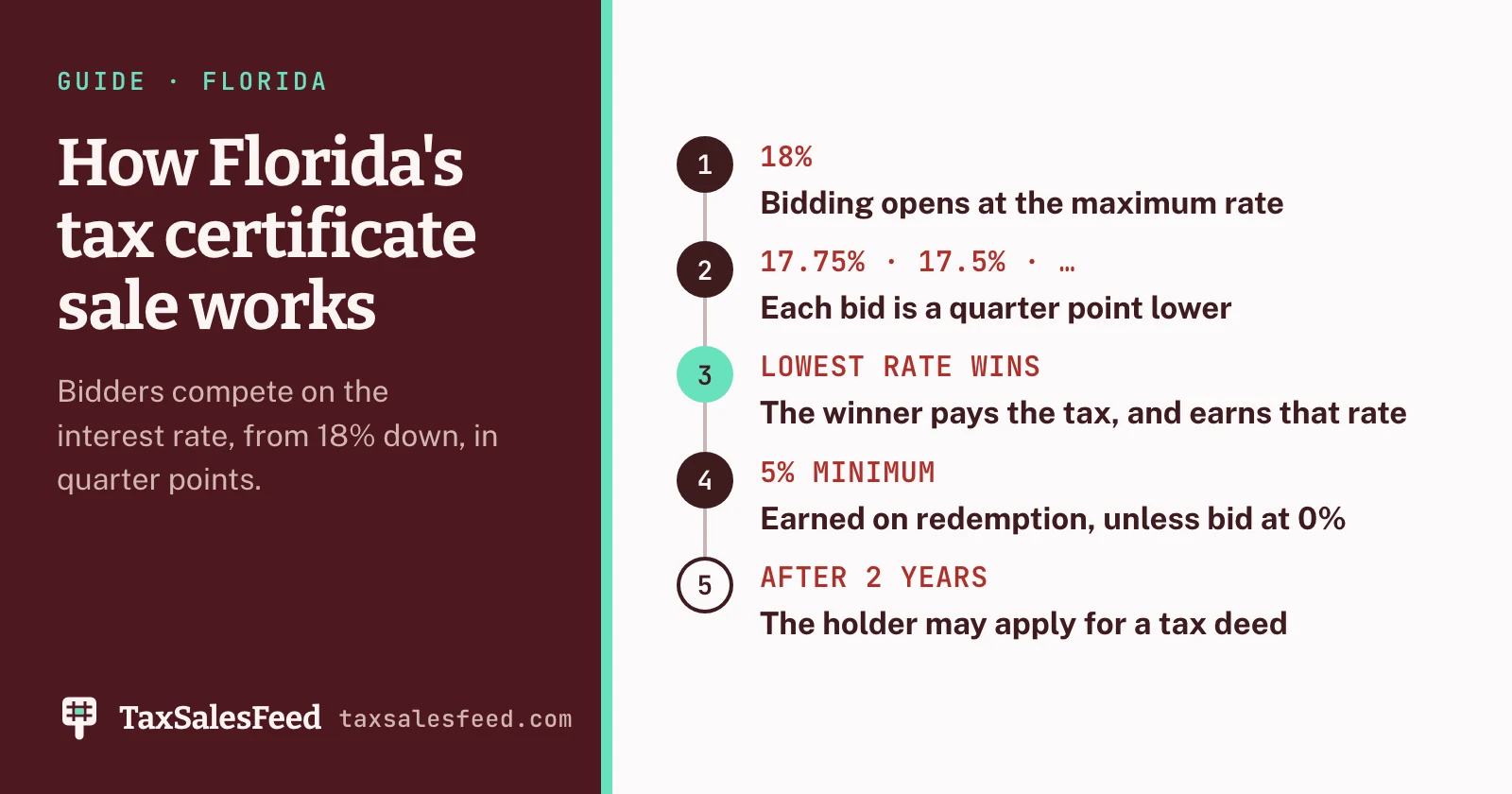
Florida sells tax-delinquent property in two auctions, years apart, and the first one does not sell property at all. It sells the unpaid tax bill, as a tax certificate, to the investor who will take the lowest interest rate on it. Searchers call it a tax lien sale, and for this stage that is exactly what it is. The second auction, the tax deed sale, is what this site tracks: 3,082 Florida parcels headed to one now, most of them on certificates bought at a sale like the one described here.
When the certificate sale happens
The calendar is fixed by statute. "All taxes shall be due and payable on November 1 of each year" [1], and "Taxes shall become delinquent on April 1 following the year in which they are assessed" [2]. From that point the tax collector has a deadline: "on or before June 1 or the 60th day after the date of delinquency, whichever is later" [3], "the tax collector shall advertise once each week for 3 weeks and shall sell tax certificates on all real property having delinquent taxes" [4].
So each county holds one sale a year, in late May or early June, run by its tax collector rather than the clerk of court who later runs the deed sale. The list is long: every parcel still unpaid in April, offered as one certificate per parcel. On the advertised day the tax collector "shall commence the sale of tax certificates on the real property on which taxes have not been paid" [5], and the law lets that happen online: the tax collector "may conduct the sale of tax certificates for unpaid taxes pursuant to this section by electronic means, which may allow for proxy bidding." [6] Most large counties do, through an auction site where bidders register, post a deposit and enter their bids ahead of time.
What a bidder is buying
A certificate is a lien, and a strong one. Florida property taxes "shall be a first lien, superior to all other liens, on any property against which the taxes have been assessed" [7]. The buyer pays the county the tax, interest and costs on the parcel, and from then on the owner owes the buyer instead. The buyer gets no right to the property, to rent or to possession; what they get is interest, and after two years the right to force a sale.
Not every parcel is offered. "A tax certificate representing less than $250 in delinquent taxes on property that has been granted a homestead exemption for the year in which the delinquent taxes were assessed may not be sold at public auction" [8]; those certificates go straight to the county.
How the bidding works
Bidders do not bid prices. They bid interest rates, downward. "The maximum rate of interest on a tax certificate is 18 percent per year." [9] "Each certificate shall be awarded to the person who will pay the taxes, interest, costs, and charges and will demand the lowest rate of interest" [10], and "The tax collector shall accept bids in even increments and in fractional interest rate bids of one-quarter of 1 percent only." [11]
On a popular parcel many bidders reach the same floor, so ties are common. The tax collector picks the method, and "Acceptable methods include the bid received first or use of a random-number generator." [12] A parcel nobody wants is not left unsold: "If a certificate is not purchased, the certificate shall be struck to the county at the maximum rate of interest allowed by this chapter." [13]
Paying is quick. "The tax collector may require payment of a reasonable deposit from any person who wishes to bid for a tax certificate." [14] Once certificates are ready, "Payment must be made within 48 hours after the transmission of the electronic notice by the tax collector or mailing of such notice" [15], or the deposit may be forfeited. Each county publishes its own registration deadline, deposit amount and bidding rules on the tax collector's site, and those terms govern.
What a certificate earns
Most certificates end in redemption: the owner pays the tax collector, and the holder is repaid. "A person may redeem a tax certificate at any time after the certificate is issued and before a tax deed is issued unless full payment for a tax deed is made to the clerk of the court" [16]. The tax collector then pays the holder "within 15 business days after the date of receipt of the redemption" [17].
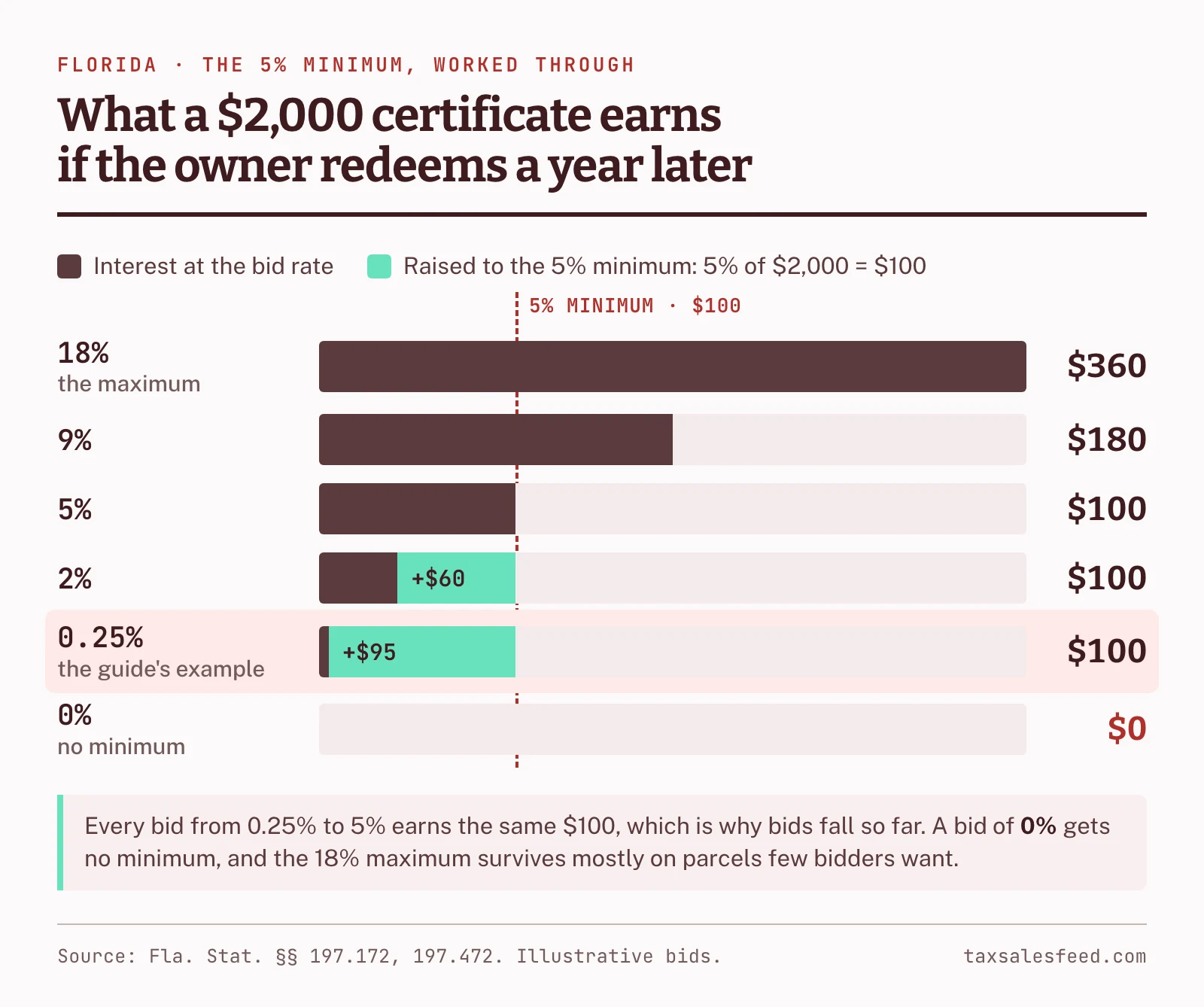
The return is the bid rate, with a floor. When a certificate's interest would come to less, "a mandatory minimum interest of an absolute 5 percent shall be levied upon the face value of the tax certificate" [18]. That floor applies to all certificates "except those with an interest rate bid of zero percent" [19].
The floor is why rates fall so far. Take a $2,000 certificate bid at 0.25 percent and redeemed a year later: the bid rate earns $5, the minimum earns $100, so the holder collects $100. A bidder who expects quick redemptions can bid near zero and still earn 5 percent. The 18 percent maximum survives mostly on parcels few bidders want.
The holder also has to wait quietly. "The holder of a tax certificate may not directly, through an agent, or otherwise initiate contact with the owner of property upon which he or she holds a tax certificate to encourage or demand payment until 2 years after April 1 of the year of issuance of the tax certificate." [20]
From certificate to tax deed
A certificate the owner never redeems becomes the start of a sale. "The holder of a tax certificate at any time after 2 years have elapsed since April 1 of the year of issuance of the tax certificate and before the cancellation of the certificate, may file the certificate and an application for a tax deed" [21]. The holder pays off the other certificates on the parcel and the costs, the clerk publishes a notice for four weeks, and the parcel goes to auction with an opening bid built from what the holder paid. How a Florida tax deed sale works follows every step from there.
Holders cannot wait forever. Seven years after issue, with no deed application and no other proceeding of record, "the tax certificate is null and void and shall be canceled" [22]. And the county must act on what it holds: the county "shall apply for a tax deed on all county-held certificates on property valued at $5,000 or more on the property appraiser’s most recent assessment roll" [23].
The investors who apply at scale are funds that buy thousands of certificates each spring. The certificate holders page ranks 61 of them by the deed applications they have pending, county by county, and every Florida county page shows how old the certificates behind its upcoming sales are.
Certificate sale or deed sale?
The two auctions suit different buyers.
| Tax certificate sale | Tax deed sale | |
|---|---|---|
| Run by | County tax collector | Clerk of court |
| When | Once a year, on or before June 1 | Year-round, on each county's sale days |
| What you buy | A first lien earning interest | The property itself |
| Usual outcome | The owner redeems; you earn your rate or 5% | You take title, subject to the liens that survive |
| Money tied up | The tax bill, often a few hundred to a few thousand dollars | The winning bid, paid within days |
A certificate is a loan with a statutory return and a remote chance of a sale. A deed is a purchase, priced by competition at an auction. Many Florida investors do both: buy certificates in the spring, and watch the deed sales for parcels whose certificates were never redeemed.
Where to go from here
- Florida tax deed sales by county: every upcoming parcel, with its certificate year and holder.
- The Florida tax deed sale calendar: each county's next sale days.
- How a Florida tax deed sale works: the application, the notice and the auction.
- Tax deed states and tax lien states: how the other 49 states sell.
Sources
- [1]Fla. Stat. § 197.333 — Florida Legislature“All taxes shall be due and payable on November 1 of each year”
- [2]Fla. Stat. § 197.333 — Florida Legislature“Taxes shall become delinquent on April 1 following the year in which they are assessed”
- [3]Fla. Stat. § 197.402(3) — Florida Legislature“on or before June 1 or the 60th day after the date of delinquency, whichever is later”
- [4]Fla. Stat. § 197.402(3) — Florida Legislature“the tax collector shall advertise once each week for 3 weeks and shall sell tax certificates on all real property having delinquent taxes”
- [5]Fla. Stat. § 197.432(1) — Florida Legislature“the tax collector shall commence the sale of tax certificates on the real property on which taxes have not been paid”
- [6]Fla. Stat. § 197.432(1) — Florida Legislature“The tax collector may conduct the sale of tax certificates for unpaid taxes pursuant to this section by electronic means, which may allow for proxy bidding.”
- [7]Fla. Stat. § 197.122(1) — Florida Legislature“shall be a first lien, superior to all other liens, on any property against which the taxes have been assessed”
- [8]Fla. Stat. § 197.432(4) — Florida Legislature“A tax certificate representing less than $250 in delinquent taxes on property that has been granted a homestead exemption for the year in which the delinquent taxes were assessed may not be sold at public auction”
- [9]Fla. Stat. § 197.172(2) — Florida Legislature“The maximum rate of interest on a tax certificate is 18 percent per year.”
- [10]Fla. Stat. § 197.432(6) — Florida Legislature“Each certificate shall be awarded to the person who will pay the taxes, interest, costs, and charges and will demand the lowest rate of interest”
- [11]Fla. Stat. § 197.432(6) — Florida Legislature“The tax collector shall accept bids in even increments and in fractional interest rate bids of one-quarter of 1 percent only.”
- [12]Fla. Stat. § 197.432(6) — Florida Legislature“Acceptable methods include the bid received first or use of a random-number generator.”
- [13]Fla. Stat. § 197.432(6) — Florida Legislature“If a certificate is not purchased, the certificate shall be struck to the county at the maximum rate of interest allowed by this chapter.”
- [14]Fla. Stat. § 197.432(7) — Florida Legislature“The tax collector may require payment of a reasonable deposit from any person who wishes to bid for a tax certificate.”
- [15]Fla. Stat. § 197.432(7) — Florida Legislature“Payment must be made within 48 hours after the transmission of the electronic notice by the tax collector or mailing of such notice”
- [16]Fla. Stat. § 197.472(1) — Florida Legislature“A person may redeem a tax certificate at any time after the certificate is issued and before a tax deed is issued unless full payment for a tax deed is made to the clerk of the court”
- [17]Fla. Stat. § 197.472(5) — Florida Legislature“within 15 business days after the date of receipt of the redemption”
- [18]Fla. Stat. § 197.472(2) — Florida Legislature“a mandatory minimum interest of an absolute 5 percent shall be levied upon the face value of the tax certificate”
- [19]Fla. Stat. § 197.472(2) — Florida Legislature“except those with an interest rate bid of zero percent”
- [20]Fla. Stat. § 197.432(13) — Florida Legislature“The holder of a tax certificate may not directly, through an agent, or otherwise initiate contact with the owner of property upon which he or she holds a tax certificate to encourage or demand payment until 2 years after April 1 of the year of issuance of the tax certificate.”
- [21]Fla. Stat. § 197.502(1) — Florida Legislature“The holder of a tax certificate at any time after 2 years have elapsed since April 1 of the year of issuance of the tax certificate and before the cancellation of the certificate, may file the certificate and an application for a tax deed”
- [22]Fla. Stat. § 197.482 — Florida Legislature“the tax certificate is null and void and shall be canceled”
- [23]Fla. Stat. § 197.502(3) — Florida Legislature“shall apply for a tax deed on all county-held certificates on property valued at $5,000 or more on the property appraiser’s most recent assessment roll”
Questions
When is the Florida tax certificate sale?
Once a year, on or before June 1, or 60 days after the taxes became delinquent if that is later. Each county's tax collector advertises its list once a week for three weeks first and sets its own sale dates; most now sell online, often over several days.
Is Florida a tax lien state or a tax deed state?
Both, in sequence. The first sale is a tax lien sale: investors buy tax certificates and earn interest. Two years later a certificate holder may apply for a tax deed, and the parcel is then sold outright at a tax deed auction run by the clerk of court.
What is the minimum return on a Florida tax certificate?
If the certificate is redeemed, at least 5 percent of its face amount, even if the owner pays a month later, unless the certificate was bid at zero percent. The most it can earn is the bid rate, up to 18 percent a year.
Can a certificate holder contact the owner for payment?
Not for the first two years. A holder may not contact the owner to encourage or demand payment until two years after April 1 of the year the certificate was issued, and one who does can be barred from bidding.
Where next
- Florida tax deed sale calendarEvery county's upcoming sale days, with parcel counts and start times.
- Tax sale guidesHow to buy at a tax sale, which states sell deeds or liens, and Florida, Texas, Georgia, Pennsylvania and California step by step.
- Tax certificate holdersThe funds applying for tax deeds, with every county they are active in.
- Tax sale glossaryTax certificate, tax deed application, opening bid, redemption — every term a notice uses.
General information about Florida procedure, not legal advice. Each clerk sets its own sale terms, and statutes change; confirm with the clerk of court before bidding.