Guide 14
How Georgia tax sales work, from the levy to the deed
8 min read · updated October 27, 2026
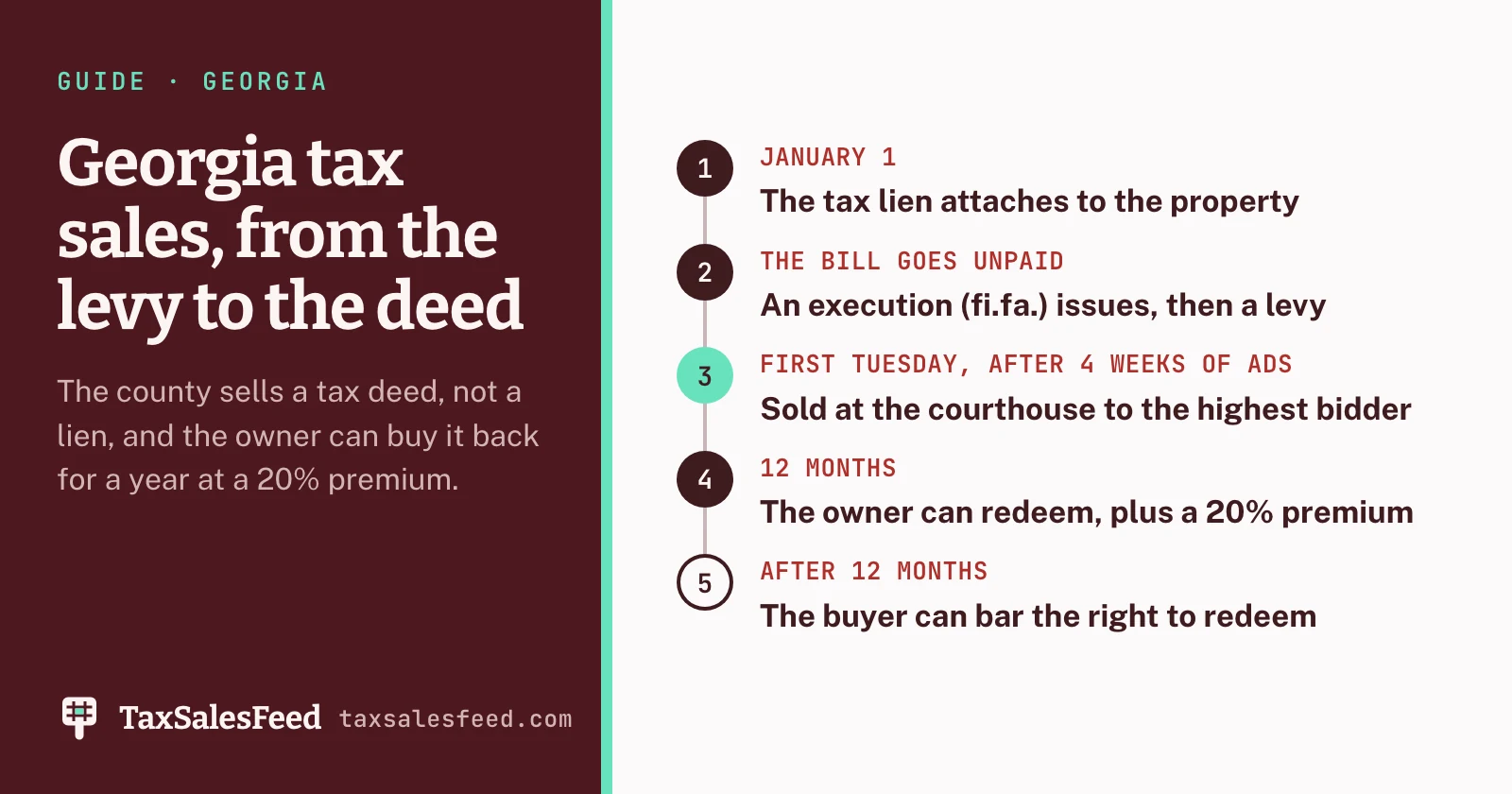
Georgia holds tax sales every month somewhere in the state, and what it sells surprises buyers who come from lien states. There is no tax lien certificate. The county sells the property itself, under a tax deed, on the first Tuesday of the month, and the owner keeps a right to buy it back: for twelve months at least, at a premium that starts at 20%. That makes Georgia a redeemable deed state, and every part of buying here follows from it.
Georgia sells tax deeds, not tax lien certificates
Georgia's tax sale sells the property under a tax deed. The buyer pays at the sale and receives the deed, but the owner and anyone else with an interest can redeem it, so for at least a year the buyer holds a deed that can be bought back.
DeKalb County's tax commissioner puts the buyer's position in one sentence: "While the successful bidder receives a tax deed, they have no immediate control over the property." [1] The words people search with do not always match. Fulton County's sheriff describes the auction as "the sale of a Tax Lien by a governmental entity for unpaid property taxes by the property’s owner" [2], because the county's tax lien is what is being enforced, and that is why "Georgia tax lien sale" is a common search. But the buyer does not get a lien certificate that earns interest; the buyer gets a deed. Gwinnett County adds that it "does not transfer tax liens in bulk to any third-party investor as a general means of collecting delinquent taxes." [3] How Georgia compares with the lien and deed states is set out in tax deed states and tax lien states.
How a Georgia property gets to a tax sale
The tax lien attaches on January 1. When the bill goes unpaid, the tax commissioner issues an execution (a fi.fa.), levies on the property, notifies the owner and lienholders, and advertises the sale for four weeks.
"A tax lien attaches to the property at its valuation (January 1; O.C.G.A. 48-2-56)" [4], and once the bill is delinquent the tax commissioner turns it into an execution, the fi.fa. that a levy can enforce. In DeKalb, "On December 31 (O.C.G.A. 48-3-3) of each year, the Tax Commissioner must issue an execution (Fi.Fa.) against all delinquent taxpayers." [5] Gwinnett describes the owner's warning: "For real property, the tax commissioner must issue a 30-day notice to the property owner before filing the lien." [6]
The levy comes next, and "In other words, a levy is a 'seizure' of property on which taxes are owed." [7] Before the sale, "Owners whose property is scheduled for sale will receive written notification prior to the sale as will those who may hold mortgages or liens on the property." [8] The owner can still stop it: "The property owner still has the option at this point to pay all applicable taxes, costs and fees to prevent the property from going to sale." [9] That is one reason the lists shrink in the weeks before a sale.
When and where Georgia tax sales are held
On the first Tuesday of the month, between 10 a.m. and 4 p.m., at the courthouse or the place the county names in its notice. Each county picks its months: some sell almost every month, others a few times a year.
"Fulton County Sheriff’s Tax Sales are held on the first Tuesday of each month, between the hours of 10 a.m. and 4 p.m." [10], and "The tax sales will be held on the courthouse steps of 136 Pryor Street SW, Atlanta, GA 30303." [11] The schedule is the county's to set. In DeKalb, "Tax sales are held each month, generally from April through December." [12] In Gwinnett, "Tax sales may be held on the first Tuesday of any month, though the tax commissioner generally only holds sales in a few selected months throughout the year." [13]
Who runs the sale also varies: in most counties it is the tax commissioner's levy sale, and in Fulton it is the sheriff's. Either way, "Notice of the sale is published once a week for four weeks immediately preceding the sale in the legal organ (newspaper) for the county" [14], so each month's list surfaces about a month before its first Tuesday.
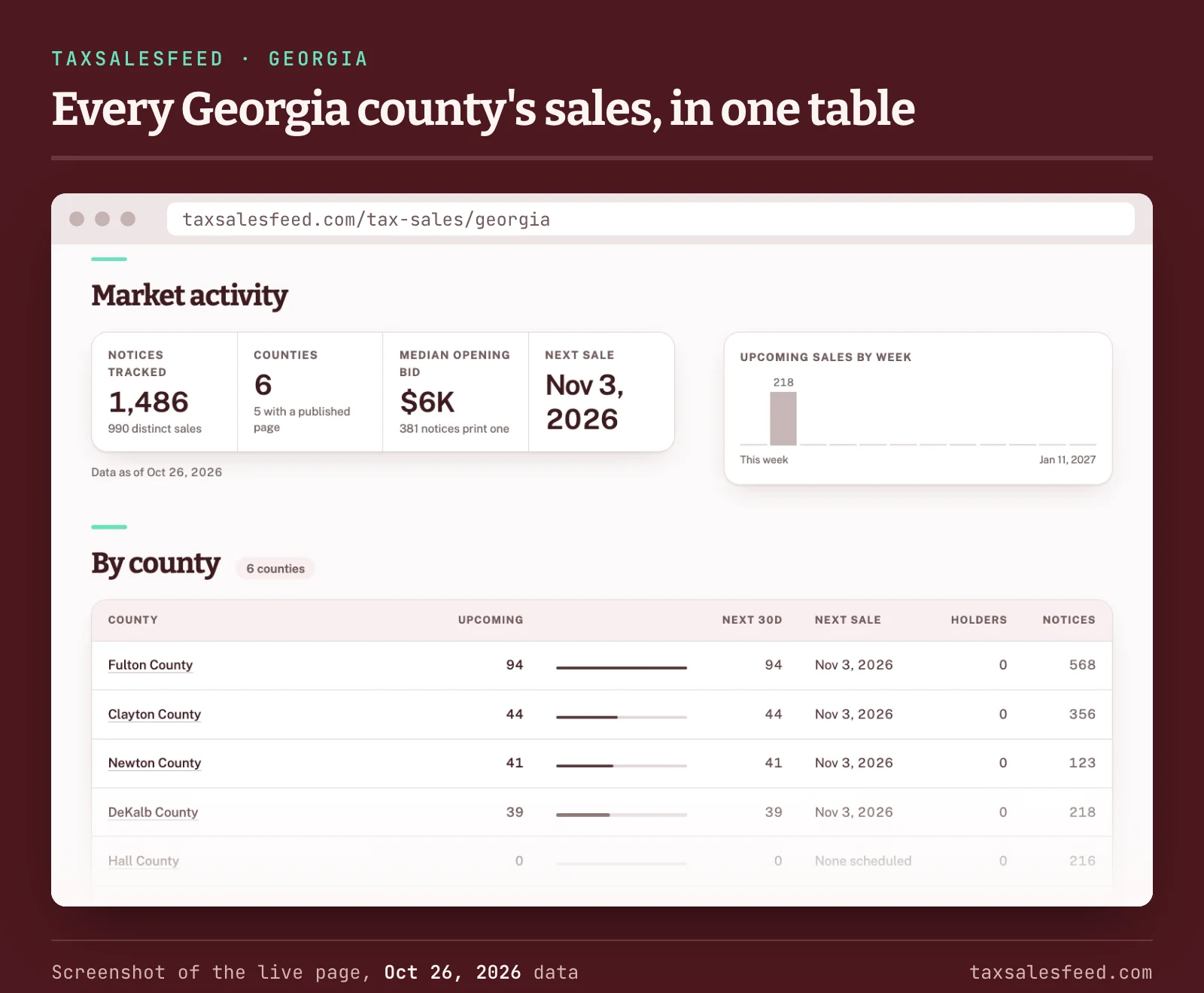
Our records hold 218 upcoming Georgia tax sales in 4 counties; the next is in Fulton County on November 3, 2026, with 94 parcels. The median opening bid across the Georgia sales we hold is $6,094.Where to find Georgia tax sale lists
No statewide list exists. Each county's tax commissioner, or the sheriff where the sheriff sells, posts its own list, and the county's legal newspaper prints it for the four weeks before the sale.
- The tax commissioner. Most counties post the month's levy list on the tax commissioner's site: DeKalb's tax sale listing, Clayton's monthly lists and Gwinnett's tax sale page, for example.
- The sheriff. Where the sheriff sells, the list is the sheriff's: Fulton County's posts each month's levy list as a PDF.
- The legal newspaper. Every sale runs in the county's legal organ for four weeks, and the Georgia Press Association collects its members' notices at georgiapublicnotice.com.
A list is a snapshot. Owners pay and properties come off it up to the morning of the sale, so the levying officer's list on the day is the only final one.
We read these sources every morning and merge them county by county, with the opening bid where the county prints one.
The Georgia counties with the most sales coming, from the same data as their pages:
| County | Upcoming | Next sale | Median opening bid |
|---|---|---|---|
| Fulton County | 94 | Nov 3, 2026 | — |
| Clayton County | 44 | Nov 3, 2026 | $5,841 |
| Newton County | 41 | Nov 3, 2026 | — |
| DeKalb County | 39 | Nov 3, 2026 | $9,667 |
How bidding works
Bidding opens at the taxes and costs owed. The property goes to the highest bidder who can pay that day in certified funds, and bidders register with the tax commissioner before the sale starts.
"Tax sale bidding commences with the total of taxes and costs (levy, recording, advertising, and commissions) on each parcel, with the property being sold to the highest bidder." [15] "If there are no bidders, the County may enter a bid on the property equal to the starting bid." [16] The highest bid alone does not win, either: Gwinnett sells to the highest and best bidder, and "This is not only the bidder who bids the highest amount for purchase of the property but also who can actually pay the amount that day." [17]
So arrive registered and funded. "Those interested in participating in the tax sale must register with the tax commissioner’s office prior to the start of the sale." [18] "The purchaser of property at tax sale must make payment with certified funds" [19], which Gwinnett lists as cash, a cashier's check or a certified check. Fulton's sheriff adds a condition worth knowing before you count on a purchase: "The Levy Officer reserves the right to rescind any tax sale within 30 days." [20] In that case the bid is refunded.
The 12-month redemption and the 20% premium
For twelve months after the sale, the owner or anyone with an interest in the property can redeem it by paying the buyer what the buyer paid, plus taxes the buyer has paid since, plus a premium of 20% for the first year or any part of it and 10% for each year after.
"The taxpayer or any other person having a right, title, interest in, or lien upon the property may redeem it within twelve (12) months of the sale by paying the redemption price." [21] The price is the amount paid at the sale and the taxes paid since, "plus 20% of that amount for the first year or fraction thereof, and 10% for each additional year or fraction thereof until redemption" [22].
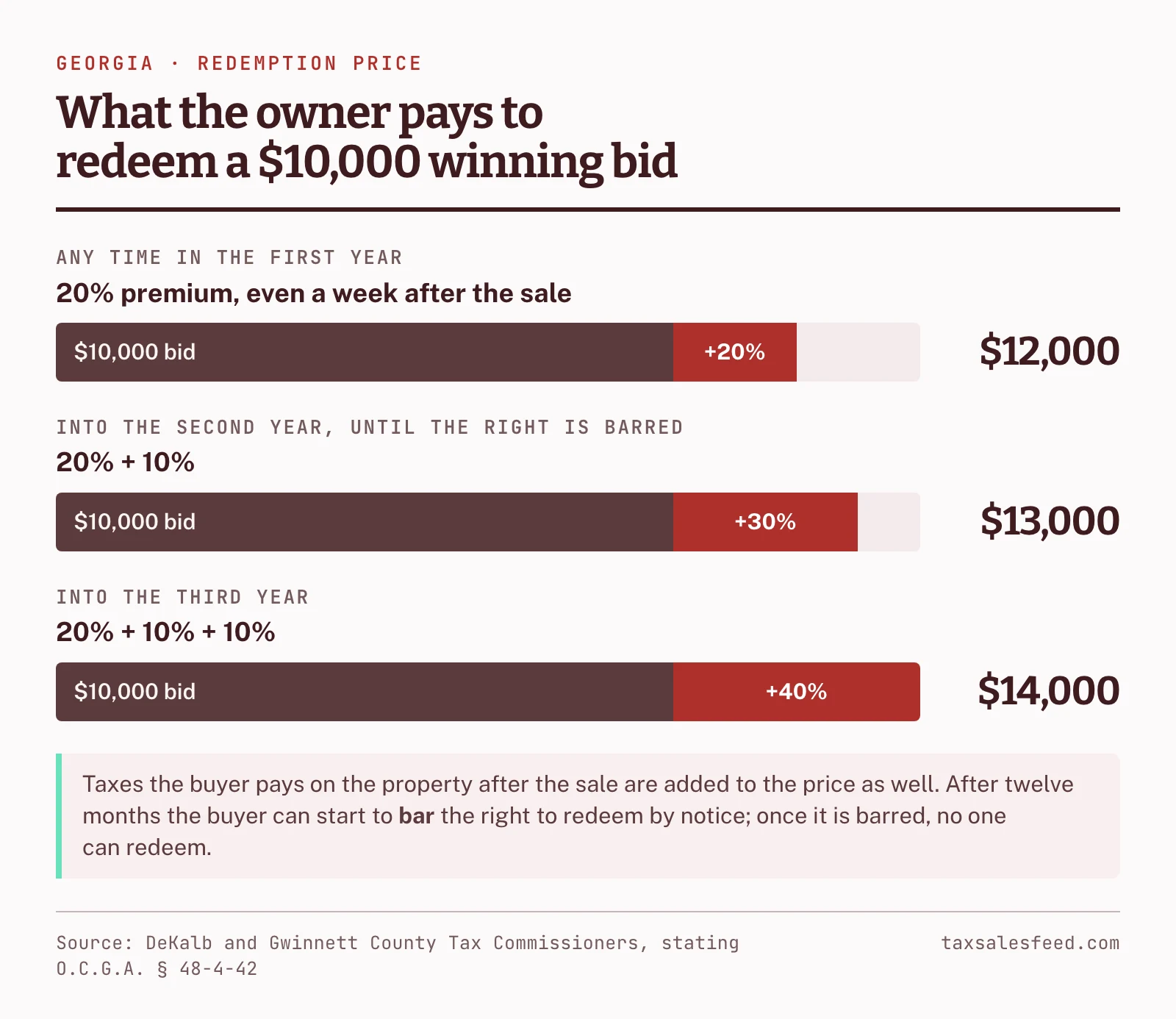
The words "or fraction thereof" are what make Georgia attractive to many buyers: the 20% is not an annual rate earned month by month, it is owed in full however soon the owner redeems. The trade-off is that the buyer is a deed holder in name only during the year. "The purchaser is not entitled to rents or profits during this period." [23] And, as Gwinnett warns, "Purchasers of property at tax sale do not automatically 'own' the property, and property owners do not immediately get evicted." [24] A lender with a security deed on the property has every reason to redeem, so a house with a mortgage on it is more likely to be redeemed, with the premium, than to stay sold.
Barring the right of redemption
Redemption does not end by itself at twelve months. The buyer ends it by serving a notice of foreclosure of the right to redeem on everyone with a recorded interest, or waits for title to ripen by prescription.
"After twelve months, the purchaser may begin to 'bar' or 'foreclose' the right of redemption by proper notice served on all parties with recorded interests." [25] Gwinnett's advice is that "the purchaser is strongly encouraged to foreclose on the right of redemption and forever bar anyone from redeeming the property from that time on" [26]. Until then the right to redeem continues, at the higher premium.
Fulton's sheriff spells out what the deed is worth before that step: "a Sheriff’s Tax Deed only conveys ‘defeasible title’ to property. To acquire ‘fee simple title’ to property, a tax deed purchaser must ‘foreclose’ or ‘bar’ the right to redeem, or allow the title to ‘ripen by prescription,’ pursuant to state law." [27] The barment notice has to reach every holder of a recorded interest, so the title search behind it is the buyer's cost and the buyer's risk. "Tax sales are complex legal transactions governed by Georgia law." [28] Use an attorney for the barment, and ask a title company before you bid what it will require before it insures a resale.
Excess funds
When a property sells for more than the taxes and costs, the excess is held for the people who had an interest in it. In Gwinnett's words, "excess funds may be claimed by the record owner of the property at the time of the tax sale, by the record owner of each security deed affecting the property, and by any other party having any recorded equity interest or claim in such property at the time of the tax sale" [29], and "A claim may be filed at any time after the sale until the funds are awarded." [30] Fulton notifies those parties itself: "if there are any ‘excess funds’ generated from the sale of the real property after all taxes and costs are paid, a notice will be sent to the same interest parties notified during the levy and sale." [31] Gwinnett also notes that "you are not required to pay, or be represented by, any third party in order to claim excess funds." [32] Tax sale surplus after Tyler v. Hennepin County covers surplus claims in other states.
Before you bid in Georgia
- Find the parcel on the county's map and records, not just the street address. The levy list gives the parcel number and the owner, and the legal description says exactly what is being sold.
- Look at the property, and read the deed records for security deeds. A recorded mortgage makes a redemption, and your 20%, more likely.
- Price the whole path: the bid, the premium you are counting on, the taxes you will pay during the year, and the attorney's cost of barring the right to redeem.
- Register with the tax commissioner before the sale, and bring certified funds for the full price.
- Check the list on the morning of the sale. Owners pay up to the last minute.
How a sale like Georgia's compares with the rest of the country, step by step, is in how to buy tax lien and tax deed properties. For the current list, see Georgia tax sales, or go straight to Fulton, DeKalb, Clayton or Gwinnett.
Sources
- [1]DeKalb County Tax Commissioner, Tax Sales — DeKalb County Tax Commissioner“While the successful bidder receives a tax deed, they have no immediate control over the property.”
- [2]Fulton County Sheriff, Tax Sales — Fulton County Sheriff's Office“A tax sale is the sale of a Tax Lien by a governmental entity for unpaid property taxes by the property’s owner.”
- [3]Gwinnett County Tax Commissioner, Tax Liens & Tax Sales — Gwinnett County Tax Commissioner“The tax commissioner does not transfer tax liens in bulk to any third-party investor as a general means of collecting delinquent taxes.”
- [4]DeKalb County Tax Commissioner, Tax Sales — DeKalb County Tax Commissioner“A tax lien attaches to the property at its valuation (January 1; O.C.G.A. 48-2-56)”
- [5]DeKalb County Tax Commissioner, Tax Sales — DeKalb County Tax Commissioner“On December 31 (O.C.G.A. 48-3-3) of each year, the Tax Commissioner must issue an execution (Fi.Fa.) against all delinquent taxpayers.”
- [6]Gwinnett County Tax Commissioner, Tax Liens & Tax Sales — Gwinnett County Tax Commissioner“For real property, the tax commissioner must issue a 30-day notice to the property owner before filing the lien.”
- [7]Gwinnett County Tax Commissioner, Tax Liens & Tax Sales — Gwinnett County Tax Commissioner“In other words, a levy is a "seizure" of property on which taxes are owed.”
- [8]Gwinnett County Tax Commissioner, Tax Liens & Tax Sales — Gwinnett County Tax Commissioner“Owners whose property is scheduled for sale will receive written notification prior to the sale as will those who may hold mortgages or liens on the property.”
- [9]Gwinnett County Tax Commissioner, Tax Liens & Tax Sales — Gwinnett County Tax Commissioner“The property owner still has the option at this point to pay all applicable taxes, costs and fees to prevent the property from going to sale.”
- [10]Fulton County Sheriff, Tax Sales — Fulton County Sheriff's Office“Fulton County Sheriff’s Tax Sales are held on the first Tuesday of each month, between the hours of 10 a.m. and 4 p.m.”
- [11]Fulton County Sheriff, Tax Sales — Fulton County Sheriff's Office“The tax sales will be held on the courthouse steps of 136 Pryor Street SW, Atlanta, GA 30303.”
- [12]DeKalb County Tax Commissioner, Tax Sales — DeKalb County Tax Commissioner“Tax sales are held each month, generally from April through December.”
- [13]Gwinnett County Tax Commissioner, Tax Liens & Tax Sales — Gwinnett County Tax Commissioner“Tax sales may be held on the first Tuesday of any month, though the tax commissioner generally only holds sales in a few selected months throughout the year.”
- [14]DeKalb County Tax Commissioner, Tax Sales — DeKalb County Tax Commissioner“Notice of the sale is published once a week for four weeks immediately preceding the sale in the legal organ (newspaper) for the county”
- [15]DeKalb County Tax Commissioner, Tax Sales — DeKalb County Tax Commissioner“Tax sale bidding commences with the total of taxes and costs (levy, recording, advertising, and commissions) on each parcel, with the property being sold to the highest bidder.”
- [16]DeKalb County Tax Commissioner, Tax Sales — DeKalb County Tax Commissioner“If there are no bidders, the County may enter a bid on the property equal to the starting bid.”
- [17]Gwinnett County Tax Commissioner, Tax Liens & Tax Sales — Gwinnett County Tax Commissioner“This is not only the bidder who bids the highest amount for purchase of the property but also who can actually pay the amount that day.”
- [18]Gwinnett County Tax Commissioner, Tax Liens & Tax Sales — Gwinnett County Tax Commissioner“Those interested in participating in the tax sale must register with the tax commissioner’s office prior to the start of the sale.”
- [19]Gwinnett County Tax Commissioner, Tax Liens & Tax Sales — Gwinnett County Tax Commissioner“The purchaser of property at tax sale must make payment with certified funds”
- [20]Fulton County Sheriff, Tax Sales — Fulton County Sheriff's Office“The Levy Officer reserves the right to rescind any tax sale within 30 days.”
- [21]DeKalb County Tax Commissioner, Tax Sales — DeKalb County Tax Commissioner“The taxpayer or any other person having a right, title, interest in, or lien upon the property may redeem it within twelve (12) months of the sale by paying the redemption price.”
- [23]DeKalb County Tax Commissioner, Tax Sales — DeKalb County Tax Commissioner“The purchaser is not entitled to rents or profits during this period.”
- [24]Gwinnett County Tax Commissioner, Tax Liens & Tax Sales — Gwinnett County Tax Commissioner“Purchasers of property at tax sale do not automatically "own" the property, and property owners do not immediately get evicted.”
- [25]DeKalb County Tax Commissioner, Tax Sales — DeKalb County Tax Commissioner“After twelve months, the purchaser may begin to "bar" or "foreclose" the right of redemption by proper notice served on all parties with recorded interests.”
- [26]Gwinnett County Tax Commissioner, Tax Liens & Tax Sales — Gwinnett County Tax Commissioner“the purchaser is strongly encouraged to foreclose on the right of redemption and forever bar anyone from redeeming the property from that time on”
- [27]Fulton County Sheriff, Tax Sales — Fulton County Sheriff's Office“a Sheriff’s Tax Deed only conveys “defeasible title” to property. To acquire “fee simple title” to property, a tax deed purchaser must “foreclose” or “bar” the right to redeem, or allow the title to “ripen by prescription,” pursuant to state law.”
- [28]DeKalb County Tax Commissioner, Tax Sales — DeKalb County Tax Commissioner“Tax sales are complex legal transactions governed by Georgia law.”
- [29]Gwinnett County Tax Commissioner, Tax Sale Excess Funds (O.C.G.A. § 48-4-5) — Gwinnett County Tax Commissioner“excess funds may be claimed by the record owner of the property at the time of the tax sale, by the record owner of each security deed affecting the property, and by any other party having any recorded equity interest or claim in such property at the time of the tax sale”
- [30]Gwinnett County Tax Commissioner, Tax Sale Excess Funds (O.C.G.A. § 48-4-5) — Gwinnett County Tax Commissioner“A claim may be filed at any time after the sale until the funds are awarded.”
- [31]Fulton County Sheriff, Tax Sales — Fulton County Sheriff's Office“if there are any “excess funds” generated from the sale of the real property after all taxes and costs are paid, a notice will be sent to the same interest parties notified during the levy and sale.”
- [32]Gwinnett County Tax Commissioner, Tax Sale Excess Funds (O.C.G.A. § 48-4-5) — Gwinnett County Tax Commissioner“Please note that you are not required to pay, or be represented by, any third party in order to claim excess funds.”
Questions
Does Georgia sell tax lien certificates?
No. Georgia's tax sale sells the property under a tax deed that the owner can redeem, which makes it a redeemable deed state. Some county offices still call the sale a tax lien sale, because what is being enforced is the county's tax lien, but the buyer receives a deed, not a certificate, and Gwinnett County's tax commissioner, for one, says it does not transfer tax liens in bulk to investors.
When are tax sales held in Georgia?
On the first Tuesday of the month, between 10 a.m. and 4 p.m., usually on the courthouse steps. Each county decides which months it sells in: DeKalb County generally sells every month from April through December, while Gwinnett County holds sales in only a few months a year. Each sale is advertised once a week for the four weeks before it in the county's legal newspaper.
What is the redemption period after a Georgia tax sale?
Twelve months from the sale, and the right continues after that until the buyer bars it by serving notice on everyone with a recorded interest in the property. The redemption price is the amount paid at the sale plus any taxes the buyer paid since, plus 20% of that for the first year or any part of a year and 10% for each additional year or part of a year.
What is the starting bid at a Georgia tax sale?
The taxes owed plus the costs of the levy and sale: levy, recording and advertising costs and commissions. The property is sold to the highest bidder who can pay that day in certified funds, such as cash or a cashier's check. If no one bids, the county may enter a bid equal to the starting bid.
Where can I find a list of Georgia tax sale properties?
From each county's tax commissioner, which posts the month's levy list (DeKalb, Clayton and Gwinnett among them); from the sheriff in counties where the sheriff sells, such as Fulton; and in the legal newspaper's notices for the four weeks before the sale, which the Georgia Press Association also collects at georgiapublicnotice.com. TaxSalesFeed reads these sources every morning and merges them by county.
Who gets the excess funds from a Georgia tax sale?
When the winning bid is more than the taxes and costs, the excess is held for the record owner at the time of the sale, the holder of each security deed on the property and anyone else with a recorded interest or claim. A claim can be filed with the tax commissioner at any time after the sale until the funds are awarded, and no one has to pay a third party to file it.
Where next
- Florida tax deed sale calendarEvery county's upcoming sale days, with parcel counts and start times.
- Tax sale guidesHow to buy at a tax sale, which states sell deeds or liens, and Florida, Texas, Georgia, Pennsylvania and California step by step.
- Tax certificate holdersThe funds applying for tax deeds, with every county they are active in.
- Tax sale glossaryTax certificate, tax deed application, opening bid, redemption — every term a notice uses.
General information about Georgia procedure, not legal advice. Each county's tax commissioner, or the sheriff where the sheriff sells, sets its own sale terms, and statutes change; confirm with the levying officer before bidding.