Guide 01
How to buy property at a tax sale, step by step
10 min read · updated October 25, 2026

Buying property at a tax sale is not complicated, but it is unforgiving. The county sells for one reason, to collect a tax, and it sells as is: no inspection, no warranty, and often no way to get inside before you own it. The buyers who do well are the ones who did the work before the sale. This is that work, in the order it happens, in any state.
Step 1: Know what your state sells
A tax sale sells one of three things: a lien that earns interest, the property itself, or the property subject to the former owner's right to buy it back. Which one your state sells decides everything else.
- A tax lien. You pay the tax and earn interest until the owner repays it. In Florida "Each certificate shall be awarded to the person who will pay the taxes, interest, costs, and charges and will demand the lowest rate of interest" [1]. If the owner never pays, the lien can eventually become a deed: a Florida certificate holder may apply for one "at any time after 2 years have elapsed since April 1 of the year of issuance of the tax certificate" [2].
- A tax deed. You buy the property outright at auction. In California "all sales pursuant to this chapter shall be at public auction to the highest bidder" [3], and the owner's right to redeem ends "at the close of business on the last business day prior to the commencement date of the tax sale" [4].
- A redeemable deed. You buy the property, but the owner can still buy it back. In South Carolina the owner "may within twelve months from the date of the delinquent tax sale redeem each item of real estate" [5]; Texas gives most owners 180 days [6].
The state-by-state answer, with each redemption period and the law behind it, is in tax deed states and tax lien states, and the difference in practice is set out in tax deed vs tax lien vs redeemable deed. Pick the kind of sale that suits your money and patience before you pick a county: a lien ties up cash for months or years to earn interest, a deed needs enough to buy a property outright, and a redeemable deed needs both.
Step 2: Find the sales and the sale list
Each county announces its sale by law, usually in a newspaper notice that runs for two to four weeks, and most also post the list on their own site or on the online auction platform that runs the sale.
The notice is where the law puts the list, so it is where every other source copies it from:
- California: "The tax collector shall publish the notice of intended sale once a week for three successive weeks" [7].
- Texas: each sale is advertised "once a week for three consecutive weeks preceding such sale, in some newspaper published in said county" [8].
- Pennsylvania: "At least thirty (30) days prior to any scheduled sale the bureau shall give notice thereof, not less than once in two (2) newspapers of general circulation in the county" [9].
Who sells changes by state: a tax collector, a treasurer, a clerk of court, a sheriff, a tax claim bureau. How to find tax delinquent properties names the office and the publishing rule for every state we cover, and the best tax sale websites compares the free county sources, the auction platforms and the paid list services.
Two habits save the most time. Follow the sale, not the delinquent list: most owners pay long before any sale, so the list that matters is the one with a date on it. And start three to four weeks out, when the notice first runs; the week before leaves no time for step 3.
Step 3: Research every parcel before the sale
A tax sale sells as is. Before you bid, confirm which land it is, look at it, compare the opening bid with what it is worth, find the liens a sale does not clear, and find out who lives there.
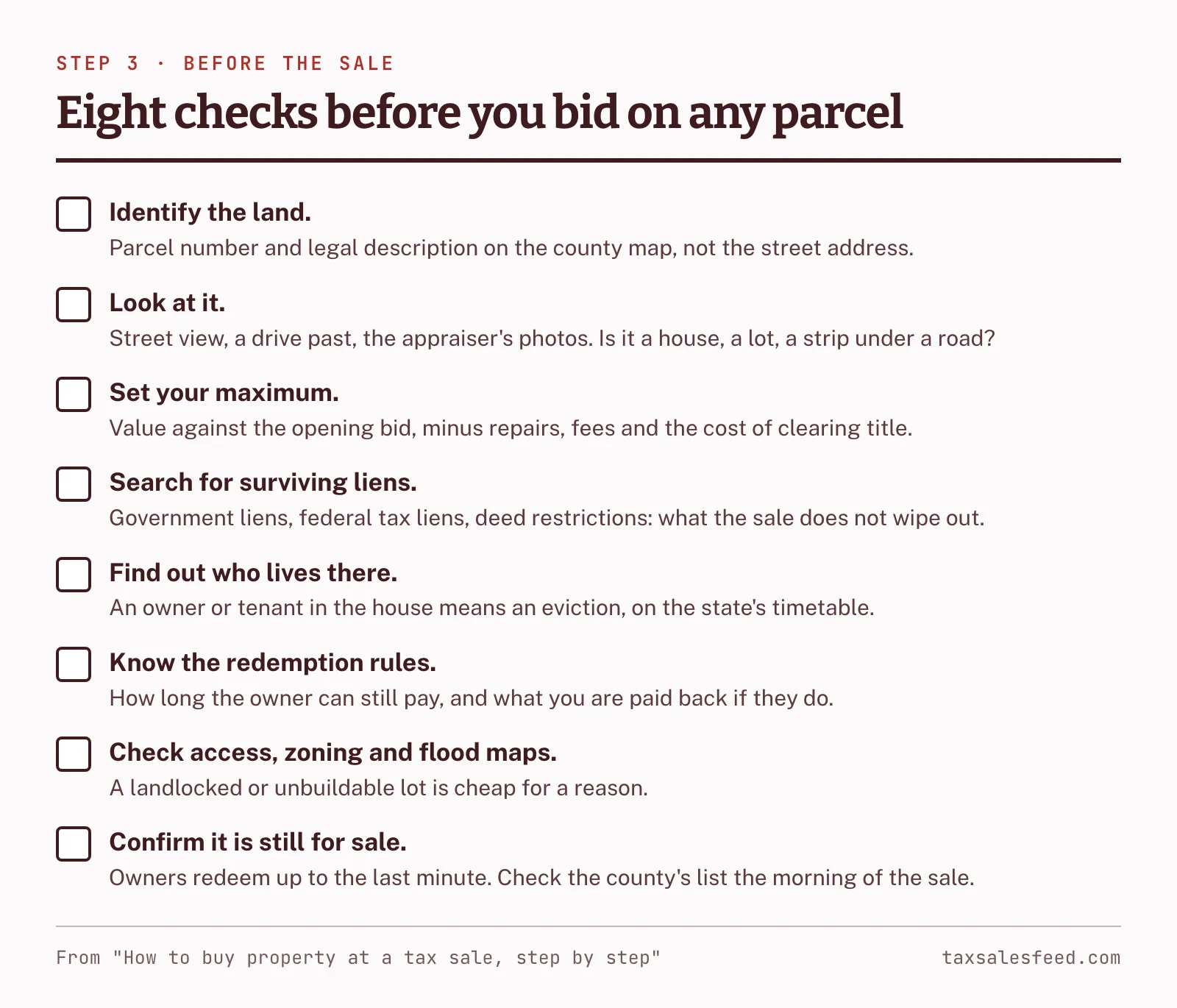
Is it still for sale? Owners can pay until a deadline, and many do at the last minute. A Florida owner can redeem "at any time after the certificate is issued and before a tax deed is issued unless full payment for a tax deed is made to the clerk of the court" [10]. Check the county's list on the morning of the sale.
Which land is it? Use the parcel number and the legal description, not the street address, which many notices do not print and which can be wrong. Find the parcel on the county's map and look at it, from the street if you can. Vacant strips, landlocked lots and land under a road all appear on sale lists.
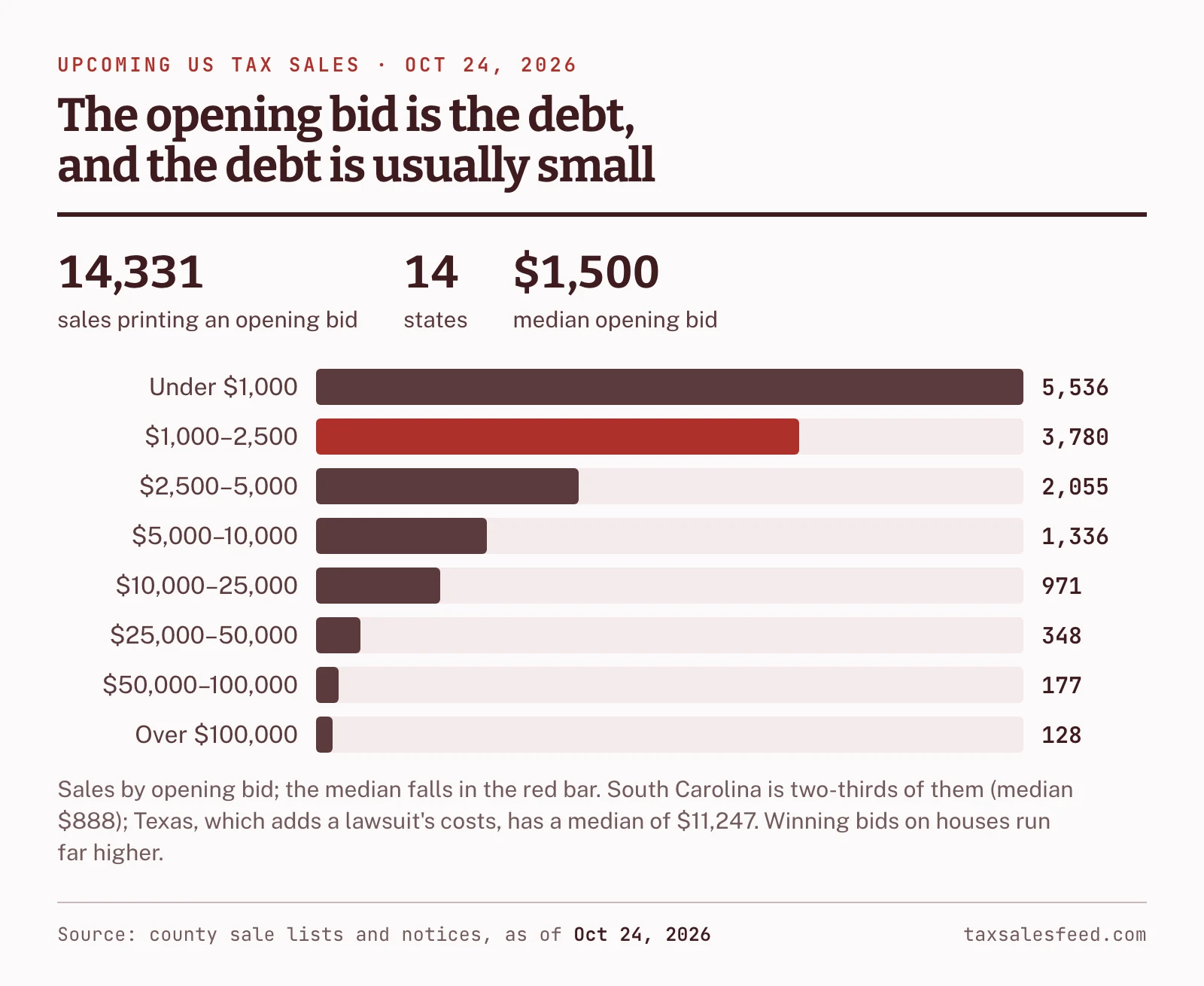
What is it worth against the opening bid? The opening bid is the debt, not the value. In California the minimum price is "not less than the total amount necessary to redeem, plus costs" [11], and in Texas a bid must cover "the lesser of the amount calculated under Subsection (b) or the adjudged value" [12]. A low opening bid says how much tax went unpaid, not what the property will sell for.
Which liens survive the sale? A tax deed clears a great deal, but not everything, and what survives differs by state. A Florida deed leaves in place "a lien of record held by a municipal or county governmental unit, special district, or community development district, when such lien is not satisfied as of the disbursement of proceeds of sale" [13]; a Texas deed is subject to "the terms of a recorded restrictive covenant running with the land that was recorded before January 1 of the year in which the tax lien on the property arose" [14]. Federal tax liens follow their own rule everywhere: unless the government was properly notified, a sale is "made subject to and without disturbing such lien or title" [15], and even after notice "the Secretary may redeem such property within the period of 120 days from the date of such sale or the period allowable for redemption under local law, whichever is longer" [16]. What survives a Florida tax deed sale walks through one state's rules in full.
Who lives there? A house may come with its owner or a tenant still in it, and getting possession is the buyer's job, on the state's terms. Texas, for example, provides for "a writ of possession to the purchaser at the sale or to the purchaser's assigns no sooner than 20 days following the date on which the purchaser's deed from the sheriff or constable is filed of record" [17]. Count the time and cost of an eviction before you bid on an occupied house.
Step 4: Register, and have the money ready
Register with the county or its auction platform before the deadline, put down any deposit it asks for, and have the full price ready: most sales are paid the same day or within days, and a winner who does not pay loses the deposit.
Terms are set county by county, within state law. At a Florida tax deed sale "The high bidder shall post with the clerk a nonrefundable deposit of 5 percent of the bid or $200, whichever is greater, at the time of the sale" [18]; at Florida's certificate sale, "Payment must be made within 48 hours after the transmission of the electronic notice by the tax collector" [19]. In California "The tax collector may require a person to submit a deposit" [20], and "Failure on the part of the successful bidder to consummate the sale within the period specified by the tax collector shall result in the forfeiture of the deposit and all rights he or she may have with respect to that property." [21]
Some states add a condition for the buyer. In Texas "The officer may not execute or deliver a deed to the purchaser of the property unless the purchaser exhibits to the officer an unexpired written statement" [22] that the buyer owes no delinquent taxes in the county. Read the county's terms of sale in full before you register; they are short, and they are the contract.
Step 5: Bid
Deed sales go to the highest bid above the opening bid. Lien sales usually go to the bidder who accepts the lowest interest rate, bid down from the state's maximum. Set your limit before the sale starts.
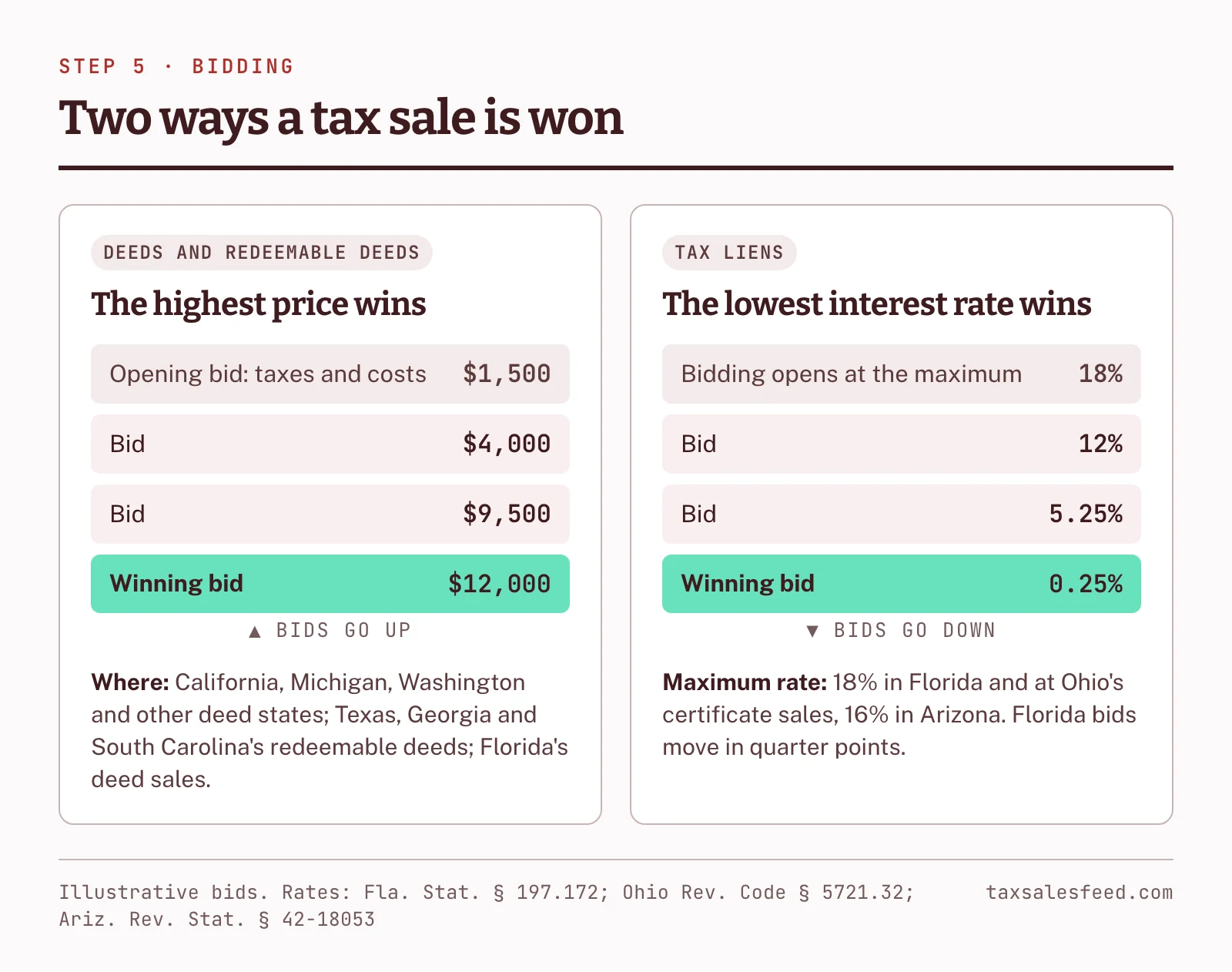
At a deed sale, bidding starts at the opening bid and the highest bid wins. Connecticut's collector "may sell at public auction to the highest bidder all of said real property, to pay the taxes with the interest, fees and other charges allowed by law" [23]; in Michigan the county "shall convey the property by deed to the person bidding the minimum bid, or if a bid is greater than the minimum bid, the highest amount above the minimum bid" [24].
At a lien sale, the bid is an interest rate. Florida's maximum is set by statute, "The maximum rate of interest on a tax certificate is 18 percent per year." [25], and Ohio's tax certificate auctions "begin the bidding at eighteen per cent per year simple interest, and accept lower bids in even increments of one-fourth of one per cent to the rate of zero per cent." [26] In Arizona the cap is "sixteen percent per year simple" [27]. Competition pushes rates down, and ties are settled by rule: in Florida "Acceptable methods include the bid received first or use of a random-number generator." [28]
Decide your maximum for each parcel during step 3 and write it down. Auctions move fast, online ones close on a clock, and the bid you regret is the one you made up during the sale.
Step 6: After the sale
A lien buyer waits: the owner repays with interest, or, years later, the buyer applies for a deed. A deed buyer pays, records the deed, waits out any redemption period, and often has to clear the title before the property can be sold or insured.
If you bought a lien, most are repaid. In Florida a redeemed certificate earns its bid rate, but "a mandatory minimum interest of an absolute 5 percent shall be levied upon the face value of the tax certificate" [29] unless it was bid at zero. If nobody repays, the holder's route to the property is a deed application and an auction, as set out in how Florida tax deed sales work.
If you bought a deed in a redeemable deed state, the owner can still buy it back for the period the law allows, repaying your bid and costs plus a premium. Texas adds 25% in a homestead's first year and 50% in its second [30]; in Georgia, DeKalb County's tax commissioner describes the price as the amount paid "plus 20% of that amount for the first year or fraction thereof, and 10% for each additional year or fraction thereof until redemption" [31], and notes that "While the successful bidder receives a tax deed, they have no immediate control over the property." [32]
If you bought a deed outright, the deed is strong evidence that the sale was proper. In Florida "All deeds issued pursuant to this section shall be prima facie evidence of the regularity of all proceedings from the valuation of the lands to the issuance of the deed, inclusive." [33] Strong evidence is not the same as insurable title, though: title companies often want a court's confirmation, a quiet title action, before they will insure a tax deed, so budget its time and cost before you count on reselling.
Whatever the sale brought above the debt is not the county's to keep. Since the Supreme Court's 2023 decision, a county "could not use the toehold of the tax debt to confiscate more property than was due" [34], so the surplus goes to the former owner and lienholders, who claim it under each state's deadline; tax sale surplus after Tyler v. Hennepin County has the details.
Where TaxSalesFeed fits
Steps 2 and 3 are where the hours go: finding each county's notice, then turning a page of legal descriptions into parcels you can research. That is what this site does. We read the published notices and county sale lists in the states we cover every morning, and merge each sale's printings into one record: the parcel number, the sale date and place, the opening bid where it is printed, the owner of record, the certificate holder where there is one, and property details where the sale has a street address.
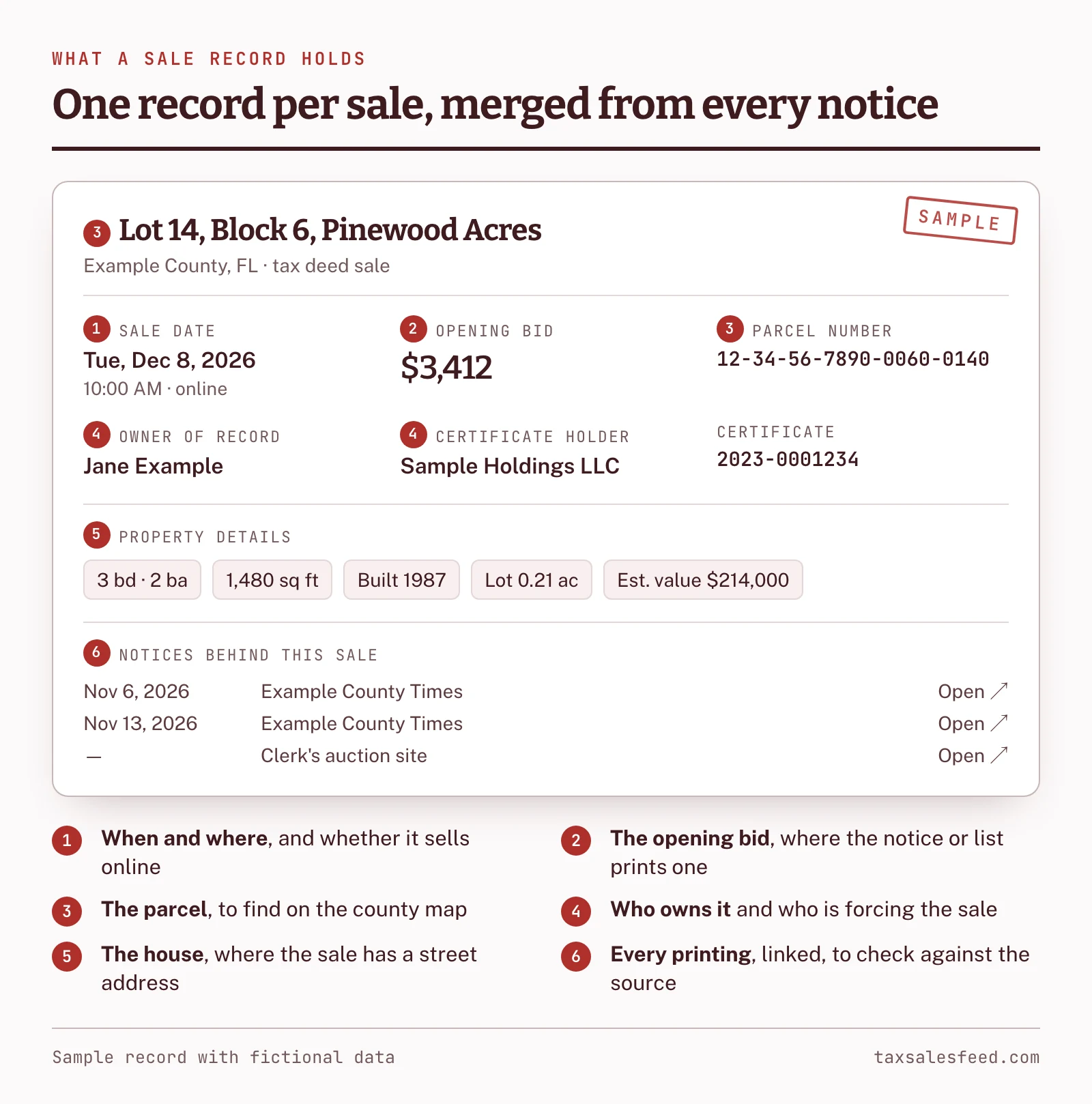
The soonest sales in every county are public, and new ones can come to your inbox each week for free. A plan opens every record, with saved searches and alerts; Pro and Business add CSV export.
Mistakes that cost first-time buyers
- Bidding on an address. The parcel number and legal description are what is sold. A street address on a list can be the owner's mailing address.
- Treating the opening bid as the price. It is the debt. Popular parcels sell far above it, and cheap ones are often cheap for a reason.
- Skipping the survivors. Government liens, federal tax liens and deed restrictions can outlast the sale, depending on the state.
- Forgetting redemption. In a lien or redeemable deed state, your money can come back with interest instead of a property, sometimes a year or two later.
- Planning a quick resale. Without insurable title many buyers cannot sell or borrow against the property until a quiet title action is done.
Sources
- [1]Fla. Stat. § 197.432(6) — Florida Legislature“Each certificate shall be awarded to the person who will pay the taxes, interest, costs, and charges and will demand the lowest rate of interest”
- [2]Fla. Stat. § 197.502(1) — Florida Legislature“The holder of a tax certificate at any time after 2 years have elapsed since April 1 of the year of issuance of the tax certificate and before the cancellation of the certificate, may file the certificate and an application for a tax deed”
- [3]Cal. Rev. & Tax. Code § 3693(a) — California Legislature“all sales pursuant to this chapter shall be at public auction to the highest bidder”
- [4]Cal. Rev. & Tax. Code § 3707(a)(1) — California Legislature“The right of redemption terminates at the close of business on the last business day prior to the commencement date of the tax sale.”
- [5]S.C. Code Ann. § 12-51-90(A) — South Carolina Legislature“may within twelve months from the date of the delinquent tax sale redeem each item of real estate”
- [6]Tex. Tax Code § 34.21(e) — Texas Legislature (Texas Legislative Council)“the owner's right of redemption may be exercised not later than the 180th day following the date on which the purchaser's or taxing unit's deed is filed for record”
- [7]Cal. Rev. & Tax. Code § 3702(a) — California Legislature“The tax collector shall publish the notice of intended sale once a week for three successive weeks”
- [8]Tex. R. Civ. P. 647 — Supreme Court of Texas (txcourts.gov)“shall be advertised by the officer by having the notice thereof published in the English language once a week for three consecutive weeks preceding such sale, in some newspaper published in said county”
- [9]72 P.S. § 5860.602(a) — Pennsylvania General Assembly“At least thirty (30) days prior to any scheduled sale the bureau shall give notice thereof, not less than once in two (2) newspapers of general circulation in the county”
- [10]Fla. Stat. § 197.472(1) — Florida Legislature“A person may redeem a tax certificate at any time after the certificate is issued and before a tax deed is issued unless full payment for a tax deed is made to the clerk of the court”
- [11]Cal. Rev. & Tax. Code § 3698.5(a) — California Legislature“the minimum price at which property may be offered for sale pursuant to this chapter shall be an amount not less than the total amount necessary to redeem, plus costs and the outstanding balance of any property tax postponement loan”
- [12]Tex. Tax Code § 34.01(j) — Texas Legislature (Texas Legislative Council)“If a bid sufficient to pay the lesser of the amount calculated under Subsection (b) or the adjudged value is not received, the taxing unit that requested the order of sale may terminate the sale.”
- [13]Fla. Stat. § 197.552 — Florida Legislature“a lien of record held by a municipal or county governmental unit, special district, or community development district, when such lien is not satisfied as of the disbursement of proceeds of sale”
- [14]Tex. Tax Code § 34.01(n) — Texas Legislature (Texas Legislative Council)“the terms of a recorded restrictive covenant running with the land that was recorded before January 1 of the year in which the tax lien on the property arose”
- [15]26 U.S.C. § 7425(b)(1) — United States Congress“shall, except as otherwise provided, be made subject to and without disturbing such lien or title, if notice of such lien was filed or such title recorded in the place provided by law for such filing or recording more than 30 days before such sale and the United States is not given notice of such sale”
- [16]26 U.S.C. § 7425(d)(1) — United States Congress“the Secretary may redeem such property within the period of 120 days from the date of such sale or the period allowable for redemption under local law, whichever is longer”
- [17]Tex. Tax Code § 33.51(a) — Texas Legislature (Texas Legislative Council)“a writ of possession to the purchaser at the sale or to the purchaser's assigns no sooner than 20 days following the date on which the purchaser's deed from the sheriff or constable is filed of record”
- [18]Fla. Stat. § 197.542(2) — Florida Legislature“The high bidder shall post with the clerk a nonrefundable deposit of 5 percent of the bid or $200, whichever is greater, at the time of the sale”
- [19]Fla. Stat. § 197.432(7) — Florida Legislature“Payment must be made within 48 hours after the transmission of the electronic notice by the tax collector or mailing of such notice”
- [20]Cal. Rev. & Tax. Code § 3693 — California Legislature“The tax collector may require a person to submit a deposit”
- [21]Cal. Rev. & Tax. Code § 3693.1 — California Legislature“Failure on the part of the successful bidder to consummate the sale within the period specified by the tax collector shall result in the forfeiture of the deposit and all rights he or she may have with respect to that property.”
- [22]Tex. Tax Code § 34.015(b) — Texas Legislature (Texas Legislative Council)“The officer may not execute or deliver a deed to the purchaser of the property unless the purchaser exhibits to the officer an unexpired written statement”
- [23]Conn. Gen. Stat. § 12-157(c) — Connecticut General Assembly“may sell at public auction to the highest bidder all of said real property, to pay the taxes with the interest, fees and other charges allowed by law”
- [24]Mich. Comp. Laws § 211.78m — Michigan Legislature“the foreclosing governmental unit shall convey the property by deed to the person bidding the minimum bid, or if a bid is greater than the minimum bid, the highest amount above the minimum bid”
- [25]Fla. Stat. § 197.172(2) — Florida Legislature“The maximum rate of interest on a tax certificate is 18 percent per year.”
- [26]Ohio Rev. Code § 5721.32(C) — Ohio Legislative Service Commission“begin the bidding at eighteen per cent per year simple interest, and accept lower bids in even increments of one-fourth of one per cent to the rate of zero per cent.”
- [27]Ariz. Rev. Stat. § 42-18053(A) — Arizona Legislature“all taxes bear interest from the time of delinquency at the rate of sixteen percent per year simple until paid”
- [28]Fla. Stat. § 197.432(6) — Florida Legislature“Acceptable methods include the bid received first or use of a random-number generator.”
- [29]Fla. Stat. § 197.472(2) — Florida Legislature“a mandatory minimum interest of an absolute 5 percent shall be levied upon the face value of the tax certificate”
- [32]DeKalb County Tax Commissioner, Tax Sales — DeKalb County Tax Commissioner“While the successful bidder receives a tax deed, they have no immediate control over the property.”
- [33]Fla. Stat. § 197.552 — Florida Legislature“All deeds issued pursuant to this section shall be prima facie evidence of the regularity of all proceedings from the valuation of the lands to the issuance of the deed, inclusive.”
- [34]Tyler v. Hennepin County, 598 U.S. 631 (2023) — Supreme Court of the United States“The County had the power to sell Tyler’s home to recover the unpaid property taxes. But it could not use the toehold of the tax debt to confiscate more property than was due.”
Questions
Can you buy a house just by paying its back taxes?
No. Paying someone else's property tax gives you no right to the property. Ownership changes hands only at the county's tax sale, through a tax lien that is never redeemed and later ripens into a deed, or by buying from the owner, who pays the taxes at closing.
How much money do you need to buy at a tax sale?
The opening bid plus whatever you bid above it, the deposit some counties ask for in advance, and the recording fees and taxes that follow. Opening bids are often small because they cover only the unpaid tax and costs: across the upcoming sales we tracked on October 24, 2026 that printed one, the median was $1,500. Winning bids on houses are usually far higher, and the money is typically due at the sale or within days.
Can you buy tax lien or tax deed properties online?
Yes, in many counties. Florida tax collectors may hold the certificate sale online, Texas commissioners courts may authorize online sheriff's sales, and many counties across the country run their auctions on platforms such as RealAuction, Bid4Assets and GovEase. You register with the platform, often put down a deposit, and bid from anywhere.
What happens if the owner pays the taxes after I win?
It depends on what you bought. A lien buyer is repaid with interest when the owner redeems: in Florida at least 5% of the certificate's face value unless it was bid at zero. A deed in a redeemable deed state is undone, and the owner repays your bid plus a premium set by law, such as 25% within 180 days in Texas or 20% for the first year in Georgia. In a straight deed state, the owner's right ends before or at the sale.
Do I need a license to buy at a tax sale?
No license is needed in general; the sale is open to the public. Counties ask you to register, some ask for a deposit or a tax form, and a few add conditions, such as Texas, where the sheriff or constable will not deliver a deed until the buyer shows a statement that they owe no delinquent taxes in that county.
Where next
- Florida tax deed sale calendarEvery county's upcoming sale days, with parcel counts and start times.
- Tax sale guidesHow to buy at a tax sale, which states sell deeds or liens, and Florida, Texas, Georgia, Pennsylvania and California step by step.
- Tax certificate holdersThe funds applying for tax deeds, with every county they are active in.
- Tax sale glossaryTax certificate, tax deed application, opening bid, redemption — every term a notice uses.
General information about tax sale law across the states, not legal advice. Each state's law and each county's sale terms differ, and statutes change; confirm with the county office holding the sale before bidding.