Guide 04
How to find tax delinquent properties you can actually buy
11 min read · updated October 27, 2026
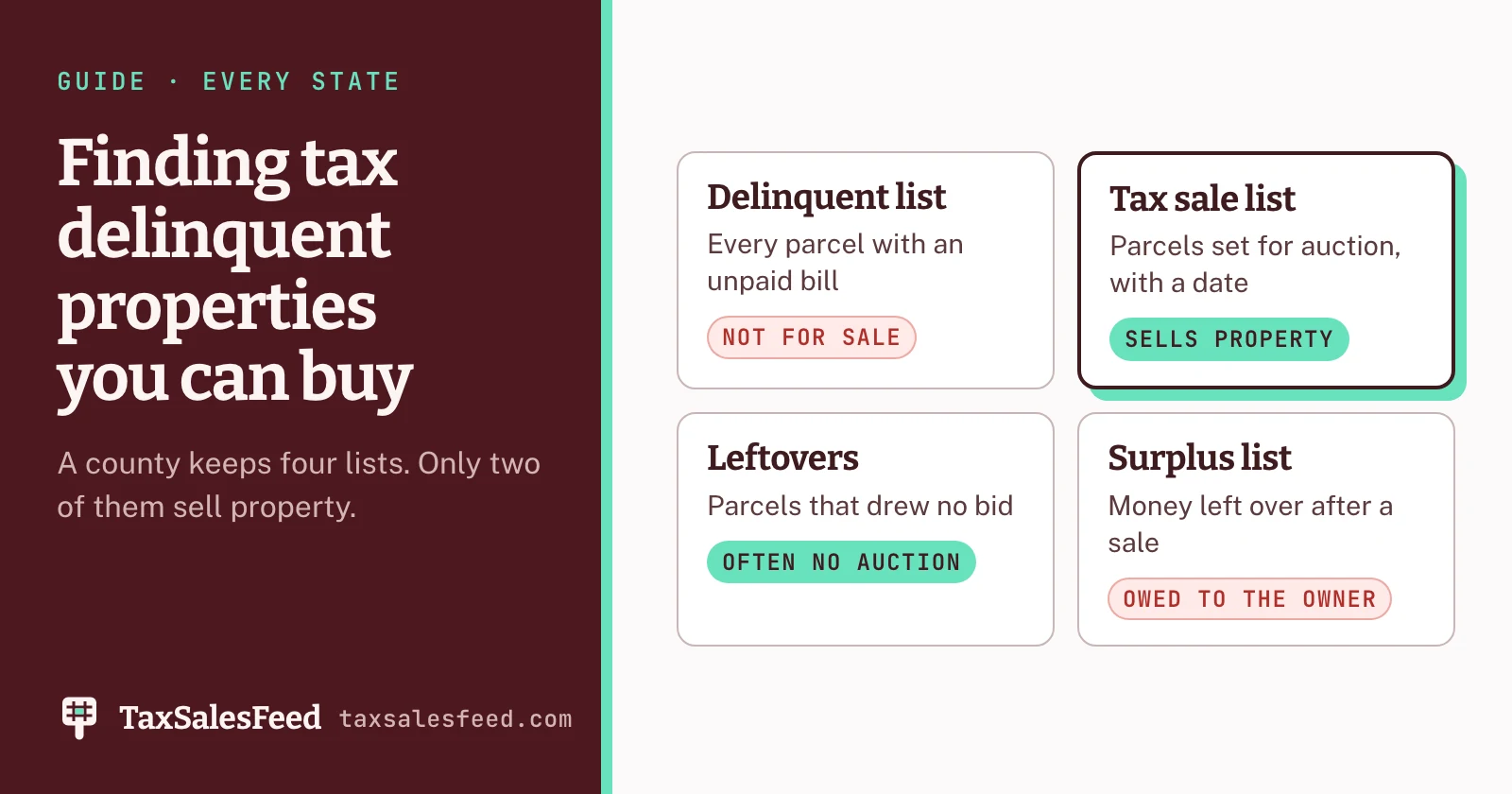
A tax delinquent property is one whose owner missed the property tax deadline. Every county keeps a list of them, and the list is public. But a parcel on the delinquent list is not for sale, and most never will be: the owner can still pay, and most do, often years before the county is allowed to sell. Finding tax delinquent properties you can actually buy means knowing which of the county's lists sells property, when it is published and where.
Four lists, and only two sell property
A county's tax records produce four lists: the delinquent list, the tax sale list, the leftovers that drew no bid, and the surplus left after a sale. Only the tax sale list and the leftovers sell property; the other two are a warning and a refund.
| List | What is on it | Can you buy from it? | When it appears |
|---|---|---|---|
| Delinquent tax list | Every parcel with an unpaid bill | No. The owner can pay, and most do | Once a year, soon after taxes go delinquent |
| Tax sale list | Parcels scheduled for auction, with the date and usually a minimum or opening bid | Yes, at the auction | Weeks before the sale |
| Leftovers | Parcels or liens that drew no bid | Yes, often without an auction | After the sale |
| Surplus list | Money left over after a sale | No. It is owed to the former owner and lienholders | After the sale |
The names change by state. The delinquent list is a "delinquent tax roll", a "delinquent land list" or, in California, a notice of tax-defaulted property. The tax sale list is a "notice of sale", an "advertisement", a notice of application for tax deed or a sheriff's sale list. The leftovers are "lands available for taxes", a "repository", "struck-off" land or over-the-counter liens. Read each one for what it does, not for what it is called.
The delinquent tax list: public, but not for sale
Most states make the county publish its delinquent list every year, in a newspaper or online, but the list is a warning: the owner can still pay, and any sale is months or years away.
The publishing duty is written into state law, and so is what comes next. Florida's tax collector advertises the delinquent list and then sells liens on everything on it: "the tax collector shall advertise once each week for 3 weeks and shall sell tax certificates on all real property having delinquent taxes" [1]. Ohio's county auditor "shall cause the delinquent tax list and the delinquent vacant land tax list, if one is compiled, to be published twice within sixty days" [2]. North Carolina's tax collector posts the liens at the courthouse and publishes "each lien at least one time in one or more newspapers" [3]. A few states also publish a statewide list online, such as Nebraska's delinquent real property list.
How far the list is from a sale depends on the state. In California, taxes still unpaid at 12:01 a.m. on July 1 "shall by operation of law be declared in default" [4], but the county gains the power to sell only "Five years or more" later [5]. Our California tax default lists collect those published lists; they show where sales may come from in years to come, not what is for sale today.
The delinquent list is the earliest signal there is, and that is its use. It is where buyers who want to buy from the owner before any sale start, and where a county's future sale list comes from.
The tax sale list: what you can bid on
The tax sale list is the county's notice that specific parcels will be auctioned on a set date, usually with a minimum or opening bid, published weeks before the sale as state law requires.
A sale list is a legal notice, so its form is set by statute: the parcel number or legal description, the owner of record, the amount due, and the date, place and terms of the sale. California's notice of intended sale must state "The minimum acceptable bid of the property to be sold." [6] How far ahead it runs differs:
- Texas: the sheriff or constable advertises the sale "once a week for three consecutive weeks preceding such sale, in some newspaper published in said county" [7].
- Pennsylvania: "At least thirty (30) days prior to any scheduled sale the bureau shall give notice thereof, not less than once in two (2) newspapers of general circulation in the county" [8].
- California: "The tax collector shall publish the notice of intended sale once a week for three successive weeks" [9].
- Florida: each certificate holder's application for a tax deed is published for four weeks, in a notice whose every line is explained in how to read a notice of application for tax deed.
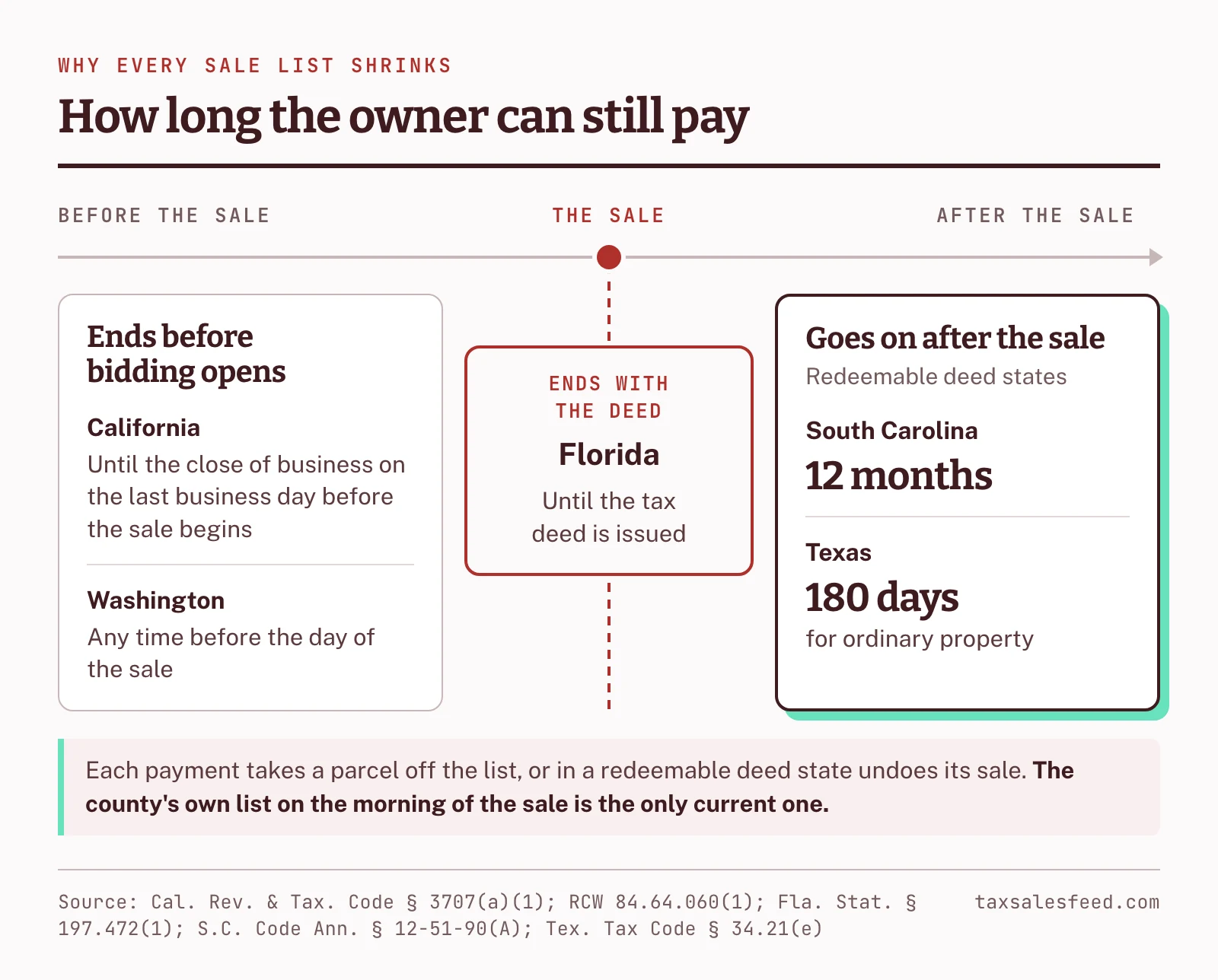
The list only shrinks. Owners keep the right to pay until a deadline, and many use it at the last minute. In Florida that is until the tax deed is issued [10]; in California, "the close of business on the last business day prior to the commencement date of the tax sale" [11]; in Washington, any time before the day of the sale [12]. In a redeemable deed state the sale itself can be undone afterwards: South Carolina owners have twelve months [13], and Texas owners of ordinary property 180 days [14].
Where each state publishes its sale list
State law names both the office that sells and the paper or place where its list must appear, so where to look is fixed by statute, county by county.
The states below are the ones with sales in our records. The office is the one that runs the sale; the publishing rule is the statute's.
| State | Who sells | Where the list must appear | Sales in our records |
|---|---|---|---|
| California | County tax collector | Notice of intended sale, once a week for three weeks [9] | 31 upcoming |
| Colorado | County treasurer, selling liens | The county's newspaper, starting at least four weeks before the sale [15] | 6 upcoming |
| Connecticut | Town tax collector | A local newspaper, once a week for three weeks [16] | 81 upcoming |
| Delaware | County sheriff, at a monition sale | A notice posted on the property itself [17] | 43 upcoming |
| Florida | Tax collector for liens; clerk of court for deeds | Delinquent list once a week for three weeks; each deed application for four weeks [1] | 3,082 upcoming |
| Georgia | Sheriff or county tax commissioner | The county's legal organ, once a week for four weeks [18] | 218 upcoming |
| Kentucky | County clerk, selling certificates of delinquency | A legal notice 30 to 45 days before the sale [19] | 24 upcoming |
| Michigan | County treasurer, or the state, after foreclosure | A notice at least 30 days before each auction [20] | 337 upcoming |
| Minnesota | County auditor, selling tax-forfeited land | Newspapers, websites and community forums, at least 30 days ahead [21] | 88 upcoming |
| Missouri | County collector | A county newspaper, once a week for three weeks [22] | past sales |
| New Mexico | State Taxation and Revenue Department | The department's notice of each county auction [23] | 104 upcoming |
| New York | County enforcing officer, in most counties | Two newspapers, in three weeks within two months [24] | 13 upcoming |
| North Carolina | Court-appointed commissioner, or the sheriff | Liens posted at the courthouse and printed in a newspaper each year [3] | 26 upcoming |
| Ohio | Sheriff for foreclosures; treasurer for liens | Delinquent list published twice within 60 days [2] | 331 upcoming |
| Oregon | The county, after it takes title | A county newspaper, once a week for four weeks [25] | past sales |
| Pennsylvania | County tax claim bureau; the sheriff in Philadelphia and Allegheny | Two newspapers and the legal journal, at least 30 days ahead [8] | 839 upcoming |
| South Carolina | County delinquent tax collector | A newspaper, once a week for three weeks [26] | 12,024 upcoming |
| Tennessee | Clerk and master, under a court order | One newspaper notice naming each owner [27] | 92 upcoming |
| Texas | Sheriff or constable | A county newspaper, once a week for three weeks [7] | 579 upcoming |
| Virginia | Court-appointed special commissioner | The parcel list, at least once in a local newspaper [28] | 187 upcoming |
| Washington | County treasurer | Posted for ten days in three public places [29] | 14 upcoming |
What each state's sale actually sells, a lien, a deed or a deed the owner can still redeem, is set out state by state in tax deed states and tax lien states. It decides what a parcel on any of these lists can become yours as.
Leftovers: parcels you can buy without an auction
When a parcel or lien draws no bid, many states let it be bought afterwards without an auction, often at a set price: lands available for taxes in Florida, the repository in Pennsylvania, over-the-counter liens in the District of Columbia and Montana.
- Florida. After a tax deed sale with no bidder and the county's first 90 days, "any person, the county, or any other governmental unit may purchase the property from the clerk, without further notice or advertising, for the opening bid" [30]. Florida's lands available for taxes explains the list and how its price grows.
- Pennsylvania. Property still unsold after a judicial sale goes into what the law calls the "repository for unsold properties" [31], a list each county's tax claim bureau keeps open to buyers.
- The District of Columbia. "an Over-the-Counter (OTC) Sale allows purchasers an opportunity to buy specific tax liens to properties that were presented but not sold to third-party purchasers at the annual real property tax sale." [32]
- Montana. There is no lien auction at all: a county-held lien "must be assigned by the county treasurer" to a buyer who has given the owner notice and pays what is due [33].
- Missouri. Land that has failed to sell through three offerings is sold with "the immediate issuance and delivery of a collector's deed and there shall be no period of redemption" [34].
- California. "any parcel remaining unsold may be reoffered within a 90-day period" [35], often at a lower minimum.
Leftovers are cheap for a reason more often than not: no access, no use, a lien that survives, or a sliver of land nobody else wanted. Check each one at least as hard as you would a parcel at auction.
Surplus funds lists are money, not property
A surplus funds list, also called an overage or excess proceeds list, is a list of money: what a sale brought above the taxes and costs, owed to the former owner and lienholders, who must claim it by a deadline.
These are among the most searched "lists" of all, and none of them sells anything. When a parcel sells for more than the debt, the county or clerk holds the surplus for the people who had an interest in the property. The deadlines are short. A Florida claimant "has 120 days from the date of the notice to file a written claim with the clerk for the surplus proceeds" [36]; a California claim must come "at any time prior to the expiration of one year following the recordation of the tax collector’s deed" [37]; in Virginia, surplus nobody claims within two years of the sale's confirmation goes to the locality [38]. Since the Supreme Court's 2023 decision in Tyler v. Hennepin County, a county "could not use the toehold of the tax debt to confiscate more property than was due" [39], and several states have since changed their laws to pay it out.
From a list to a bid: checking one parcel
A parcel on a sale list is where the work starts: confirm it is still for sale, find out what it is and what survives the sale, read the county's terms, and only then decide what to bid.
- Find the parcel. Take the parcel number, or the legal description where no number is printed, to the county property appraiser's or assessor's site for the address, map, size, use and assessed value. A sale list rarely prints a street address, and an opening bid says nothing about what the land is worth.
- Look at it. Satellite view first, then in person if you can. Sale lists are full of slivers, landlocked strips, retention ponds and common areas that nobody would buy at any price, which is often why the taxes went unpaid.
- Check what the sale does not clear. A tax deed wipes out most private liens, but not all of them. Government liens, some special assessments, easements and recorded restrictions survive in many states; what survives in Florida and California is set out line by line in which liens survive a Florida tax deed sale and how California tax deed auctions work.
- Confirm it is still on the list. Owners redeem up to the deadline, and in some states after the sale too. The county's own list on the morning of the sale is the only current one.
- Read the sale terms. Deposit, how and when the balance is due, accepted funds, registration deadlines, recording fees and transfer tax are the county's, and they differ between counties in the same state.
- Budget past the bid. Add a quiet title action if you will need title insurance, any assessments that survive, and the cost of getting possession lawfully if someone lives there.
Buying from the owner before the sale
Until the sale, the delinquent owner still owns the property and can sell it, with the taxes paid off at closing, which is why investors use the owner of record printed on a sale list to make offers before the auction.
A sale list names the owner of record, the property and a deadline, and that makes it useful before the auction as well as at it. An owner facing a sale has a reason to sell, and a sale to you pays the county in full at closing, like any other lien. Treat it as an ordinary purchase from someone under pressure: get the title searched, pay the taxes through the closing rather than to the owner, and know that some states regulate contracts with owners facing tax foreclosure or the loss of their equity. A local real estate attorney will know your state's rules.
Free county lists or a data service?
County lists are free and official but scattered across thousands of offices, formats and newspapers; delinquency data services flag unpaid taxes from assessor rolls, which is a larger and different list than the parcels actually scheduled for sale.
The county's own list is the authority. It is free, and it is what the sale runs on. The cost is time: the United States has more than 3,000 counties, each publishing on its own schedule and in its own format (a PDF on the treasurer's site, a spreadsheet on an auction platform, a column of fine print in a weekly newspaper), and each list starts going stale the day it is published.
Delinquency data services, the property-data tools sold to wholesalers, flag tax-delinquent owners from assessor and tax-roll data. They are built for outreach to owners. But a delinquency flag is the first list, not the second: it tells you a bill is unpaid, not that a sale is scheduled, and most of the owners it flags will pay.
TaxSalesFeed reads the second list: the published notices of sale, from newspapers, clerks and county sale sites, every night. Each sale comes with its parcel, date and whatever else the notice prints (the opening bid, the owner of record, the certificate holder forcing a Florida sale), merged into one record however many times the notice ran. You can search them by county, owner, holder or bid, save the search, and get an email the morning a new one is published. The sale calendar shows Florida's sale days, and the county auction calendar the sales announced in other states.
Sources
- [1]Fla. Stat. § 197.402(3) — Florida Legislature“the tax collector shall advertise once each week for 3 weeks and shall sell tax certificates on all real property having delinquent taxes”
- [2]Ohio Rev. Code § 5721.03(B)(1) — Ohio Legislative Service Commission“The auditor shall cause the delinquent tax list and the delinquent vacant land tax list, if one is compiled, to be published twice within sixty days after the delivery of the delinquent land duplicate to the county treasurer.”
- [3]N.C. Gen. Stat. § 105-369(c) — North Carolina General Assembly“The county tax collector shall advertise county tax liens by posting a notice of the liens at the county courthouse and by publishing each lien at least one time in one or more newspapers having general circulation in the taxing unit.”
- [4]Cal. Rev. & Tax. Code § 3436 — California Legislature“At 12:01 a.m. on July 1, the taxes, assessments, penalties, and costs on real property except tax-defaulted property and possessory interests, which have not been paid shall by operation of law be declared in default.”
- [5]Cal. Rev. & Tax. Code § 3691(a)(1)(A) — California Legislature“Five years or more, or three years or more in the case of nonresidential commercial property, after the property has become tax defaulted, the tax collector shall have the power to sell”
- [6]Cal. Rev. & Tax. Code § 3704(e) — California Legislature“The minimum acceptable bid of the property to be sold.”
- [7]Tex. R. Civ. P. 647 — Supreme Court of Texas (txcourts.gov)“shall be advertised by the officer by having the notice thereof published in the English language once a week for three consecutive weeks preceding such sale, in some newspaper published in said county”
- [8]72 P.S. § 5860.602(a) — Pennsylvania General Assembly“At least thirty (30) days prior to any scheduled sale the bureau shall give notice thereof, not less than once in two (2) newspapers of general circulation in the county”
- [9]Cal. Rev. & Tax. Code § 3702(a) — California Legislature“The tax collector shall publish the notice of intended sale once a week for three successive weeks”
- [10]Fla. Stat. § 197.472(1) — Florida Legislature“A person may redeem a tax certificate at any time after the certificate is issued and before a tax deed is issued unless full payment for a tax deed is made to the clerk of the court”
- [11]Cal. Rev. & Tax. Code § 3707(a)(1) — California Legislature“The right of redemption terminates at the close of business on the last business day prior to the commencement date of the tax sale.”
- [12]RCW 84.64.060(1) — Washington State Legislature“may in person or by agent pay the taxes, interest and costs due thereon to the county treasurer of the county in which the same are situated, at any time before the day of the sale”
- [13]S.C. Code Ann. § 12-51-90(A) — South Carolina Legislature“may within twelve months from the date of the delinquent tax sale redeem each item of real estate”
- [14]Tex. Tax Code § 34.21(e) — Texas Legislature (Texas Legislative Council)“the owner's right of redemption may be exercised not later than the 180th day following the date on which the purchaser's or taxing unit's deed is filed for record”
- [15]Colo. Rev. Stat. § 39-11-102(1) — Colorado General Assembly (Office of Legislative Legal Services)“the treasurer shall cause the notice described in subsection (2) of this section to be published in the newspaper selected pursuant to section 39-11-105, the first publication being at least four weeks before the date of sale”
- [16]Conn. Gen. Stat. § 12-157(a) — Connecticut General Assembly“Such collector shall also publish a similar notice for three weeks, at least once each week, in a newspaper published in such town, or in a newspaper published in the state having a general circulation in such town.”
- [17]9 Del. C. § 8724 — Delaware General Assembly“The posting of the notice as herein required shall constitute notice to the owner or owners and all persons having any interest in the property.”
- [18]DeKalb County Tax Commissioner, Tax Sales — DeKalb County Tax Commissioner“Notice of the sale is published once a week for four weeks immediately preceding the sale in the legal organ (newspaper) for the county”
- [19]Ky. Rev. Stat. § 134.128(5)(a) — Kentucky General Assembly (Legislative Research Commission)“At least thirty (30) but not more than forty-five (45) days before the scheduled sale date, the county clerk shall cause a notice to be published in accordance with the provisions of KRS Chapter 424.”
- [20]Mich. Comp. Laws § 211.78m(2) — Michigan Legislature“Notice of the time and location of a sale must be published not less than 30 days before a sale in a notice publication circulated in the county in which the property is located”
- [21]Minn. Stat. § 282.005, subd. 4(a) — Minnesota Office of the Revisor of Statutes“Notice of the sale under this subdivision must be provided by publication in newspapers, websites, and other forums that serve diverse communities in the county where the property is located at least 30 days before the commencement of the sale.”
- [22]Mo. Rev. Stat. § 140.170 — Missouri Revisor of Statutes“the county collector shall cause a copy of the list of delinquent lands and lots to be printed in some newspaper of general circulation published in the county for three consecutive weeks, one insertion weekly, before the sale”
- [23]N.M. Taxation & Revenue Dep't, Notice of Public Auction Sale (De Baca County, Sept. 23, 2026) — New Mexico Taxation and Revenue Department“Notice is hereby given that, pursuant to provisions of Section 7-38-65 NMSA 1978, the Property Tax Division of the Taxation and Revenue Department will offer for sale at public auction”
- [24]N.Y. Real Prop. Tax Law § 1124 — New York State Senate“the enforcing officer forthwith shall cause a notice of foreclosure to be published in each of three non-consecutive weeks in a two month period in at least two newspapers designated by him or her”
- [25]Or. Rev. Stat. § 275.120(1) — Oregon State Legislature“the sheriff shall publish a notice of the sale of such property in a newspaper of general circulation, printed and published in the county where the land is situated, once each week for four consecutive weeks prior to such sale.”
- [26]S.C. Code Ann. § 12-51-40(d) — South Carolina Legislature“The advertising must be published once a week before the legal sales date for three consecutive weeks for the sale of real property”
- [27]UT CTAS e-Li, Tax Sale (CTAS-1599) — University of Tennessee County Technical Assistance Service“The property must be advertised in one sale notice in the newspaper (or by printed handbills as the court orders) setting out the names of the owners of the different tracts or parcels of land”
- [28]Va. Code § 58.1-3965(A) — Virginia General Assembly (LIS)“Such officer shall also cause to be published at least once a list of real estate which will be offered for sale under the provisions of this article in a newspaper of general circulation in the locality”
- [29]RCW 84.64.080(5) — Washington State Legislature“give notice of the time and place where the sale is to take place for ten days successively by posting notice thereof in three public places in the county”
- [30]Fla. Stat. § 197.502(7) — Florida Legislature“Thereafter, any person, the county, or any other governmental unit may purchase the property from the clerk, without further notice or advertising, for the opening bid”
- [31]72 P.S. § 5860.626 — Pennsylvania General Assembly“any property remains unsold, it shall be placed in a category to be termed "repository for unsold properties."”
- [32]DC Office of Tax and Revenue, Real Property Tax Lien Sale — DC Office of Tax and Revenue“an Over-the-Counter (OTC) Sale allows purchasers an opportunity to buy specific tax liens to properties that were presented but not sold to third-party purchasers at the annual real property tax sale.”
- [33]Mont. Code Ann. § 15-17-323 — Montana Legislature“A tax lien certificate or other official record in which the county is listed as the possessor of the tax lien must be assigned by the county treasurer to any person who, after providing proof of mail notice to the person to whom the property was assessed”
- [34]Mo. Rev. Stat. § 140.250 — Missouri Revisor of Statutes“shall be entitled to the immediate issuance and delivery of a collector's deed and there shall be no period of redemption from such post-third year sales”
- [35]Cal. Rev. & Tax. Code § 3692(e) — California Legislature“any parcel remaining unsold may be reoffered within a 90-day period”
- [36]Fla. Stat. § 197.582(3) — Florida Legislature“has 120 days from the date of the notice to file a written claim with the clerk for the surplus proceeds”
- [37]Cal. Rev. & Tax. Code § 4675(a)(1) — California Legislature“Any party of interest in the property may file with the county a claim for the excess proceeds, in proportion to that person’s interest held with others of equal priority in the property at the time of sale, at any time prior to the expiration of one year following the recordation of the tax collector’s deed to the purchaser.”
- [38]Va. Code § 58.1-3967 (amended 2025, c. 267) — Virginia General Assembly (LIS)“if no claim for such surplus is made by such former owner or his heirs, devisees, successors, or assigns within two years after the date of confirmation of such sale”
- [39]Tyler v. Hennepin County, 598 U.S. 631 (2023) — Supreme Court of the United States“The County had the power to sell Tyler’s home to recover the unpaid property taxes. But it could not use the toehold of the tax debt to confiscate more property than was due.”
Questions
Where can I find a list of tax delinquent properties?
From the county office that collects delinquent property tax, which goes by a different title in each state: the tax collector, treasurer, revenue commissioner, tax claim bureau or delinquent tax collector. State law makes that office publish its delinquent list or its tax sale list, usually in a local newspaper for two to four weeks, and most also post it on the county website or the online auction site that runs the sale. The list that sells property is the tax sale list, not the yearly delinquent list.
Can you buy a property just by paying its back taxes?
No. Paying the tax on a property you do not own generally gives you no right to it. Ownership changes hands at the county's tax sale, through a tax lien that later ripens into a deed, or by buying from the owner, who pays the taxes off at closing. Where a state sells tax liens, paying the taxes at the lien sale buys you the right to interest, not the property.
Are lists of tax delinquent properties public record?
Yes. Property tax records are public, and most states require the county to publish its delinquent list or sale list. Florida's tax collector advertises the delinquent list once a week for three weeks before the certificate sale, Ohio's county auditor publishes the delinquent tax list twice within sixty days, and Pennsylvania's tax claim bureaus publish each sale at least thirty days ahead in two newspapers.
Where can I find a list of tax delinquent properties for sale in Pennsylvania?
In 65 of Pennsylvania's 67 counties, from the county tax claim bureau, which must publish each upset sale at least thirty days ahead in two newspapers and the county's legal journal. Property that is still unsold after the judicial sale goes on the bureau's repository list for unsold properties. Philadelphia and Allegheny County sell at sheriff's sales instead, under a different law.
How do I find tax delinquent properties in Ohio?
Start with the county auditor's delinquent tax list, which must be published twice within sixty days. Properties are then sold by foreclosure, at sheriff's sales the county advertises once a week for three weeks, and the owner can redeem until the court confirms the sale. Some county treasurers also sell tax certificates on selected parcels, with bidding starting at 18% a year.
How do I find tax delinquent properties in Alabama?
From the county revenue commissioner or tax collector. Each county chooses every year whether to sell tax liens, bid down from 12% interest, or the property itself. Parcels that do not sell pass to the Alabama Department of Revenue, which lists the land it holds on its website.
How often are tax sale lists updated?
The county publishes the list once, for the weeks the law requires, and then it only shrinks: owners redeem, parcels are withdrawn and some sales are postponed. Florida owners can redeem until the tax deed is issued, and California owners until the business day before the sale, so the county's own list on the morning of the sale is the only current one.
Where next
- Florida tax deed sale calendarEvery county's upcoming sale days, with parcel counts and start times.
- Tax sale guidesHow to buy at a tax sale, which states sell deeds or liens, and Florida, Texas, Georgia, Pennsylvania and California step by step.
- Tax certificate holdersThe funds applying for tax deeds, with every county they are active in.
- Tax sale glossaryTax certificate, tax deed application, opening bid, redemption — every term a notice uses.
General information about tax sale law across the states, not legal advice. Each state's law and each county's sale terms differ, and statutes change; confirm with the county office holding the sale before bidding.