Guide 15
How Pennsylvania tax sales work: upset, judicial and repository
10 min read · updated October 27, 2026
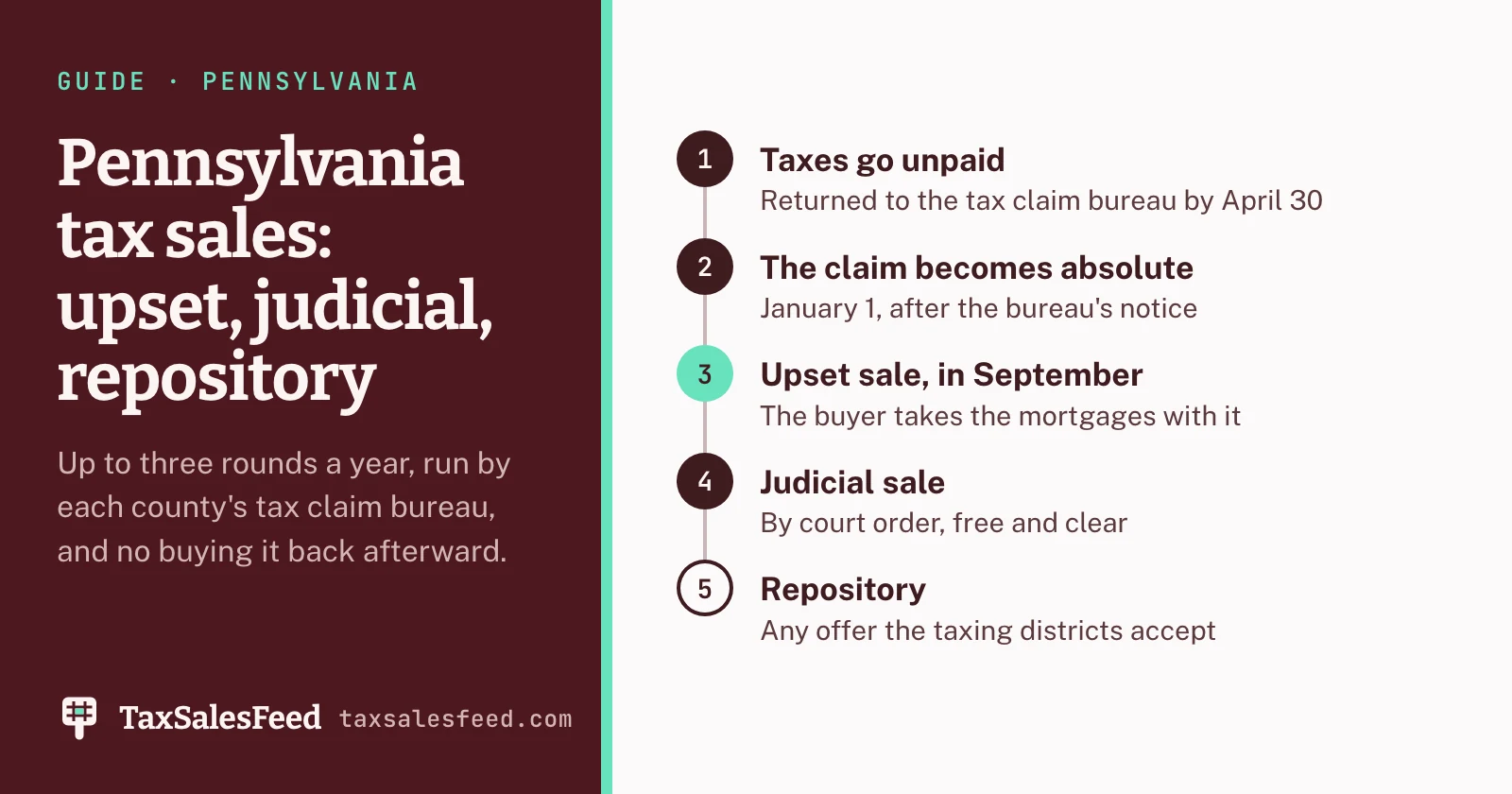
Pennsylvania does not sell tax liens. When property taxes go unpaid, the county sells the property, and in most of the state it does so in up to three rounds, each with its own rules: the upset sale in September, a judicial sale for what the upset sale could not sell, and the repository for what is left. Which round a property is in decides what you pay, what comes with it and whether you can get title insurance afterward. Philadelphia, which holds most of the Pennsylvania sales in our records, runs a fourth kind: the sheriff's sale.
Most of Pennsylvania sells under the Real Estate Tax Sale Law
Outside Philadelphia and Allegheny counties, each county's tax claim bureau collects delinquent property taxes and sells the property under the Real Estate Tax Sale Law of 1947, at an upset sale, a judicial sale or from the repository. There is no tax lien certificate.
The law covers every county but two: its definition of a taxing district reaches every local unit of government "except counties of the first and second class" [1], which are Philadelphia and Allegheny. Everywhere else the bureau sells in order. "The Upset Sale is conducted once a year and is the first sale at which a delinquent taxpayer's property may be sold." [2] What the upset sale cannot sell can go to a judicial sale, and what that cannot sell goes into the repository.
How Pennsylvania compares with the lien and deed states is set out in tax deed states and tax lien states.
From unpaid tax to the upset sale
Unpaid taxes are returned to the tax claim bureau by the end of April, the bureau notifies the owner by July 31, and the claim becomes absolute the next January 1. The property goes to that September's upset sale, about two years after the first missed bill.
Each local tax collector must "make a return to the bureau on or before the last day of April of each year" [3] of the properties whose taxes for the previous year are unpaid, and from then "Interest shall be charged at the rate of nine per centum (9%) per annum." [4] "Not later than the thirty-first day of July of each year, the bureau shall give only one notice of the return of said taxes and the entry of such claim" [5]. Then, "On the first day of January next following the notice hereinbefore prescribed, if the amount of the tax claim referred to in the notice has not been paid, or no exceptions thereto filed, the claim shall become absolute." [6]
An absolute claim is what puts a property in the upset sale. "The bureau shall schedule the date of the sale no earlier than the second Monday of September and before October 1" [7], and "the sale may be adjourned, readjourned or continued" [8], but "all sales shall be held by the bureau by the end of the calendar year" [9]. Lehigh County sums up the timing: "Properties in which the real estate taxes are delinquent for two years are eligible for the Upset Sale." [10]
The notice is thorough. "At least thirty (30) days prior to any scheduled sale the bureau shall give notice thereof, not less than once in two (2) newspapers of general circulation in the county" [11] and in the county's legal journal, sends certified mail to each owner, and "Each property scheduled for sale shall be posted at least ten (10) days prior to the sale." [12] An owner who lives in the property must also be served in person: "No owner-occupied property may be sold unless the bureau has given the owner occupant written notice of such sale at least ten (10) days prior to the date of actual sale by personal service" [13]. Up to the last moment the owner can pay: "If payment is made after July 1 of the year following the notice of claim, but before the actual sale of the property, the property shall not be sold" [14].
The upset sale: the mortgages come with it
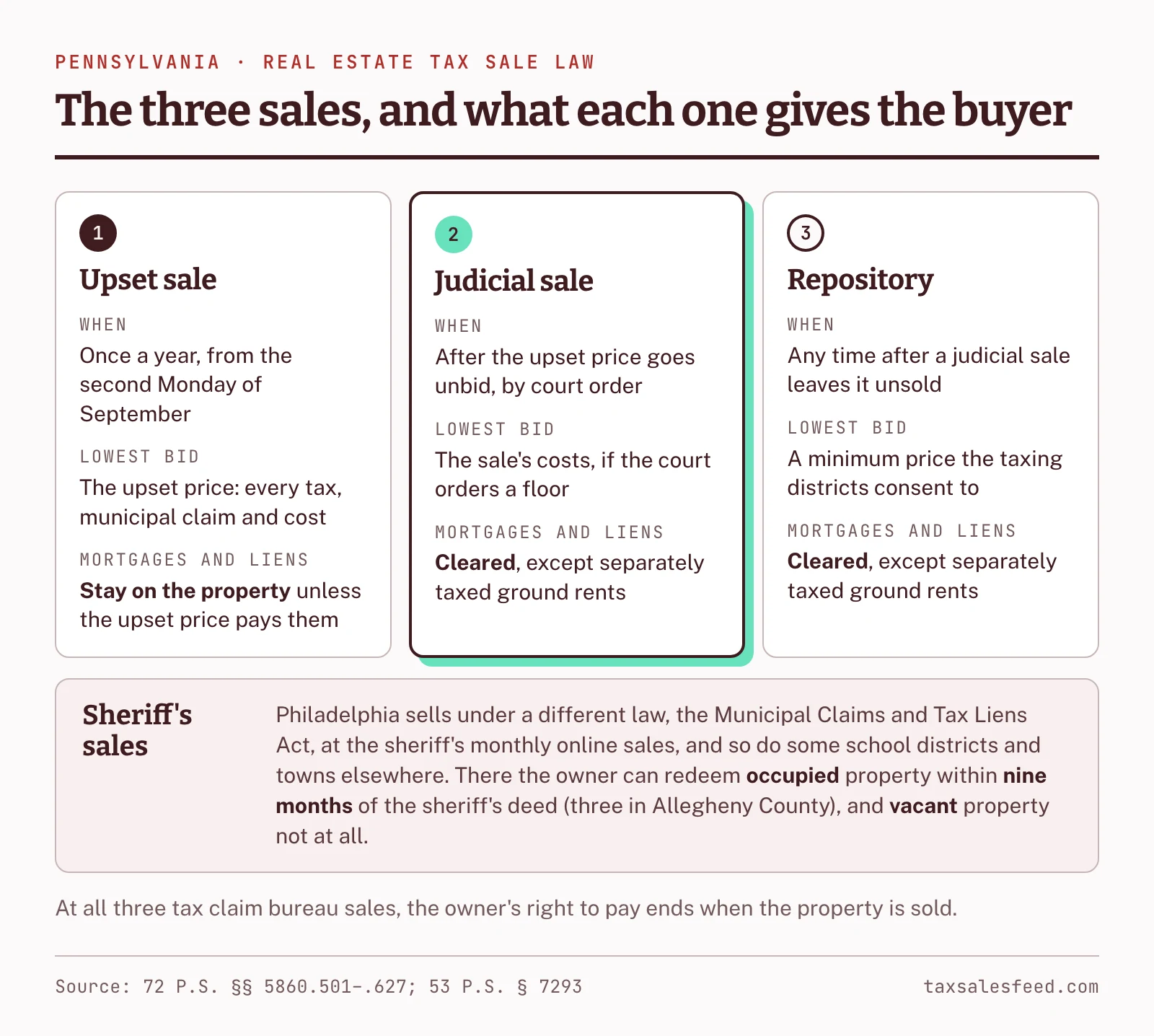
The lowest bid at an upset sale is the upset price: the delinquent taxes, other tax and municipal claims, current taxes and the costs of the sale. The buyer takes the property subject to every recorded mortgage and lien the upset price does not pay.
The upset price adds up everything the taxing bodies are owed, from "the tax liens of the Commonwealth" to "the amount of the municipal claims against the property, and (f) the record costs and costs of sale" [15], and "No sale of property shall be made by the bureau unless a bid equal to the upset price is made." [16] Above it, the highest bid wins.
What the buyer gets is the part most first-time buyers miss. "Every such sale shall convey title to the property under and subject to the lien of every recorded obligation, claim, lien, estate, mortgage, ground rent and Commonwealth tax lien not included in the upset price" [17]. Lehigh County's bureau says the same in plain terms: "The sale of a property is subject to all liens and encumbrances at the time of sale." [18] A house with a $90,000 mortgage that sells at the upset sale for $6,000 still carries the $90,000 mortgage, and the lender can foreclose on it. Run a lien search on every upset-sale parcel before you bid.
The sale is not final on the day, either. Within sixty days the bureau reports its sales to the court, which confirms them nisi, and the owner is notified that "the owner may file objections or exceptions with the court relating to the regularity and procedures followed during the sale no later than thirty (30) days after the court has made a confirmation nisi of the consolidated return" [19]. Owners who were not properly notified do challenge sales, and "If such objections or exceptions are sustained and the court deems the defect not amendable, it shall, by its order or decree, invalidate the sale" [20].
The judicial sale: free and clear
When no one bids the upset price, the bureau can ask the court to sell the property free and clear. After notice to everyone with an interest, the court orders a judicial sale at which the buyer takes title clear of mortgages and liens, except separately taxed ground rents.
"In cases where the upset price shall not be bid at any such sale, the sale shall be continued, but not beyond the end of the calendar year, without further advertising" [21], and the bureau petitions the court of common pleas to sell the property. The court grants a rule on every owner, lienholder and mortgage holder the title search turns up to show cause why it should not be sold free of their claims. If it is satisfied, "the purchaser at such sale shall take and thereafter have an absolute title to the property sold free and clear of all tax and municipal claims, mortgages, liens, charges and estates of whatsoever kind" [22], except separately taxed ground rents.
The price can be much lower than at the upset sale, because the floor is no longer the whole debt: "The court order may specify that no sale shall be made except to the county unless a bid equal to such costs is offered." [23] Deeds do not change hands at once: they "shall not be exchanged any sooner than twenty (20) days nor later than forty-five (45) days after any sale" [24], a window in which a municipality can ask the court to bar a buyer with a record of unremedied code violations. And the former owner cannot come back in by bidding: "The owner shall have no right to purchase the owner's property at a judicial sale, a private sale or from the bureau's repository for unsold property under the provisions of this act." [25]
The repository: properties you can buy by offer
A property the judicial sale cannot sell goes on the bureau's repository list. The bureau can sell it, without an auction, for any offer at or above a minimum price the taxing districts consent to, and the buyer takes it free and clear.
After a judicial sale, if "any property remains unsold, it shall be placed in a category to be termed 'repository for unsold properties.'" [26] "A list of properties in this category shall be maintained by the bureau and shall be available during normal office hours to the general public." [27] That list is the repository list many county bureaus post online, and it is the one place in Pennsylvania where you can make an offer on a tax-sale property instead of waiting for an auction.
"The bureau may, with the written consent of all the taxing districts where the property is located, establish a minimum purchase price and accept an offer of any price equal to or greater than the minimum purchase price" [28]. The taxing districts cannot sit on an offer forever: "if no consent is provided within sixty (60) days of the date notice was received by the taxing district, it shall be deemed that the taxing district consents to the sale of the property" [29], though a district may first ask the buyer to appear before its board. Once paid, "The property shall be conveyed to the purchaser upon payment of the agreed price, free and clear of all tax and municipal claims, mortgages, liens, and charges and estates of whatsoever kind, except ground rents separately taxed." [30] Repository properties are, by definition, ones two auctions passed over: vacant lots, slivers of land and buildings that need more than they are worth. Some are bargains for a neighbor; look at each before you offer.
Philadelphia's sheriff's sales
Philadelphia sells tax-delinquent property at sheriff's sales under the Municipal Claims and Tax Liens Act, online, through the year. The owner can redeem occupied property within nine months of the sheriff's deed; vacant property cannot be redeemed.
Because the Real Estate Tax Sale Law excludes counties of the first and second class, Philadelphia's delinquent taxes are collected by lawsuit and sold by the sheriff. The sheriff's auction site lists each sale; "This site is for searching auctions only. Bidding takes place on" [31] Bid4Assets, with a separate account. Linebarger Goggan Blair & Sampson, which collects for the city, posts the properties in its tax foreclosure cases. In our records Philadelphia has sales on several days a month, and school districts and towns in other counties sell through the sheriff the same way, as in Lehigh and Montgomery counties.
A sheriff's tax sale can be undone. The owner, or anyone whose lien the sale discharged, can redeem "at any time within nine months from the date of the acknowledgment of the sheriff's deed" [32], or "within three months from the date of the acknowledgment of the sheriff's deed therefor" [33] in Allegheny County and Pittsburgh, by repaying the bid and the buyer's costs "and a sum equal to interest at the rate of ten per centum per annum thereon, from the time of each of such payments" [34]. That right is for occupied homes only: "there shall be no redemption of vacant property by any person after the date of the acknowledgment of the sheriff's deed therefor" [35], and property counts as vacant "unless it was continuously occupied by the same individual or basic family unit as a residence for at least ninety days prior to the date of the sale" [36] and still is when the deed is acknowledged.
Where to find Pennsylvania tax sale lists
Each county's tax claim bureau posts its upset, judicial and repository lists, and the sale notices run in two newspapers and the legal journal 30 days ahead. Philadelphia's are on the sheriff's auction site.
- The tax claim bureau. Each bureau posts its own lists, often with the results afterward: Lehigh's upset sale, Schuylkill's tax sales and Westmoreland's judicial sale lists, for example. Many contract the sale to an agent, whose site carries the list.
- The newspapers and the legal journal. Every upset sale is advertised in two papers and the county's legal journal at least 30 days ahead, and Pennsylvania's newspapers post their legal notices at publicnoticepa.com.
- The repository list. Ask the bureau, or look on its site: the law makes the list public.
- The sheriff. Philadelphia's sales are on the sheriff's auction site, and sheriff's sales on school and municipal tax claims elsewhere are on the county sheriff's sale list, such as those on CivilView.
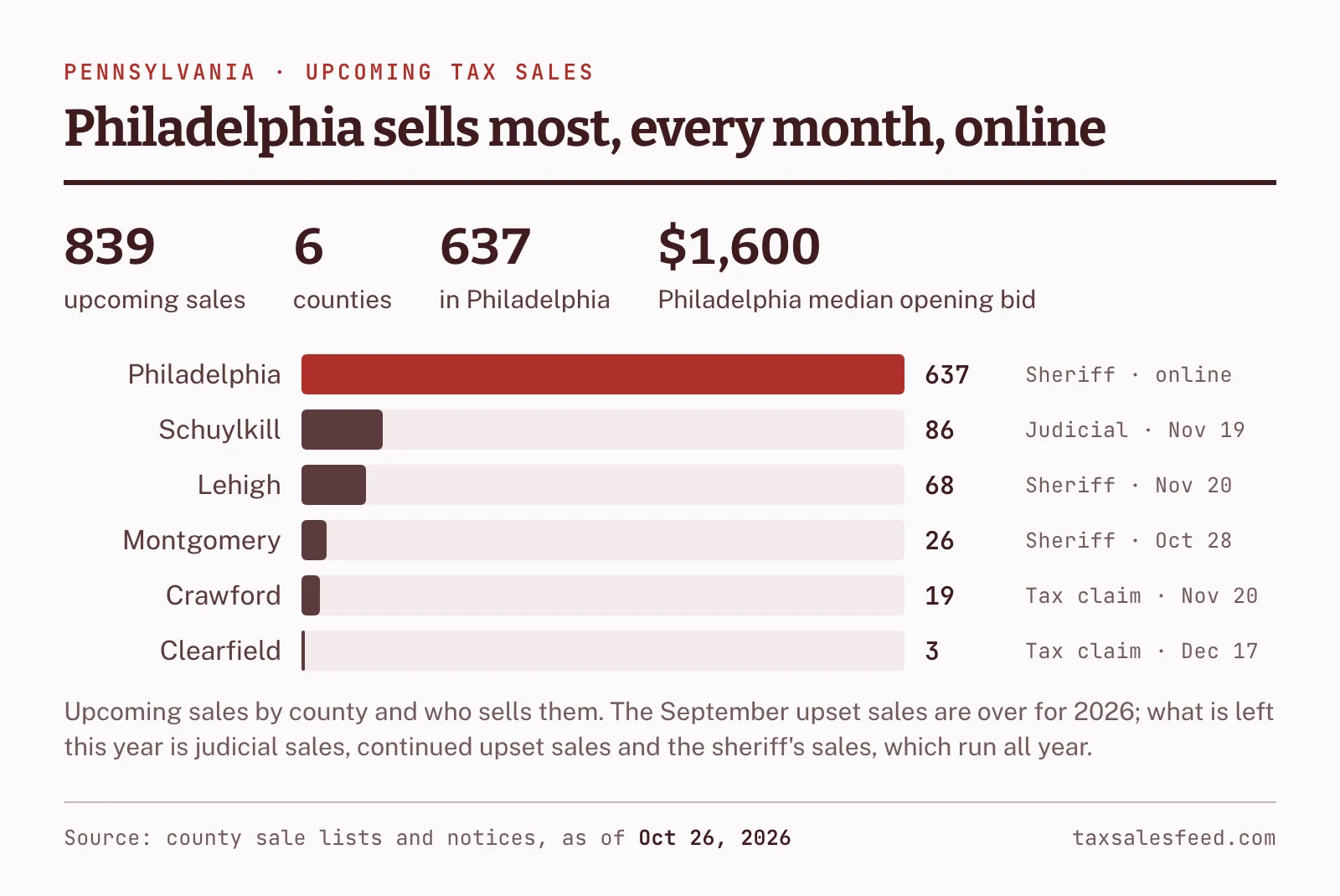
The Pennsylvania counties with the most sales coming, from the same data as their pages:
| County | Upcoming | Next sale | Median opening bid |
|---|---|---|---|
| Philadelphia County | 637 | Oct 27, 2026 | $1,600 |
| Schuylkill County | 86 | Nov 19, 2026 | $405 |
| Lehigh County | 68 | Nov 20, 2026 | — |
| Montgomery County | 26 | Oct 28, 2026 | — |
| Crawford County | 19 | Nov 20, 2026 | — |
| Clearfield County | 3 | Dec 17, 2026 | $600 |
Before you bid in Pennsylvania
- Know which sale it is. Upset, judicial, repository or sheriff's: it decides the price, whether the mortgages survive and whether the owner can redeem.
- Search the liens on every upset-sale parcel. The upset price clears the taxes, not the mortgage.
- Look at the property and the parcel on the county's map. Sale lists give a parcel number and a short description.
- Read the bureau's terms: the deposit, when the balance is due, and the affidavit buyers must sign. A buyer whose landlord license a municipality has revoked cannot buy at a tax sale in that county.
- Wait out the confirmation. An upset sale can still be set aside on an owner's objection after the court confirms it nisi.
- Check the list on the day. Owners pay up to the start of the sale.
The same steps for any state are in how to buy tax lien and tax deed properties. For the current lists, see Pennsylvania tax sales, or Philadelphia, Schuylkill and Lehigh.
Sources
- [1]72 P.S. § 5860.102 ("Taxing District") — Pennsylvania General Assembly“any similar general purpose unit of government which may be created or authorized by statute except counties of the first and second class”
- [2]Lehigh County Tax Claim Bureau, Upset Sale — Lehigh County Tax Claim Bureau“The Upset Sale is conducted once a year and is the first sale at which a delinquent taxpayer's property may be sold.”
- [3]72 P.S. § 5860.306(a) — Pennsylvania General Assembly“make a return to the bureau on or before the last day of April of each year”
- [4]72 P.S. § 5860.306(a) — Pennsylvania General Assembly“Interest shall be charged at the rate of nine per centum (9%) per annum.”
- [5]72 P.S. § 5860.308(a) — Pennsylvania General Assembly“Not later than the thirty-first day of July of each year, the bureau shall give only one notice of the return of said taxes and the entry of such claim”
- [6]72 P.S. § 5860.311 — Pennsylvania General Assembly“On the first day of January next following the notice hereinbefore prescribed, if the amount of the tax claim referred to in the notice has not been paid, or no exceptions thereto filed, the claim shall become absolute.”
- [7]72 P.S. § 5860.601(a) — Pennsylvania General Assembly“The bureau shall schedule the date of the sale no earlier than the second Monday of September and before October 1”
- [8]72 P.S. § 5860.601(a) — Pennsylvania General Assembly“the sale may be adjourned, readjourned or continued”
- [9]72 P.S. § 5860.601(a) — Pennsylvania General Assembly“Except as otherwise provided in this article, all sales shall be held by the bureau by the end of the calendar year.”
- [10]Lehigh County Tax Claim Bureau, Upset Sale — Lehigh County Tax Claim Bureau“Properties in which the real estate taxes are delinquent for two years are eligible for the Upset Sale.”
- [11]72 P.S. § 5860.602(a) — Pennsylvania General Assembly“At least thirty (30) days prior to any scheduled sale the bureau shall give notice thereof, not less than once in two (2) newspapers of general circulation in the county”
- [12]72 P.S. § 5860.602(e)(3) — Pennsylvania General Assembly“Each property scheduled for sale shall be posted at least ten (10) days prior to the sale.”
- [13]72 P.S. § 5860.601(a)(3) — Pennsylvania General Assembly“No owner-occupied property may be sold unless the bureau has given the owner occupant written notice of such sale at least ten (10) days prior to the date of actual sale by personal service”
- [14]72 P.S. § 5860.501(a) — Pennsylvania General Assembly“If payment is made after July 1 of the year following the notice of claim, but before the actual sale of the property, the property shall not be sold”
- [15]72 P.S. § 5860.605 — Pennsylvania General Assembly“the amount of the municipal claims against the property, and (f) the record costs and costs of sale”
- [16]72 P.S. § 5860.605 — Pennsylvania General Assembly“No sale of property shall be made by the bureau unless a bid equal to the upset price is made.”
- [17]72 P.S. § 5860.609 — Pennsylvania General Assembly“Every such sale shall convey title to the property under and subject to the lien of every recorded obligation, claim, lien, estate, mortgage, ground rent and Commonwealth tax lien not included in the upset price”
- [18]Lehigh County Tax Claim Bureau, Upset Sale — Lehigh County Tax Claim Bureau“The sale of a property is subject to all liens and encumbrances at the time of sale.”
- [19]72 P.S. § 5860.607(a.1)(1) — Pennsylvania General Assembly“the owner may file objections or exceptions with the court relating to the regularity and procedures followed during the sale no later than thirty (30) days after the court has made a confirmation nisi of the consolidated return”
- [20]72 P.S. § 5860.607(e) — Pennsylvania General Assembly“If such objections or exceptions are sustained and the court deems the defect not amendable, it shall, by its order or decree, invalidate the sale”
- [21]72 P.S. § 5860.610 — Pennsylvania General Assembly“In cases where the upset price shall not be bid at any such sale, the sale shall be continued, but not beyond the end of the calendar year, without further advertising”
- [22]72 P.S. § 5860.612(a) — Pennsylvania General Assembly“the purchaser at such sale shall take and thereafter have an absolute title to the property sold free and clear of all tax and municipal claims, mortgages, liens, charges and estates of whatsoever kind”
- [23]72 P.S. § 5860.612(a) — Pennsylvania General Assembly“The court order may specify that no sale shall be made except to the county unless a bid equal to such costs is offered.”
- [24]72 P.S. § 5860.619(a) — Pennsylvania General Assembly“shall not be exchanged any sooner than twenty (20) days nor later than forty-five (45) days after any sale”
- [25]72 P.S. § 5860.618(a) — Pennsylvania General Assembly“The owner shall have no right to purchase the owner's property at a judicial sale, a private sale or from the bureau's repository for unsold property under the provisions of this act.”
- [26]72 P.S. § 5860.626 — Pennsylvania General Assembly“any property remains unsold, it shall be placed in a category to be termed "repository for unsold properties."”
- [27]72 P.S. § 5860.626 — Pennsylvania General Assembly“A list of properties in this category shall be maintained by the bureau and shall be available during normal office hours to the general public.”
- [28]72 P.S. § 5860.627(a) — Pennsylvania General Assembly“The bureau may, with the written consent of all the taxing districts where the property is located, establish a minimum purchase price and accept an offer of any price equal to or greater than the minimum purchase price”
- [29]72 P.S. § 5860.627(a) — Pennsylvania General Assembly“if no consent is provided within sixty (60) days of the date notice was received by the taxing district, it shall be deemed that the taxing district consents to the sale of the property”
- [30]72 P.S. § 5860.627(b) — Pennsylvania General Assembly“The property shall be conveyed to the purchaser upon payment of the agreed price, free and clear of all tax and municipal claims, mortgages, liens, and charges and estates of whatsoever kind, except ground rents separately taxed.”
- [31]Philadelphia Sheriff's Office, auction site — Philadelphia Sheriff's Office“This site is for searching auctions only. Bidding takes place on”
- [32]53 P.S. § 7293(a) — Pennsylvania General Assembly“redeem the same if the property is not located in a city of the second class or a county of the second class or a municipality therein at any time within nine months from the date of the acknowledgment of the sheriff's deed”
- [33]53 P.S. § 7293(a) — Pennsylvania General Assembly“if the property is located in a city of the second class or a county of the second class or a municipality therein at any time within three months from the date of the acknowledgment of the sheriff's deed therefor”
- [34]53 P.S. § 7293(a) — Pennsylvania General Assembly“and a sum equal to interest at the rate of ten per centum per annum thereon, from the time of each of such payments”
- [35]53 P.S. § 7293(c) — Pennsylvania General Assembly“there shall be no redemption of vacant property by any person after the date of the acknowledgment of the sheriff's deed therefor”
- [36]53 P.S. § 7293(c) — Pennsylvania General Assembly“unless it was continuously occupied by the same individual or basic family unit as a residence for at least ninety days prior to the date of the sale”
Questions
Does Pennsylvania sell tax lien certificates?
No. Pennsylvania's tax sales sell the property itself. Outside Philadelphia and Allegheny counties, the county tax claim bureau sells it at an upset sale, a judicial sale or from the repository for unsold properties under the Real Estate Tax Sale Law, and the buyer receives a deed. Philadelphia sells at sheriff's sales under the Municipal Claims and Tax Liens Act.
What is an upset tax sale in Pennsylvania?
The first sale at which a tax-delinquent property can be sold, held once a year by the county tax claim bureau, no earlier than the second Monday of September. The lowest acceptable bid is the upset price: the delinquent taxes, other tax and municipal claims, accrued taxes and the costs of the sale. The buyer takes the property subject to every recorded mortgage and lien the upset price does not pay.
Is there a redemption period after a Pennsylvania tax sale?
Not after a tax claim bureau sale: the owner can stop the sale only by paying before it happens. At a sheriff's sale on a tax claim, as in Philadelphia, the owner can redeem within nine months of the acknowledgment of the sheriff's deed (three months in Allegheny County and Pittsburgh), but only if the property was occupied as a residence by the same person or family for at least 90 days before the sale and still is. Vacant property cannot be redeemed after the sheriff's deed is acknowledged.
What is a repository list in Pennsylvania?
The tax claim bureau's list of properties that went unsold at a judicial sale, which the law calls the repository for unsold properties. The bureau keeps the list open to the public and can sell a repository property for any offer at or above a minimum price, with the written consent of the taxing districts where it is located, free and clear of mortgages and liens except separately taxed ground rents.
When are tax sales held in Pennsylvania?
Upset sales are scheduled once a year, no earlier than the second Monday of September and before October 1, and can be continued to the end of the year. Judicial sales follow for property the upset sale did not sell, on a date the court fixes, and repository sales happen whenever an offer is accepted. Philadelphia's sheriff sells tax-delinquent property online throughout the year.
Does a Pennsylvania judicial tax sale clear the mortgage?
Yes. A judicial sale is ordered free and clear of all tax and municipal claims, mortgages, liens, charges and estates, except separately taxed ground rents, and the same holds for a sale from the repository. An upset sale does not: the buyer takes the property subject to every recorded mortgage and lien that the upset price did not include.
Where next
- Florida tax deed sale calendarEvery county's upcoming sale days, with parcel counts and start times.
- Tax sale guidesHow to buy at a tax sale, which states sell deeds or liens, and Florida, Texas, Georgia, Pennsylvania and California step by step.
- Tax certificate holdersThe funds applying for tax deeds, with every county they are active in.
- Tax sale glossaryTax certificate, tax deed application, opening bid, redemption — every term a notice uses.
General information about Pennsylvania procedure, not legal advice. Each county's tax claim bureau, and in Philadelphia the sheriff, sets its own sale terms, and statutes change; confirm with the bureau or the sheriff before bidding.