Guide 13
How Texas tax sales work, from the lawsuit to the deed
9 min read · updated October 25, 2026
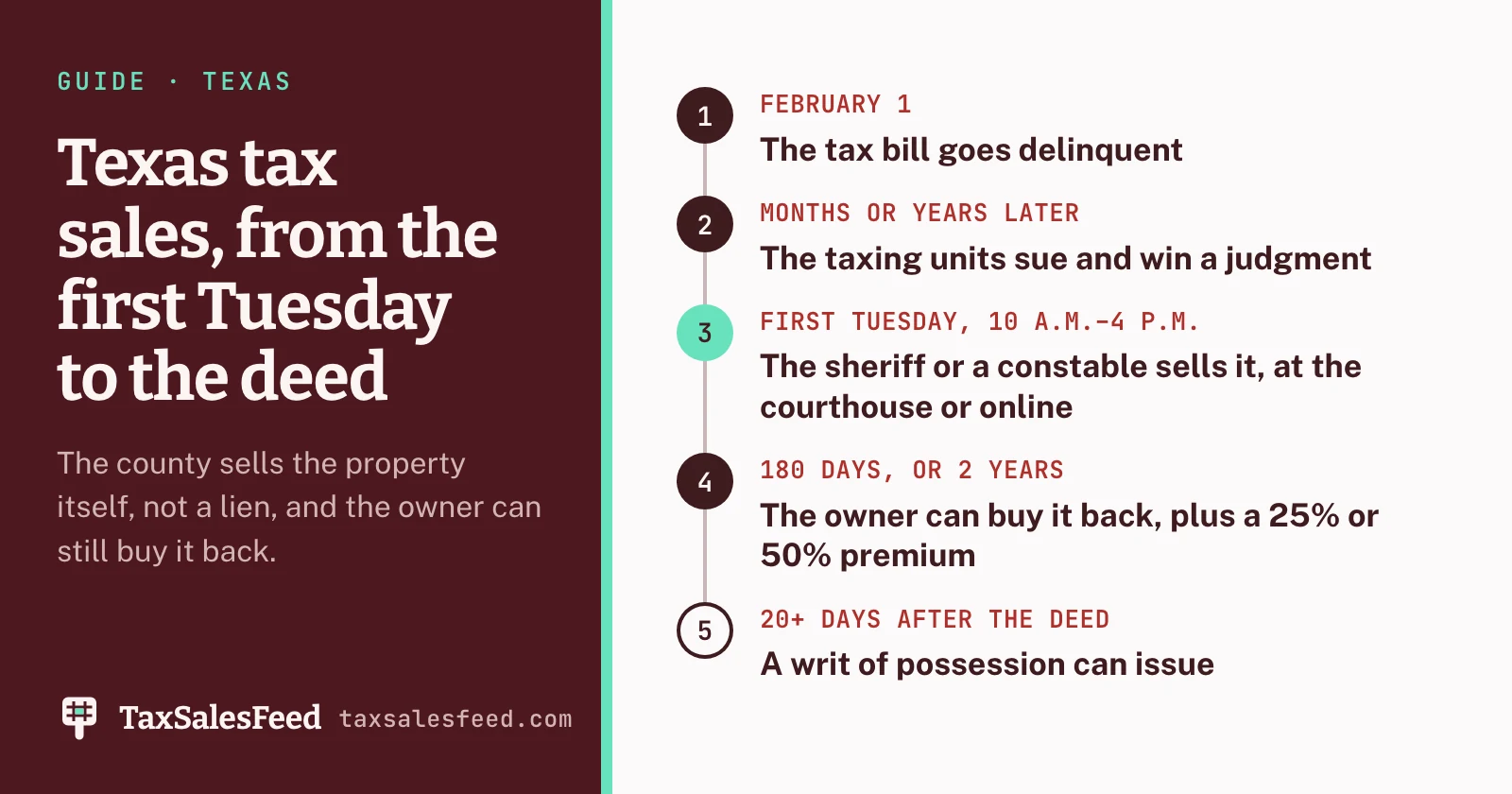
Texas holds tax sales every month, but it does not sell what many buyers expect. There are no tax lien certificates in Texas. Unpaid property tax is collected by a lawsuit, and the property itself is auctioned by the sheriff or a constable on the first Tuesday of the month. The buyer gets a deed at once, and the former owner can still buy the property back for a set time, at a premium the law fixes. That makes Texas a redeemable deed state, and every part of buying here follows from it.
Texas sells the property, not a tax lien
Texas has no tax lien certificate sale. The taxing units sue to foreclose their tax lien, and after judgment the property is sold at a sheriff's or constable's sale, with a right of redemption for the former owner.
Texas property taxes "are delinquent if not paid before February 1 of the year following the year in which imposed" [1]. From that day, "a taxing unit may file suit to foreclose the lien securing payment of the tax, to enforce personal liability for the tax, or both" [2]. The county, the school district, the city and the other units that tax a property usually join one suit, and most suits are brought for them by the private law firms that collect delinquent taxes, which is why those firms publish the sale lists.
When the court rules for the taxing units, property "ordered sold pursuant to foreclosure of a tax lien shall be sold by the officer charged with selling the property" [3]: the county sheriff or a constable. Collin County's constable puts the difference from a lien state plainly: "This is NOT a tax lien certificate. The real property is sold. There is no Tax Lien Certificate Sale in Collin County." [4] How Texas compares with the lien and deed states is set out in tax deed states and tax lien states.
When and where Texas tax sales are held
On the first Tuesday of each month: between 10 a.m. and 4 p.m. at the place the county designates, usually at the courthouse, or in an online auction that closes at 4 p.m. that day.
An in-person sale "must take place between 10 a.m. and 4 p.m. on the first Tuesday of a month or, if the first Tuesday of a month occurs on January 1 or July 4, between 10 a.m. and 4 p.m. on the first Wednesday of the month" [5]. A county can also sell online: its commissioners court "may authorize the officer charged with selling property under this section to conduct a public auction using online bidding and sale" [6], and an online sale "may begin at any time and must conclude at 4 p.m. on the first Tuesday of a month" [7]. El Paso and Nueces counties, for example, sell on their own online sheriff sale sites, El Paso's and Nueces's.
Each sale is advertised "once a week for three consecutive weeks preceding such sale, in some newspaper published in said county" [8], and "The first of said publications shall appear not less than twenty days immediately preceding the day of sale." [9] So each month's list surfaces three to four weeks ahead of its first Tuesday, and a buyer who starts looking the week before has a few days to research it.
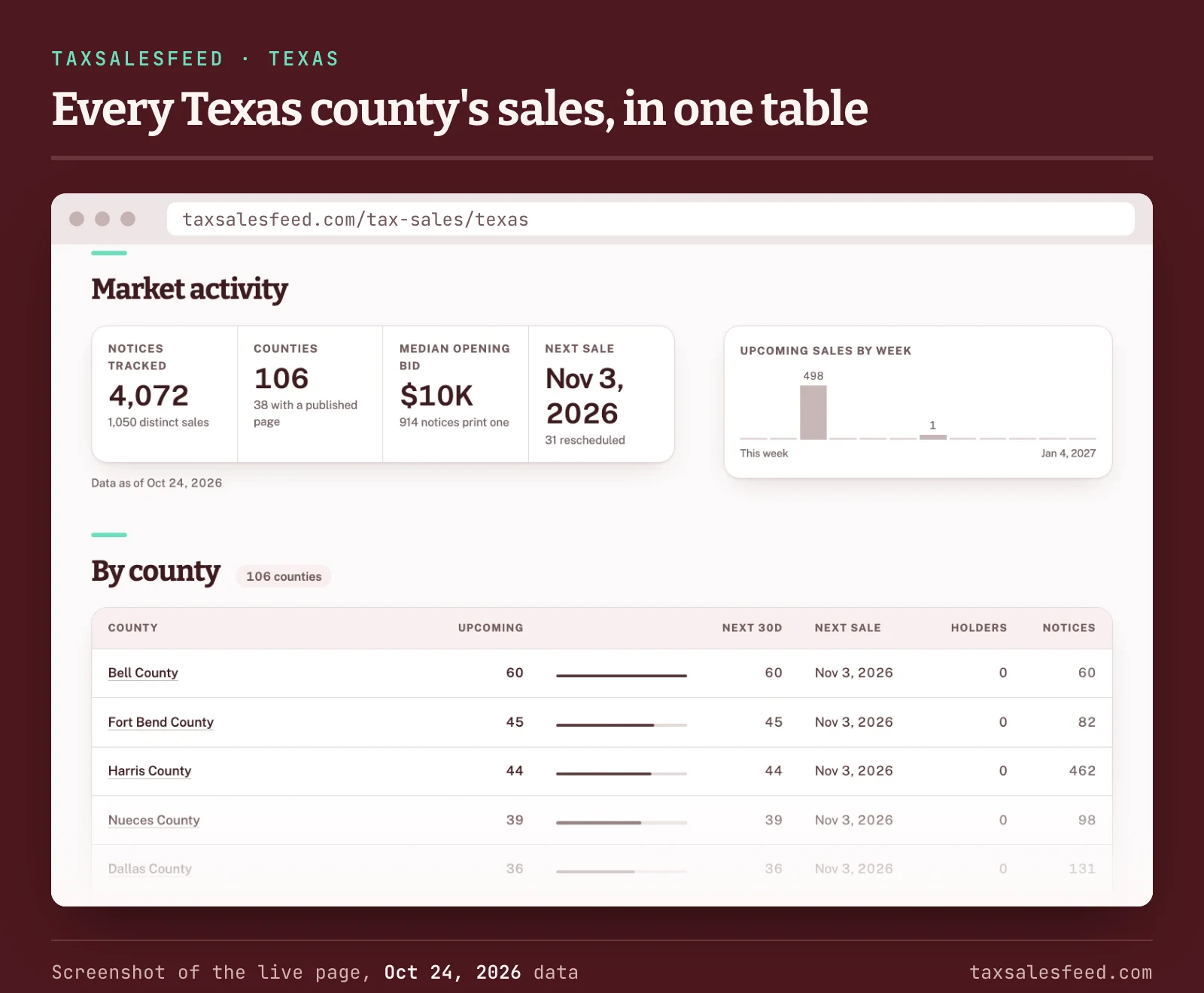
Our records hold 579 upcoming Texas tax sales in 33 counties; the next is in Harris County on November 3, 2026, with 72 parcels. The median opening bid across the Texas sales we hold is $10,000.Where to find Texas tax sale lists
No single official list covers Texas. Each month's properties are posted by the law firms that bring the tax suits, on the county's online auction site where it has one, in the newspaper notice and, in some counties, by the tax office.
- The delinquent-tax law firms. Linebarger Goggan Blair & Sampson, Perdue Brandon Fielder Collins & Mott and McCreary, Veselka, Bragg & Allen each post the sales for the counties and taxing units they represent, as a searchable list or a PDF per county.
- The county's auction site. A county that sells online lists every property, with its opening bid, on its auction site, such as El Paso's and Nueces's above.
- The newspaper notice. Rule 647 requires one for every sale. The Texas Press Association collects members' notices at texaspublicnotices.com.
- The county tax office. Some publish their own; Harris County's tax office posts its tax sale lists.
A list is a snapshot. Properties come off it when the account is paid or the suit is settled, up to the morning of the sale, so the officer's list on the day is the only final one.
We read these sources every morning and merge them county by county.
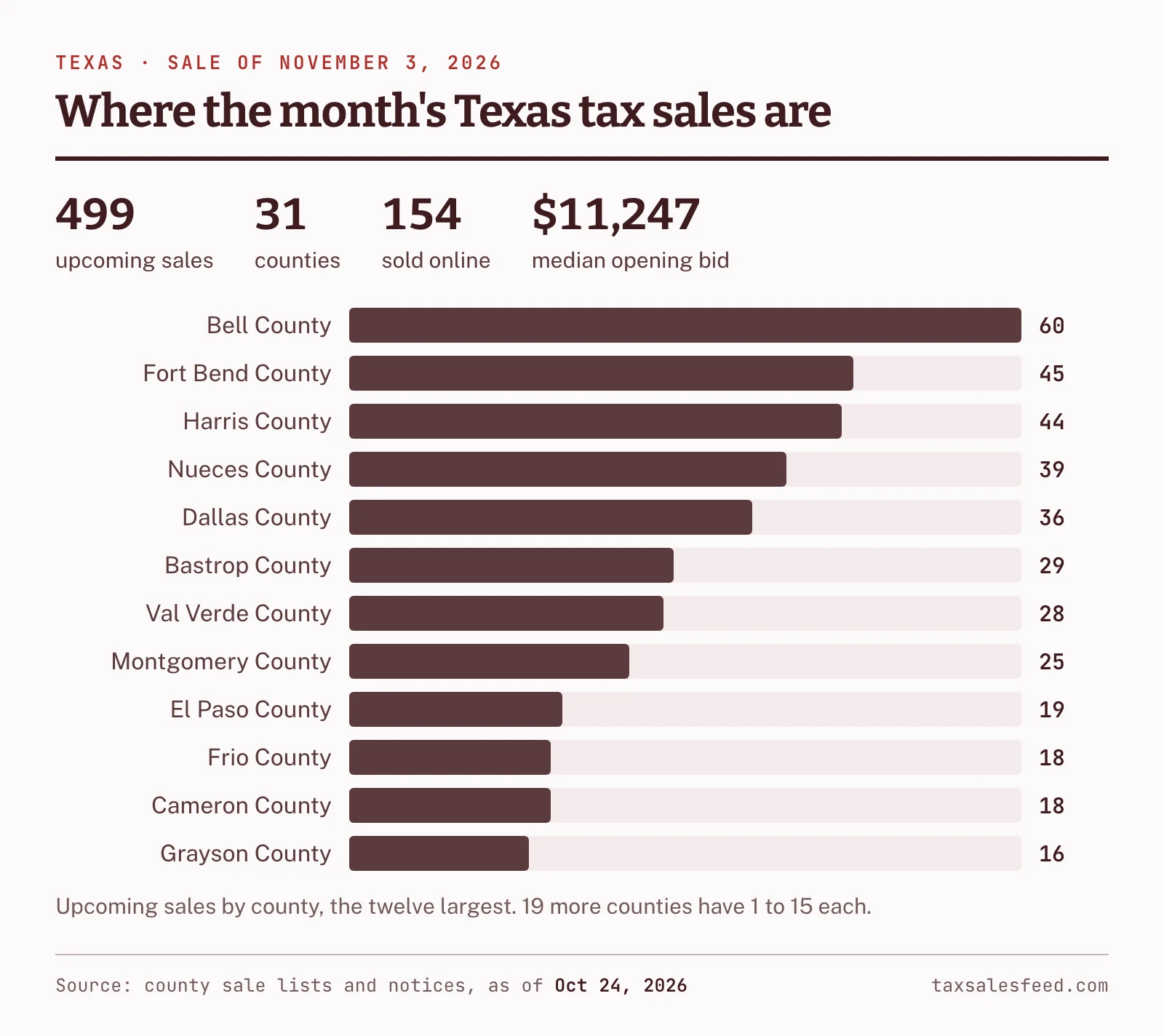
The Texas counties with the most sales coming, from the same data as their pages:
| County | Upcoming | Next sale | Median opening bid |
|---|---|---|---|
| Harris County | 72 | Nov 3, 2026 | $13,245 |
| Bell County | 62 | Nov 3, 2026 | $2,500 |
| Fort Bend County | 45 | Nov 3, 2026 | $17,000 |
| Tarrant County | 42 | Nov 3, 2026 | $10,339 |
| Nueces County | 39 | Nov 3, 2026 | $14,000 |
| Dallas County | 36 | Nov 3, 2026 | $38,994 |
| Bastrop County | 29 | Nov 3, 2026 | $9,900 |
| Val Verde County | 28 | Nov 3, 2026 | $12,284 |
| Montgomery County | 25 | Nov 3, 2026 | $12,559 |
| Angelina County | 21 | Dec 1, 2026 | $2,024 |
| El Paso County | 19 | Nov 3, 2026 | — |
| Frio County | 18 | Nov 3, 2026 | $9,530 |
How bidding works
Bidding must reach the lesser of the amount due under the judgment or the property's adjudged value. The highest bid at or above that wins; with no such bid, the property is struck off to the taxing unit.
Before the sale, "The officer shall calculate the total amount due under the judgment, including all taxes, penalties, and interest, plus any other amount awarded by the judgment, court costs, and the costs of the sale." [10] That total, or the property's adjudged value if lower, is the floor: "If a bid sufficient to pay the lesser of the amount calculated under Subsection (b) or the adjudged value is not received, the taxing unit that requested the order of sale may terminate the sale." [11] The lists print it as the minimum or opening bid, often beside the adjudged value and the cause number of the suit.
The officer's terms of sale, in the notice or on the auction site, say how and when the price is paid, and an online sale has its own registration rules. One Texas rule applies everywhere: "The officer may not execute or deliver a deed to the purchaser of the property unless the purchaser exhibits to the officer an unexpired written statement" [12] from the county tax assessor-collector, showing that the buyer owes no delinquent taxes to the county or to the school districts and cities in it. Ask for it before the sale: "On the written request of any person, a county assessor-collector shall issue a written statement stating whether there are any delinquent taxes owed by the person to that county" [13].
The redemption period: 180 days or two years
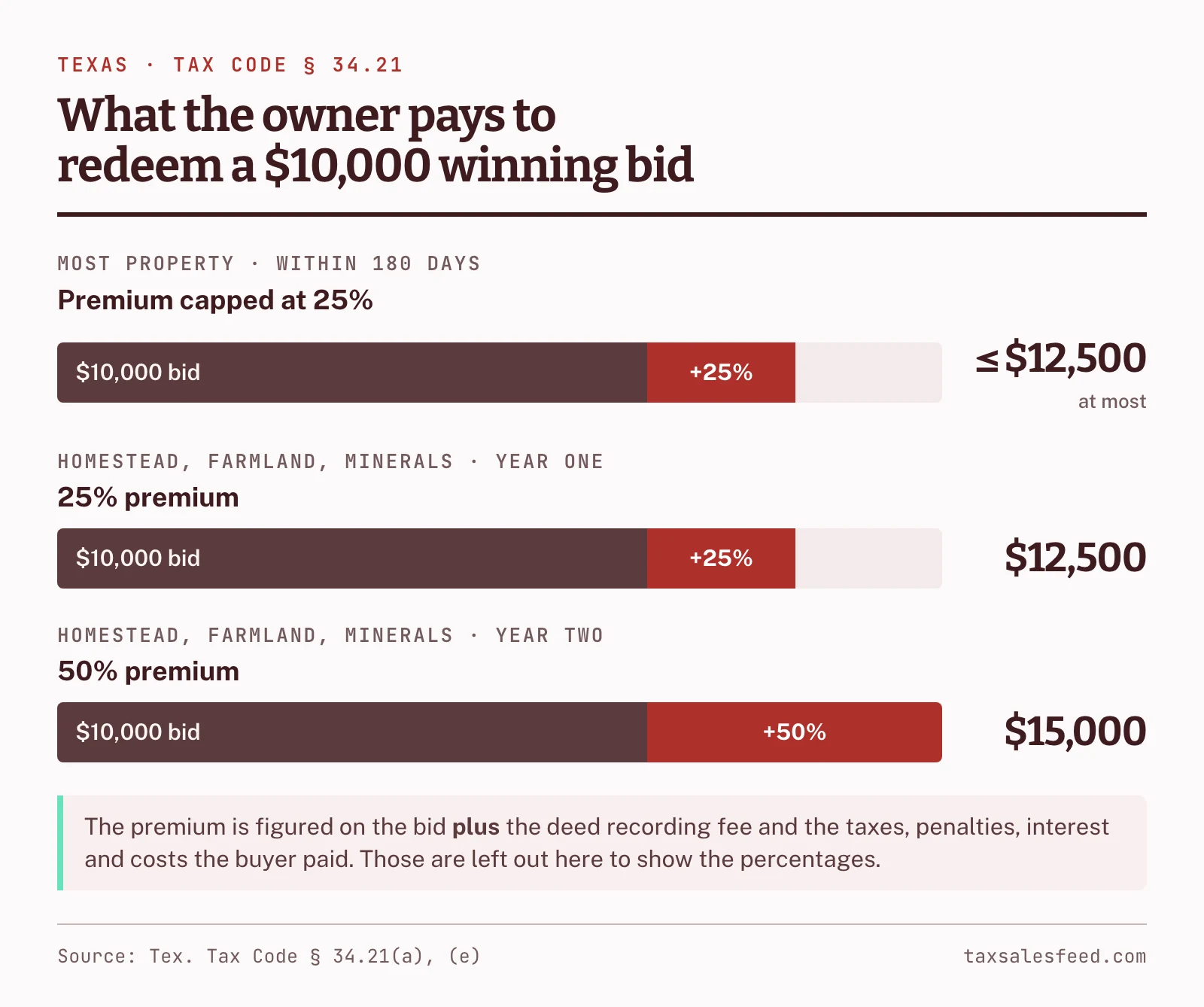
After the sale, the former owner can buy the property back: within 180 days for most property, or two years for a homestead, land designated for agricultural use or a mineral interest, by repaying the buyer's money plus a premium.
The owner of a homestead, farmland or a mineral interest "may redeem the property on or before the second anniversary of the date on which the purchaser's deed is filed for record" [14], "by paying the purchaser the amount the purchaser bid for the property, the amount of the deed recording fee, and the amount paid by the purchaser as taxes, penalties, interest, and costs on the property" [15], plus "a redemption premium of 25 percent of the aggregate total if the property is redeemed during the first year of the redemption period or 50 percent of the aggregate total if the property is redeemed during the second year" [16].
For everything else, "the owner's right of redemption may be exercised not later than the 180th day following the date on which the purchaser's or taxing unit's deed is filed for record" [17], and "the redemption premium payable by the owner to a purchaser other than a taxing unit may not exceed 25 percent" [18].
So a Texas deed is conditional until the period ends. A redemption returns the money with the premium, and the costs repaid include "the amount reasonably spent by the purchaser for maintaining, preserving, and safekeeping the property" [19], but repairs count only when they were "required by a local ordinance or building code or by a lease of the property in effect on the date of the sale" [20]. Money spent improving the property beyond that is at risk until the period ends. Possession has its own clock: the judgment provides for "a writ of possession to the purchaser at the sale or to the purchaser's assigns no sooner than 20 days following the date on which the purchaser's deed from the sheriff or constable is filed of record" [21].
What the deed gives you, and what survives it
The deed passes the interest the defendants in the tax suit owned, subject to redemption, to restrictive covenants and easements recorded before the tax year began, and to a covenant lien the judgment did not extinguish. It can be attacked only for fraud.
"The deed vests good and perfect title in the purchaser or the purchaser's assigns to the interest owned by the defendant in the property subject to the foreclosure" [22]. The words to notice are "owned by the defendant": the deed carries what the people sued owned, so the judgment's list of defendants is part of the title. Three things survive it:
- Deed restrictions: "the terms of a recorded restrictive covenant running with the land that was recorded before January 1 of the year in which the tax lien on the property arose" [23].
- An association's lien: "a recorded lien that arose under that restrictive covenant that was not extinguished in the judgment foreclosing the tax lien" [24]. Whether past-due owners' association dues follow the property depends on whether the judgment dealt with them.
- Easements: "each valid easement of record as of the date of the sale that was recorded before January 1 of the year the tax lien arose" [25].
Once issued, "The deed may be impeached only for fraud." [26] That protects the sale, not the buyer's resale plans: whether a title company will insure the property, and on what conditions, is a question to ask before you bid, not after.
Struck-off property and resales
A property nobody bids enough for is struck off to the taxing unit, which can resell it later, by public or private sale and for any amount, still subject to the former owner's redemption.
Without a sufficient bid, "the officer making the sale shall bid the property off to the taxing unit that requested the order of sale" [27]. The taxing unit then holds it, and "the taxing unit may sell the property at any time by public or private sale" [28]. Property it asks the sheriff or a constable to resell "may be sold for any amount" [29], and "The sale is subject to any right of redemption of the former owner." [30] A resale by the sheriff or a constable is a public sale like the first, and because it may go for any amount, struck-off property can sell well below its judgment, usually for the same reasons nobody bid the first time.
Excess proceeds
When a property sells for more than the judgment, the excess is held for the people who had an interest in it. "A person, including a taxing unit and the Title IV-D agency, may file a petition in the court that ordered the seizure or sale setting forth a claim to the excess proceeds." [31] "The petition must be filed before the second anniversary of the date of the sale of the property." [32] Taxing units and lienholders come first, then "each former owner of the property, as the interest of each may appear" [33]. Tax sale surplus after Tyler v. Hennepin County covers claiming in Texas and other states.
Before you bid in Texas
- Read the judgment. The cause number on the list leads to the suit in the district court's records: who was sued, the amount, the adjudged value.
- Look the property up with the county's appraisal district, then look at the property itself. A list gives an account number and a legal description, and only the legal description says exactly which lot is being sold.
- Check whether it was a homestead or farmland. Two years of redemption, and a 50% premium in the second, change what the purchase is.
- Search the county records for deed restrictions and association liens the deed will not clear, and ask a title company whether it will insure the deed.
- Get your statement from the tax assessor-collector, and register for the online sale in time if the county sells online.
- Check the list on the morning of the sale. Properties are withdrawn until the last minute.
Sources
- [1]Tex. Tax Code § 31.02(a) — Texas Legislature (Texas Legislative Council)“taxes are due on receipt of the tax bill and are delinquent if not paid before February 1 of the year following the year in which imposed”
- [2]Tex. Tax Code § 33.41(a) — Texas Legislature (Texas Legislative Council)“At any time after its tax on property becomes delinquent, a taxing unit may file suit to foreclose the lien securing payment of the tax, to enforce personal liability for the tax, or both.”
- [3]Tex. Tax Code § 34.01(a) — Texas Legislature (Texas Legislative Council)“ordered sold pursuant to foreclosure of a tax lien shall be sold by the officer charged with selling the property”
- [4]Collin County Constable Precinct 1, Sale Information — Collin County, Texas“This is NOT a tax lien certificate. The real property is sold. There is no Tax Lien Certificate Sale in Collin County.”
- [5]Tex. Tax Code § 34.01(r-1) — Texas Legislature (Texas Legislative Council)“must take place between 10 a.m. and 4 p.m. on the first Tuesday of a month or, if the first Tuesday of a month occurs on January 1 or July 4, between 10 a.m. and 4 p.m. on the first Wednesday of the month”
- [6]Tex. Tax Code § 34.01(a-1) — Texas Legislature (Texas Legislative Council)“The commissioners court of a county by official action may authorize the officer charged with selling property under this section to conduct a public auction using online bidding and sale.”
- [7]Tex. Tax Code § 34.01(r-2) — Texas Legislature (Texas Legislative Council)“may begin at any time and must conclude at 4 p.m. on the first Tuesday of a month”
- [8]Tex. R. Civ. P. 647 — Supreme Court of Texas (txcourts.gov)“shall be advertised by the officer by having the notice thereof published in the English language once a week for three consecutive weeks preceding such sale, in some newspaper published in said county”
- [9]Tex. R. Civ. P. 647 — Supreme Court of Texas (txcourts.gov)“The first of said publications shall appear not less than twenty days immediately preceding the day of sale.”
- [10]Tex. Tax Code § 34.01(b) — Texas Legislature (Texas Legislative Council)“The officer shall calculate the total amount due under the judgment, including all taxes, penalties, and interest, plus any other amount awarded by the judgment, court costs, and the costs of the sale.”
- [11]Tex. Tax Code § 34.01(j) — Texas Legislature (Texas Legislative Council)“If a bid sufficient to pay the lesser of the amount calculated under Subsection (b) or the adjudged value is not received, the taxing unit that requested the order of sale may terminate the sale.”
- [12]Tex. Tax Code § 34.015(b) — Texas Legislature (Texas Legislative Council)“The officer may not execute or deliver a deed to the purchaser of the property unless the purchaser exhibits to the officer an unexpired written statement”
- [13]Tex. Tax Code § 34.015(c) — Texas Legislature (Texas Legislative Council)“On the written request of any person, a county assessor-collector shall issue a written statement stating whether there are any delinquent taxes owed by the person to that county”
- [14]Tex. Tax Code § 34.21(a) — Texas Legislature (Texas Legislative Council)“may redeem the property on or before the second anniversary of the date on which the purchaser's deed is filed for record”
- [15]Tex. Tax Code § 34.21(a) — Texas Legislature (Texas Legislative Council)“by paying the purchaser the amount the purchaser bid for the property, the amount of the deed recording fee, and the amount paid by the purchaser as taxes, penalties, interest, and costs on the property”
- [17]Tex. Tax Code § 34.21(e) — Texas Legislature (Texas Legislative Council)“the owner's right of redemption may be exercised not later than the 180th day following the date on which the purchaser's or taxing unit's deed is filed for record”
- [19]Tex. Tax Code § 34.21(g)(2) — Texas Legislature (Texas Legislative Council)“the amount reasonably spent by the purchaser for maintaining, preserving, and safekeeping the property”
- [20]Tex. Tax Code § 34.21(g)(2) — Texas Legislature (Texas Legislative Council)“repairs or improvements required by a local ordinance or building code or by a lease of the property in effect on the date of the sale”
- [21]Tex. Tax Code § 33.51(a) — Texas Legislature (Texas Legislative Council)“a writ of possession to the purchaser at the sale or to the purchaser's assigns no sooner than 20 days following the date on which the purchaser's deed from the sheriff or constable is filed of record”
- [22]Tex. Tax Code § 34.01(n) — Texas Legislature (Texas Legislative Council)“The deed vests good and perfect title in the purchaser or the purchaser's assigns to the interest owned by the defendant in the property subject to the foreclosure”
- [23]Tex. Tax Code § 34.01(n) — Texas Legislature (Texas Legislative Council)“the terms of a recorded restrictive covenant running with the land that was recorded before January 1 of the year in which the tax lien on the property arose”
- [24]Tex. Tax Code § 34.01(n) — Texas Legislature (Texas Legislative Council)“a recorded lien that arose under that restrictive covenant that was not extinguished in the judgment foreclosing the tax lien”
- [25]Tex. Tax Code § 34.01(n) — Texas Legislature (Texas Legislative Council)“each valid easement of record as of the date of the sale that was recorded before January 1 of the year the tax lien arose”
- [26]Tex. Tax Code § 34.01(n) — Texas Legislature (Texas Legislative Council)“The deed may be impeached only for fraud.”
- [27]Tex. Tax Code § 34.01(j) — Texas Legislature (Texas Legislative Council)“the officer making the sale shall bid the property off to the taxing unit that requested the order of sale”
- [28]Tex. Tax Code § 34.05(a) — Texas Legislature (Texas Legislative Council)“the taxing unit may sell the property at any time by public or private sale”
- [29]Tex. Tax Code § 34.05(b) — Texas Legislature (Texas Legislative Council)“may be sold for any amount”
- [30]Tex. Tax Code § 34.05(a) — Texas Legislature (Texas Legislative Council)“The sale is subject to any right of redemption of the former owner.”
- [31]Tex. Tax Code § 34.04(a) — Texas Legislature (Texas Legislative Council)“A person, including a taxing unit and the Title IV-D agency, may file a petition in the court that ordered the seizure or sale setting forth a claim to the excess proceeds.”
- [32]Tex. Tax Code § 34.04(a) — Texas Legislature (Texas Legislative Council)“The petition must be filed before the second anniversary of the date of the sale of the property.”
- [33]Tex. Tax Code § 34.04(c)(5) — Texas Legislature (Texas Legislative Council)“to each former owner of the property, as the interest of each may appear”
Questions
Does Texas sell tax lien certificates?
No. Texas collects unpaid property tax by suing to foreclose the tax lien, and the property itself is sold at a sheriff's or constable's sale. The buyer receives a deed, which the former owner can redeem for 180 days, or two years for a homestead, land designated for agricultural use or a mineral interest.
When are tax sales held in Texas?
On the first Tuesday of the month. An in-person sale must take place between 10 a.m. and 4 p.m., at the place the county designates, and moves to the first Wednesday when the first Tuesday falls on January 1 or July 4. A county whose commissioners court has authorized online sales may open bidding earlier, but the auction must close at 4 p.m. on the first Tuesday.
How long is the redemption period after a Texas tax sale?
180 days from the day the buyer's deed is recorded for most property, with a premium of no more than 25%. For a residence homestead, land designated for agricultural use or a mineral interest it is two years, with a 25% premium in the first year and 50% in the second, on top of the bid, the recording fee and the taxes and costs the buyer paid.
What is the minimum bid at a Texas tax sale?
The lesser of the total due under the judgment (taxes, penalties, interest, court costs and the costs of the sale) or the property's adjudged value. If no one bids that much, the taxing unit can end the sale, or the property is struck off to the taxing unit, which can resell it later.
Where can I find a list of Texas tax sale properties?
From the law firms that collect delinquent taxes for the taxing units, such as Linebarger Goggan Blair & Sampson, Perdue Brandon Fielder Collins & Mott and McCreary, Veselka, Bragg & Allen, which post each month's sale lists; from the county's online auction site; from the newspaper notice, published once a week for three weeks before the sale; and from some county tax offices, such as Harris County's. TaxSalesFeed reads these sources every morning and merges them by county.
Do you get clear title at a Texas tax sale?
The deed vests title to the interest the defendants in the tax suit owned, subject to the former owner's right of redemption, restrictive covenants and easements recorded before the tax year began, and a covenant lien the judgment did not extinguish. It can be impeached only for fraud. Anyone the suit did not name was not a defendant, so read the judgment, and ask a title company before the sale whether it will insure the deed.
Where next
- Florida tax deed sale calendarEvery county's upcoming sale days, with parcel counts and start times.
- Tax sale guidesHow to buy at a tax sale, which states sell deeds or liens, and Florida, Texas, Georgia, Pennsylvania and California step by step.
- Tax certificate holdersThe funds applying for tax deeds, with every county they are active in.
- Tax sale glossaryTax certificate, tax deed application, opening bid, redemption — every term a notice uses.
General information about Texas procedure, not legal advice. Each county's sheriff or constable sells on terms the county sets, and statutes change; confirm with the officer or the taxing units' attorneys before bidding.