Guide 15
How New Jersey tax lien sales work, from bid to foreclosure
13 min read · updated November 16, 2026
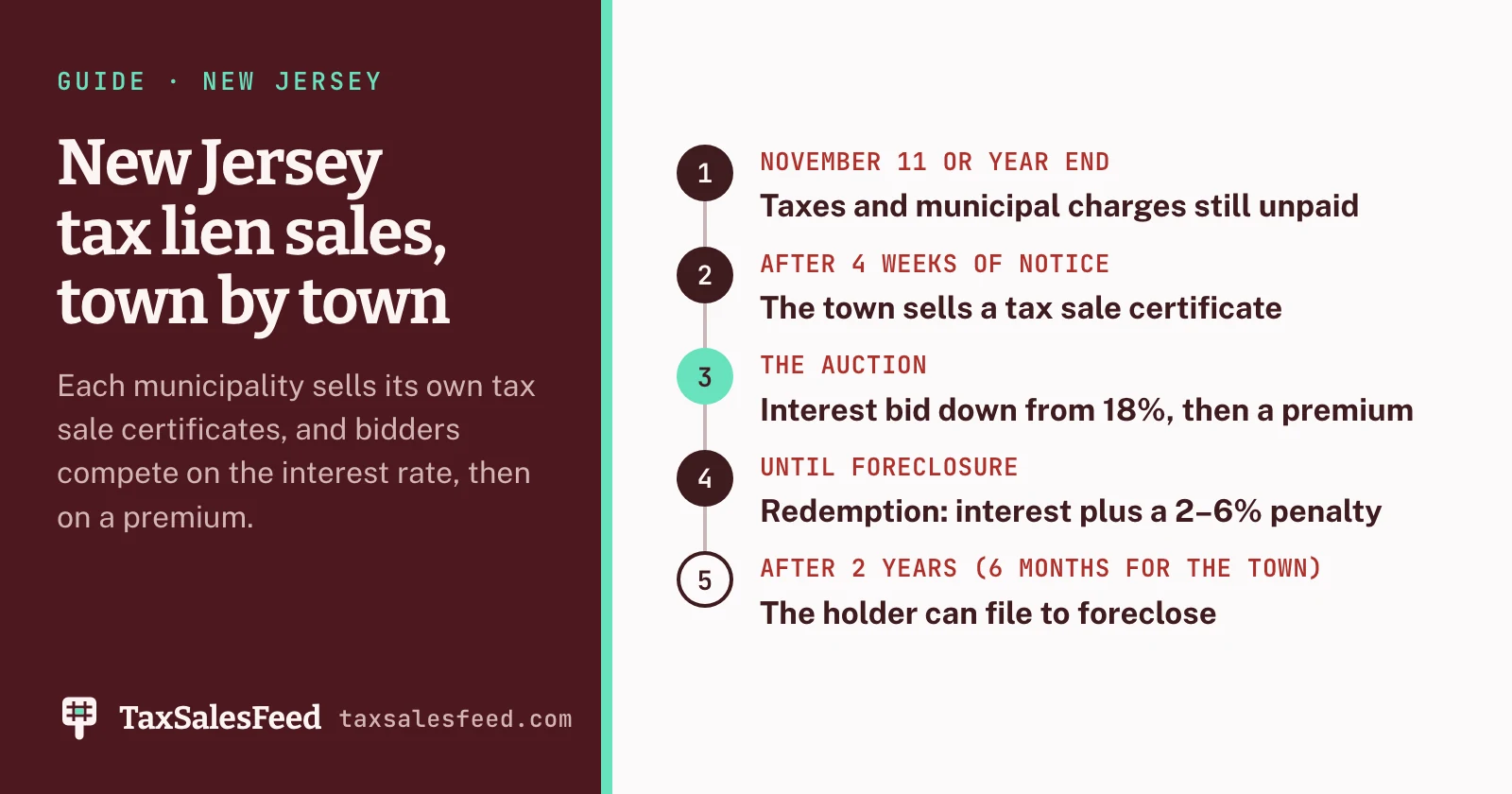
New Jersey has no county tax sale. Each of its towns, boroughs, townships and cities holds its own, run by the local tax collector, and what it sells is not the property but a lien on it: a tax sale certificate that earns interest until the owner pays. That makes New Jersey a pure tax lien state, and its auctions are contests over the return: bidders give up interest, and on many liens then pay cash premiums, for the right to hold a certificate. This guide covers how New Jersey tax lien sales work, from the bid to foreclosure, and where this season's sales are.
New Jersey tax lien certificates: a lien, not the property
A New Jersey tax sale sells a tax sale certificate: a lien for the unpaid taxes and municipal charges, earning interest at the rate the winning bidder accepted. The owner keeps the property and can pay off the certificate until a court forecloses the right to redeem.
The state's Division of Local Government Services says it plainly: "At the tax sale, title to the delinquent property itself is not sold. What is sold is a tax sale certificate, a lien on the property." [1] The lien covers more than property tax. In Vineland's words, "A Tax Sale is the enforcement of collections against a property by placing a lien against the property for all outstanding municipal charges due at the end of the calendar year, which is December 31." [2] Water, sewer and utility charges, special assessments and added assessments go into the same certificate.
What the buyer does not get is the house. "The sale of a tax lien on a property does not give the purchaser of the certificate any rights of ownership or to trespass on the property. This is acquired by the foreclosure process." [3] Hopewell Township's collector goes further: "Lien holders have no legal right to exercise rights of ownership, seek entry, inspect property, or act as landlord." [4] How New Jersey compares with the deed states is set out in tax deed states and tax lien states.
When NJ tax sales are held
Every municipality with delinquent taxes or charges must hold at least one sale a year. Many sell the current year's unpaid charges at an accelerated sale that cannot be completed before the last month of the fiscal year, which is why so many New Jersey tax sales fall in December.
New Jersey law requires each municipality "to hold at least one tax sale per year, if the municipality has delinquent property taxes and/or municipal charges" [5]. The Tax Sale Law gives it two ways to do it. Charges still unpaid when the year closes go to a standard sale: the collector "shall enforce the lien by selling the property in the manner set forth in this article by holding a standard tax sale in the following fiscal year." [6] Or the town can sell the current year's arrears at once, "by conducting an accelerated tax sale by selling the property in the manner set forth in this article, provided that the sale is conducted and completed no earlier than in the last month of the fiscal year." [7]
For the many towns on a calendar fiscal year, that last month is December. Stafford Township's rule is typical of an accelerated-sale town: "Any tax delinquency for the current year remaining delinquent on November 11th will be subject to tax sale." [8] So every autumn the sale lists appear in November and the sales crowd into the first half of December, alongside towns that sell in spring or summer on the standard schedule.
The notice comes first. "New Jersey State Tax Sale Law requires the Tax Collector to create the Tax Sale list 50 days prior to the sale." [9] Then "Copies of the Tax Sale Notice must be advertised one time in each of the four weeks preceding the Tax Sale." [10] Owners pay throughout those weeks, so a list shrinks until the morning of the sale.
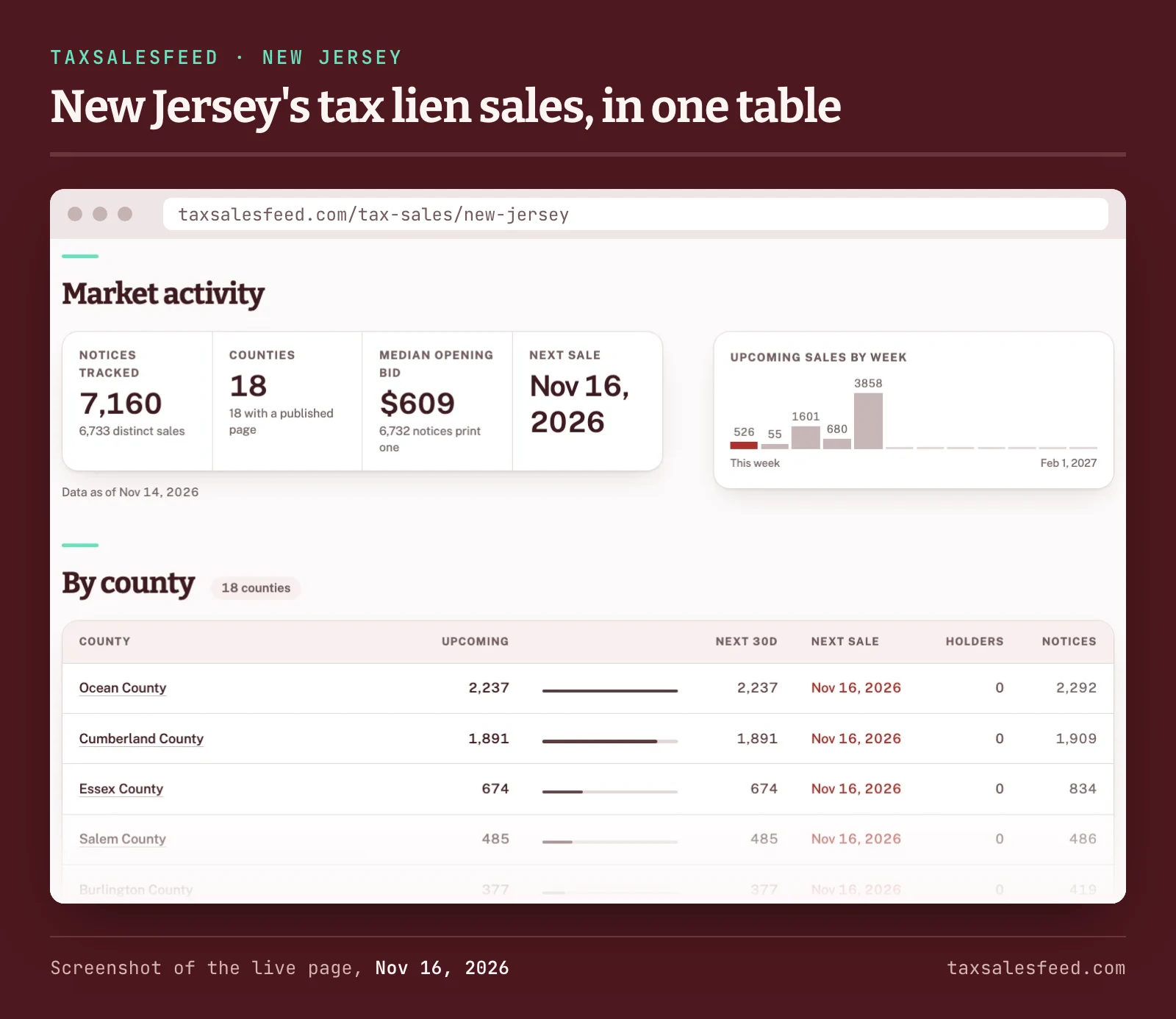
Our records hold 27,128 upcoming New Jersey tax sales in 18 counties; the next is in Mercer County on November 21, 2026, with 7,922 parcels. The median opening bid across the New Jersey sales we hold is $799.Where to find New Jersey tax sale lists
From each municipality's tax collector, whose sale notice runs for four weeks, and, for towns that sell online, from the sale site, which must show every line item free. No state office publishes one list for all of New Jersey.
- The tax collector. Every sale is the collector's, and the notice lists each property and the amount due. Towns with a website usually post it there too.
- The online sale site. Many towns now sell online, and the state's rules for online sales say "The tax lien sale line items shall be publicly available on the vendor’s website free-of-charge without requiring registration or membership prior to viewing." [11] Each town that sells online has its own sale site, which its tax collector's page links.
- The newspaper. The notice also runs in the town's official newspaper for the four weeks before the sale.
The difficulty is not access but scattering: several hundred municipalities, each with its own site, list and date. We read the towns' sale sites every morning and put every coming sale in one list, county by county, with the amount due on each lien.
The New Jersey counties with the most sales coming, from the same data as their pages:
| County | Upcoming | Next sale | Median opening bid |
|---|---|---|---|
| Mercer County | 7,922 | Nov 21, 2026 | $897 |
| Atlantic County | 6,443 | Nov 21, 2026 | $732 |
| Cumberland County | 2,476 | Nov 21, 2026 | $808 |
| Essex County | 2,280 | Nov 21, 2026 | $694 |
| Ocean County | 1,897 | Nov 21, 2026 | $537 |
| Monmouth County | 1,522 | Nov 21, 2026 | $2,247 |
| Middlesex County | 1,264 | Nov 21, 2026 | $431 |
| Hudson County | 903 | Nov 21, 2026 | $1,984 |
| Passaic County | 673 | Dec 15, 2026 | $3,405 |
| Burlington County | 610 | Nov 21, 2026 | $676 |
| Salem County | 485 | Nov 21, 2026 | $799 |
| Morris County | 184 | Nov 21, 2026 | $478 |
How the NJ tax lien auction works: 18% down to a premium
Bidders compete on the interest rate the owner will pay, starting at 18% a year and going down. At 0%, or any rate under 1%, they bid a cash premium instead, and the highest premium wins. A lien no one bids on goes to the municipality at 18%.
The rule is one sentence of the Tax Sale Law: "The sale shall be made in fee to such person as will purchase the property, subject to redemption at the lowest rate of interest, but in no case in excess of 18% per annum." [12] Vineland's collector describes how that plays out on the day: "Bidding at the sale begins when a potential purchaser (bidder) offers an initial bid rate of return (interest rate), usually the maximum bid of 18%. If there is competitive bidding, the rate of the bid goes downward until it reaches 0%." [13]
Below that, the bidding turns to cash. The statute lets a bidder at a rate "less than 1%, or at no interest" offer "a premium over and above the amount of taxes, assessments or other charges", and the lien is "sold to the bidder who offers to pay the amount of such taxes, assessments or charges, plus the highest amount of premium." [14] The premium "can go as high as any one bidder is willing to pay." [15] At the other end, "If there are no bidders on a parcel for sale, the collector must strike it off in the name of the municipality at a redemption interest rate of 18%." [16]
Anyone may bid except the owner: "anyone who is not the owner of the property in the Tax Sale shall be allowed to bid for a lien against the property." [17] The winning rate is what the certificate earns, so "Tax sale certificates can earn interest of up to 18 per cent, depending on the winning percentage bid at the auction." [18]
Online sales
Many towns now sell online (we read the online sale sites of more than 275 New Jersey municipalities), under state rules, N.J.A.C. 5:33-1.1, that the Division of Local Government Services set out in 2018. Register on the sale site well before the day, because "Prior to placing a bid, each bidder must post a forfeitable deposit of a percentage or amount set by the tax collector" [19]. The collector chooses direct or proxy bidding; in a proxy sale "participants in a proxy bid auction enter their lowest acceptable interest rate or highest acceptable premium for an item" [20], and the system bids for them down to that limit.
Three rules shape strategy. "All liens shall be auctioned individually, such that a bid will be placed on each lien with a winning bidder determined for each lien; bulk sale of liens is prohibited." [21] "Bid amounts shall not be visible to the public or to the municipality while the auction is in progress." [22] And "Successful bidders must make full payment for liens within 24 hours after bidding closes." [23] On the sites in our records, bidding opens about a month before the sale day and closes on it.
After the sale, "the Tax Collector will issue Tax Sale Certificates to the proper bidders within 10 days of the close of sale." [24] Record it: to protect your interest, the state advises, "it should be recorded in the Deed Room at the County Clerk’s Office within 90 days of the sale." [25]
What an owner pays to redeem
The certificate amount, interest at the winning rate, any later taxes the holder paid with their interest, allowed search and recording costs, and a penalty of 2%, 4% or 6% of the certificate, depending on its size. Redemption is paid to the tax collector, never to the holder.
Not everyone can redeem: "the only persons able to redeem that lien are the owner, his/her heirs, the holder of a prior outstanding Tax Lien Certificate, mortgage company, or legal occupant of property sold at a Tax Sale." [26] And "Redemption can only be made through the Collector." [27] Hopewell Township lists what the holder then receives: "The lien holder is entitled to receive his original investment, the interest on the certificate, any subsequent taxes paid plus the interest accrued on them, the amount legally allowed by the state for search and recording (if recorded), and a redemption penalty." [28]
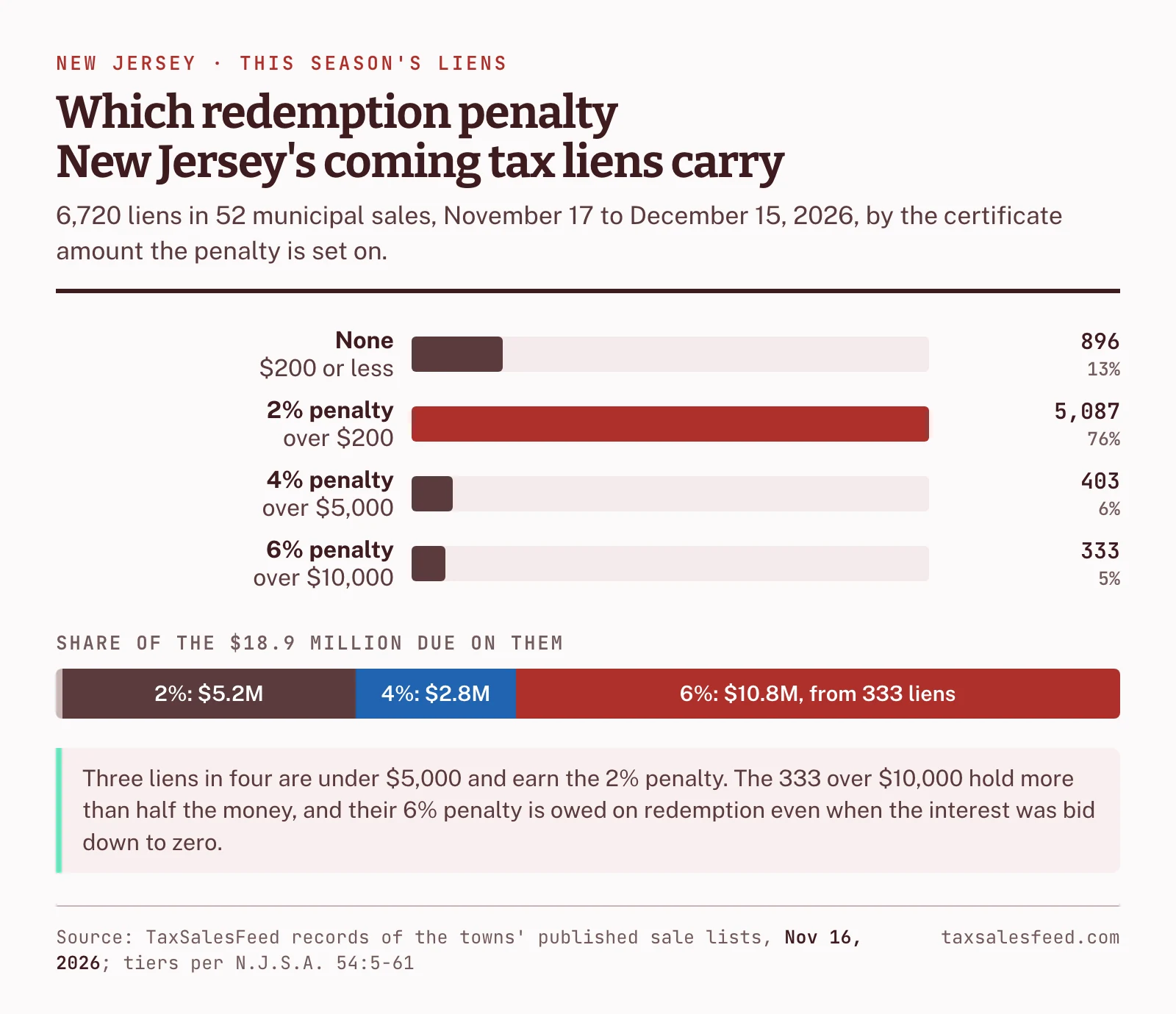
The penalty is set by the certificate's size, not the bid. Over $200, the holder collects "an additional sum equal to two per cent of the amount so paid for the tax title certificate." [29] Then "When the tax title certificate amount shall exceed the sum of $5,000, such additional sum shall be equal to 4% of such amount paid; and when the tax title certificate amount exceeds $10,000, such additional sum shall be equal to 6% of such amount paid." [30] The state's summary: "the certificate earns a redemption penalty at the rate of 2, 4, or 6 percent, depending on the amount of the original tax sale certificate" [31]. It comes only with a redemption: "This penalty is assessed at time of redemption only - a foreclosure does not receive this penalty." [32]
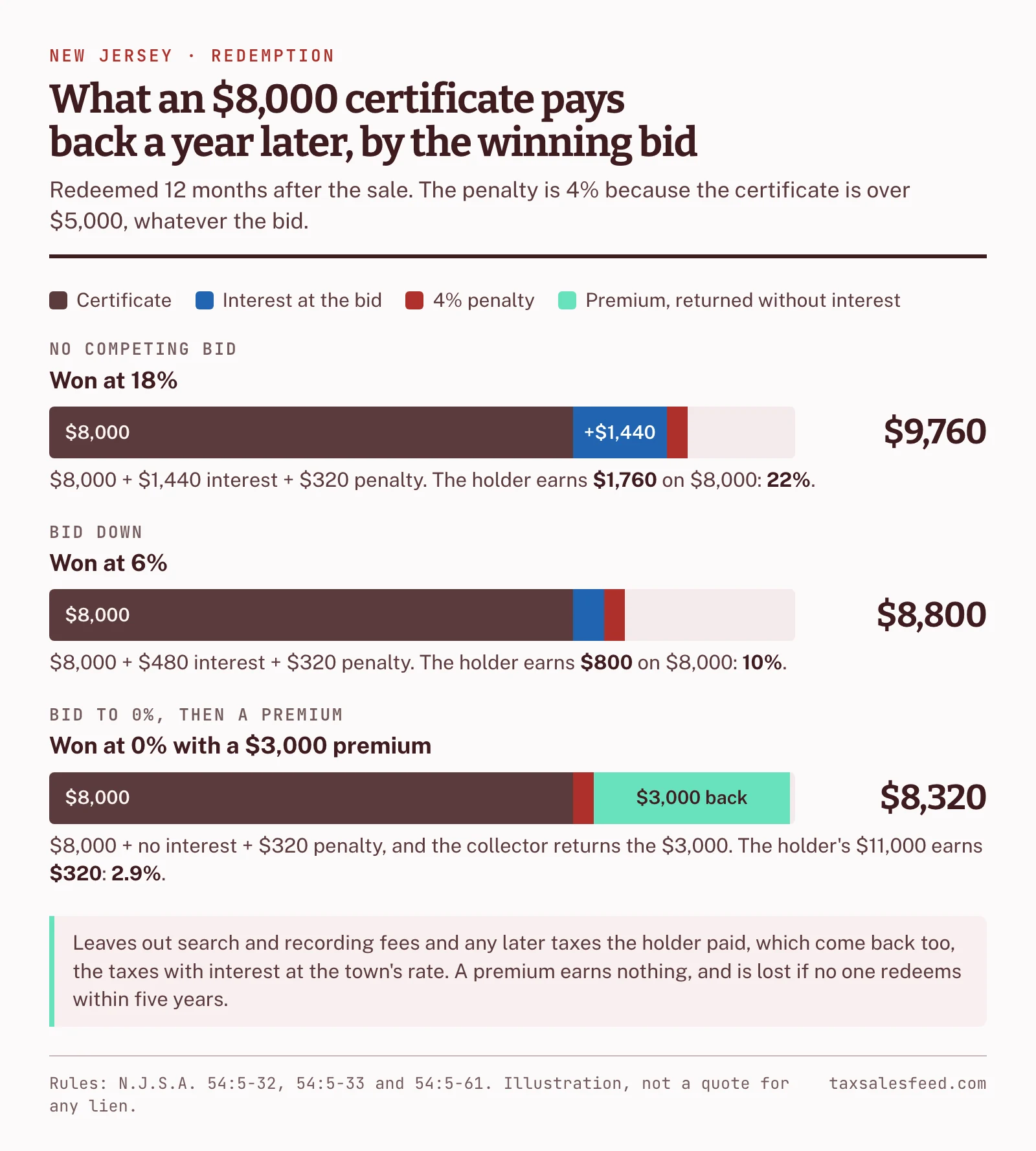
The penalty is why a bid of zero can still pay. On a certificate over $5,000 the holder still collects 4% on redemption even at a 0% bid, so a bidder can accept no interest at all and still be paid something. The certificate amount itself already carries the town's own interest on the arrears: "Delinquency on a property may accrue interest at up to 8 per cent for the first $1,500 due, and 18 per cent for any amount over $1,500." [33]
Premiums: held for five years, earning nothing
A premium earns no interest. The tax collector holds it and returns it if the owner redeems within five years of the sale, or if a sheriff's sale is scheduled in that time; otherwise it becomes the town's money.
"Any premium payment shall be held by the collector and returned to the purchaser of the fee if and when redemption is made." [34] It is dead money while it sits there: "No interest accrues on the premium to the benefit of the buyer of the tax sale certificate." [35] And it is lost if the owner never redeems: "If redemption is not made within five years from date of sale the premium payment shall be turned over to the treasurer of the municipality and become a part of the funds of the municipality." [36]
Since 2024 there is one more way to get it back: where the property has to go to a sheriff's sale, "the premium shall be refunded to the lienholder if, within five years of the date of the tax sale, the writ of execution is sent to the county sheriff's office to schedule the judicial sale or Internet auction." [37] A holder who forecloses without a sheriff's sale, and does not get the writ out in five years, leaves the premium with the town.
Subsequent taxes
Taxes keep coming after the sale, and the holder gets first claim to pay them. "After the Tax Sale Certificate has been issued, the lien holder has the right to pay any delinquent municipal charges that have not gone to sale. These are known as subsequent payments." [38] They are added to the certificate, and they earn the town's rate, not the rate the holder bid: "Subsequent taxes paid by the lien holder earn interest at the rate set by the municipality." [39] That is part of why bidders pay premiums: a certificate bid to 0% still lets its holder pay the later taxes and earn the town's rate on them.
Skipping them is a risk. "Bidders have the option to pay these subsequent taxes; if they are not paid, a tax sale certificate will be sold at the next tax sale. Any subsequent certificate issued will be paramount to any prior certificate." [40] Someone else's later certificate would rank ahead of yours.
Foreclosing the right to redeem
A private holder can sue in the Superior Court to foreclose the right to redeem two years after the sale; a municipality holding the certificate, six months after. The owner can redeem until the court's judgment, and since July 10, 2024 can demand a sheriff's sale or online auction to keep any equity.
For a private buyer, "an action to foreclose the right of redemption may be instituted at any time after the expiration of the term of two years from the date of sale of the tax sale certificate" [41]. A town moves faster: "When the municipality is the purchaser of a tax sale certificate, the municipality, or its assignee or transferee, may, at any time after the expiration of the term of six months from the date of sale, institute an action to foreclose the right of redemption." [42] Filing does not end redemption: "On instituting the action the right to redeem shall exist and continue until barred by the judgment of the Superior Court" [43].
The steps cost money and have to be done in order. A holder that wants its fees must first give "at least 30 days' written notice to the parties entitled to redeem whose interests appear of record at the time of the tax sale" [44], and once the complaint is filed, "attorney's fees in the amount of $2,500, which amount shall be deemed reasonable for both the preparation and the filing of the action to foreclose the right to redeem the tax sale certificate" [45] are added to what the owner must pay to redeem.
After Tyler v. Hennepin: the owner's right to a sheriff's sale
In Tyler v. Hennepin County (2023) the Supreme Court held that a county "could not use the toehold of the tax debt to confiscate more property than was due." [46] New Jersey answered with P.L. 2024, c. 39. Now, "in order to preserve any equity that may exist in the property being foreclosed, the owner, or the owner's heirs, shall have the right to demand, by written request to the Superior Court before the date that the final judgment is entered" [47], a sheriff's sale or online auction instead of a straight transfer of the property to the holder. The holder is then repaid from the sale, and "The sheriff of the county shall deposit with the clerk of the Superior Court any surplus funds derived from the judicial sale or the Internet auction" [48], less a first lien for the holder "in the amount of 10 percent of the surplus funds, to cover administrative costs related to the foreclosure action, not to exceed $5,000." [49]
The demand is the owner's to make. "In the event that the owner or the owner's heirs do not demand a judicial sale or an Internet auction, the owner of the tax sale certificate may proceed under subsection a. of this section and foreclose without a judicial sale or an Internet auction, and the owner and the owner's heirs shall have no claim against the holder of the tax sale certificate for any equity in the property." [50] The act "shall apply to any tax lien for which the right of redemption has not been foreclosed as of the effective date of this act" [51], so it covers every certificate sold this season. For a buyer it means a foreclosure on a property with real equity can end in a sheriff's sale, with the holder repaid rather than handed the house. How other states handle surplus after Tyler is in tax sale surplus after Tyler v. Hennepin County.
Before you bid in New Jersey
- Price the lien, not the house. Your return is the winning rate, the 2–6% penalty and the interest on any subsequent taxes you pay. A premium earns nothing and can be lost.
- Read the line item. It names the block, lot and qualifier, the owner of record and the amount due; check the property and its assessment in the town's records before you bid.
- Register and fund early. The deposit, the W-9 and the bidder forms come before the first bid, and full payment is due within 24 hours of the close.
- Plan for the subsequent taxes. Paying them keeps your certificate first in line; skipping them lets the next sale put a certificate ahead of yours.
- Record the certificate with the county clerk, and keep a calendar of the two-year mark.
- Expect to manage it. The state's own warning: "tax sale certificates require “active” follow up and management by the investor." [52]
How lien buying compares with deed buying, step by step, is in how to buy tax lien and tax deed properties. For the current list, see New Jersey tax sales, or go straight to Ocean, Cumberland, Essex, Salem or Burlington counties.
Sources
- [1]N.J. Div. of Local Gov't Servs., Elements of Tax Sales in New Jersey — New Jersey Department of Community Affairs“At the tax sale, title to the delinquent property itself is not sold. What is sold is a tax sale certificate, a lien on the property.”
- [2]City of Vineland Tax Collector, Tax Collector Frequently Asked Questions — City of Vineland, New Jersey“A Tax Sale is the enforcement of collections against a property by placing a lien against the property for all outstanding municipal charges due at the end of the calendar year, which is December 31.”
- [3]Stafford Township Tax Collector, Tax Sale Information — Stafford Township, New Jersey“The sale of a tax lien on a property does not give the purchaser of the certificate any rights of ownership or to trespass on the property. This is acquired by the foreclosure process.”
- [4]Hopewell Township Tax Collector, Redemption & More Information — Hopewell Township, New Jersey“Lien holders have no legal right to exercise rights of ownership, seek entry, inspect property, or act as landlord.”
- [5]N.J. Div. of Local Gov't Servs., Elements of Tax Sales in New Jersey — New Jersey Department of Community Affairs“to hold at least one tax sale per year, if the municipality has delinquent property taxes and/or municipal charges”
- [6]N.J. Stat. Ann. § 54:5-19 (as amended by P.L. 2009, c. 320) — New Jersey Legislature“When unpaid taxes or any municipal lien, or part thereof, on real property remain in arrears at the close of the fiscal year, the collector or other officer charged by law in the municipality with that duty, shall enforce the lien by selling the property in the manner set forth in this article by holding a standard tax sale in the following fiscal year.”
- [7]N.J. Stat. Ann. § 54:5-19 (as amended by P.L. 2009, c. 320) — New Jersey Legislature“by conducting an accelerated tax sale by selling the property in the manner set forth in this article, provided that the sale is conducted and completed no earlier than in the last month of the fiscal year.”
- [8]Stafford Township Tax Collector, Tax Sale Information — Stafford Township, New Jersey“Any tax delinquency for the current year remaining delinquent on November 11th will be subject to tax sale.”
- [9]City of Vineland Tax Collector, Tax Collector Frequently Asked Questions — City of Vineland, New Jersey“New Jersey State Tax Sale Law requires the Tax Collector to create the Tax Sale list 50 days prior to the sale.”
- [10]City of Vineland Tax Collector, Tax Collector Frequently Asked Questions — City of Vineland, New Jersey“Copies of the Tax Sale Notice must be advertised one time in each of the four weeks preceding the Tax Sale.”
- [11]N.J. Div. of Local Gov't Servs., Local Finance Notice 2018-08 (N.J.A.C. 5:33-1.1) — New Jersey Department of Community Affairs“The tax lien sale line items shall be publicly available on the vendor’s website free-of-charge without requiring registration or membership prior to viewing.”
- [12]N.J. Stat. Ann. § 54:5-32 (as amended by P.L. 2009, c. 320) — New Jersey Legislature“The sale shall be made in fee to such person as will purchase the property, subject to redemption at the lowest rate of interest, but in no case in excess of 18% per annum.”
- [13]City of Vineland Tax Collector, Tax Collector Frequently Asked Questions — City of Vineland, New Jersey“Bidding at the sale begins when a potential purchaser (bidder) offers an initial bid rate of return (interest rate), usually the maximum bid of 18%. If there is competitive bidding, the rate of the bid goes downward until it reaches 0%.”
- [16]City of Vineland Tax Collector, Tax Collector Frequently Asked Questions — City of Vineland, New Jersey“If there are no bidders on a parcel for sale, the collector must strike it off in the name of the municipality at a redemption interest rate of 18%.”
- [17]City of Vineland Tax Collector, Tax Collector Frequently Asked Questions — City of Vineland, New Jersey“anyone who is not the owner of the property in the Tax Sale shall be allowed to bid for a lien against the property.”
- [18]N.J. Div. of Local Gov't Servs., Elements of Tax Sales in New Jersey — New Jersey Department of Community Affairs“Tax sale certificates can earn interest of up to 18 per cent, depending on the winning percentage bid at the auction.”
- [19]N.J. Div. of Local Gov't Servs., Local Finance Notice 2018-08 (N.J.A.C. 5:33-1.1) — New Jersey Department of Community Affairs“Prior to placing a bid, each bidder must post a forfeitable deposit of a percentage or amount set by the tax collector”
- [20]N.J. Div. of Local Gov't Servs., Local Finance Notice 2018-08 (N.J.A.C. 5:33-1.1) — New Jersey Department of Community Affairs“participants in a proxy bid auction enter their lowest acceptable interest rate or highest acceptable premium for an item.”
- [21]N.J. Div. of Local Gov't Servs., Local Finance Notice 2018-08 (N.J.A.C. 5:33-1.1) — New Jersey Department of Community Affairs“All liens shall be auctioned individually, such that a bid will be placed on each lien with a winning bidder determined for each lien; bulk sale of liens is prohibited.”
- [23]N.J. Div. of Local Gov't Servs., Local Finance Notice 2018-08 (N.J.A.C. 5:33-1.1) — New Jersey Department of Community Affairs“Successful bidders must make full payment for liens within 24 hours after bidding closes.”
- [24]City of Vineland Tax Collector, Tax Collector Frequently Asked Questions — City of Vineland, New Jersey“the Tax Collector will issue Tax Sale Certificates to the proper bidders within 10 days of the close of sale.”
- [25]N.J. Div. of Local Gov't Servs., Elements of Tax Sales in New Jersey — New Jersey Department of Community Affairs“it should be recorded in the Deed Room at the County Clerk’s Office within 90 days of the sale.”
- [26]City of Vineland Tax Collector, Tax Collector Frequently Asked Questions — City of Vineland, New Jersey“the only persons able to redeem that lien are the owner, his/her heirs, the holder of a prior outstanding Tax Lien Certificate, mortgage company, or legal occupant of property sold at a Tax Sale.”
- [27]Hopewell Township Tax Collector, Redemption & More Information — Hopewell Township, New Jersey“Redemption can only be made through the Collector.”
- [28]Hopewell Township Tax Collector, Redemption & More Information — Hopewell Township, New Jersey“The lien holder is entitled to receive his original investment, the interest on the certificate, any subsequent taxes paid plus the interest accrued on them, the amount legally allowed by the state for search and recording (if recorded), and a redemption penalty.”
- [29]N.J. Stat. Ann. § 54:5-61 (as amended by P.L. 2001, c. 72) — New Jersey Legislature“When the tax title certificate amount shall exceed the sum of two hundred dollars, the holder, upon redemption of the tax title shall be entitled to collect from the owner or other person having an interest in the lands an additional sum equal to two per cent of the amount so paid for the tax title certificate.”
- [30]N.J. Stat. Ann. § 54:5-61 (as amended by P.L. 2001, c. 72) — New Jersey Legislature“When the tax title certificate amount shall exceed the sum of $5,000, such additional sum shall be equal to 4% of such amount paid; and when the tax title certificate amount exceeds $10,000, such additional sum shall be equal to 6% of such amount paid.”
- [31]N.J. Div. of Local Gov't Servs., Elements of Tax Sales in New Jersey — New Jersey Department of Community Affairs“the certificate earns a redemption penalty at the rate of 2, 4, or 6 percent, depending on the amount of the original tax sale certificate”
- [32]Hopewell Township Tax Collector, Redemption & More Information — Hopewell Township, New Jersey“This penalty is assessed at time of redemption only - a foreclosure does not receive this penalty.”
- [33]N.J. Div. of Local Gov't Servs., Elements of Tax Sales in New Jersey — New Jersey Department of Community Affairs“Delinquency on a property may accrue interest at up to 8 per cent for the first $1,500 due, and 18 per cent for any amount over $1,500.”
- [36]N.J. Stat. Ann. § 54:5-33 (as amended by P.L. 2024, c. 39) — New Jersey Legislature“If redemption is not made within five years from date of sale the premium payment shall be turned over to the treasurer of the municipality and become a part of the funds of the municipality.”
- [37]N.J. Stat. Ann. § 54:5-33 (as amended by P.L. 2024, c. 39) — New Jersey Legislature“the premium shall be refunded to the lienholder if, within five years of the date of the tax sale, the writ of execution is sent to the county sheriff's office to schedule the judicial sale or Internet auction.”
- [38]City of Vineland Tax Collector, Tax Collector Frequently Asked Questions — City of Vineland, New Jersey“After the Tax Sale Certificate has been issued, the lien holder has the right to pay any delinquent municipal charges that have not gone to sale. These are known as subsequent payments.”
- [39]N.J. Div. of Local Gov't Servs., Elements of Tax Sales in New Jersey — New Jersey Department of Community Affairs“Subsequent taxes paid by the lien holder earn interest at the rate set by the municipality.”
- [40]N.J. Div. of Local Gov't Servs., Elements of Tax Sales in New Jersey — New Jersey Department of Community Affairs“Bidders have the option to pay these subsequent taxes; if they are not paid, a tax sale certificate will be sold at the next tax sale. Any subsequent certificate issued will be paramount to any prior certificate.”
- [41]N.J. Stat. Ann. § 54:5-86 (as amended by P.L. 2024, c. 39) — New Jersey Legislature“an action to foreclose the right of redemption may be instituted at any time after the expiration of the term of two years from the date of sale of the tax sale certificate”
- [42]N.J. Stat. Ann. § 54:5-86 (as amended by P.L. 2024, c. 39) — New Jersey Legislature“When the municipality is the purchaser of a tax sale certificate, the municipality, or its assignee or transferee, may, at any time after the expiration of the term of six months from the date of sale, institute an action to foreclose the right of redemption.”
- [43]N.J. Stat. Ann. § 54:5-86 (as amended by P.L. 2024, c. 39) — New Jersey Legislature“On instituting the action the right to redeem shall exist and continue until barred by the judgment of the Superior Court”
- [44]N.J. Stat. Ann. § 54:5-97.1 (as amended by P.L. 2024, c. 39) — New Jersey Legislature“prior to the filing of the complaint, the plaintiff shall have given at least 30 days' written notice to the parties entitled to redeem whose interests appear of record at the time of the tax sale”
- [45]N.J. Stat. Ann. § 54:5-98 (as amended by P.L. 2024, c. 39) — New Jersey Legislature“attorney's fees in the amount of $2,500, which amount shall be deemed reasonable for both the preparation and the filing of the action to foreclose the right to redeem the tax sale certificate”
- [46]Tyler v. Hennepin County, 598 U.S. 631 (2023) — Supreme Court of the United States“The County had the power to sell Tyler’s home to recover the unpaid property taxes. But it could not use the toehold of the tax debt to confiscate more property than was due.”
- [47]N.J. Stat. Ann. § 54:5-87 (as amended by P.L. 2024, c. 39) — New Jersey Legislature“in order to preserve any equity that may exist in the property being foreclosed, the owner, or the owner's heirs, shall have the right to demand, by written request to the Superior Court before the date that the final judgment is entered”
- [48]N.J. Stat. Ann. § 54:5-87 (as amended by P.L. 2024, c. 39) — New Jersey Legislature“The sheriff of the county shall deposit with the clerk of the Superior Court any surplus funds derived from the judicial sale or the Internet auction”
- [49]N.J. Stat. Ann. § 54:5-98.1 (added by P.L. 2024, c. 39) — New Jersey Legislature“in the amount of 10 percent of the surplus funds, to cover administrative costs related to the foreclosure action, not to exceed $5,000.”
- [50]N.J. Stat. Ann. § 54:5-87 (as amended by P.L. 2024, c. 39) — New Jersey Legislature“In the event that the owner or the owner's heirs do not demand a judicial sale or an Internet auction, the owner of the tax sale certificate may proceed under subsection a. of this section and foreclose without a judicial sale or an Internet auction, and the owner and the owner's heirs shall have no claim against the holder of the tax sale certificate for any equity in the property.”
- [51]P.L. 2024, c. 39, § 11 — New Jersey Legislature“This act shall take effect immediately and shall apply to any tax lien for which the right of redemption has not been foreclosed as of the effective date of this act.”
- [52]N.J. Div. of Local Gov't Servs., Elements of Tax Sales in New Jersey — New Jersey Department of Community Affairs“tax sale certificates require “active” follow up and management by the investor.”
Questions
Is New Jersey a tax lien or a tax deed state?
A tax lien state. The municipality sells a tax sale certificate, a lien on the property for the unpaid taxes and municipal charges, not the property. The certificate earns interest until the owner redeems, and the property can only be reached by foreclosing the right to redeem in the Superior Court, which a private holder can start two years after the sale.
How does bidding work at an NJ tax lien sale?
Bidders compete on the interest rate the owner will pay on redemption, starting at the 18% maximum and going down. When the rate reaches 0%, or any rate below 1%, bidders compete instead on a cash premium paid on top of the amount due, and the highest premium wins. A lien no one bids on is struck off to the municipality at 18%.
What is the redemption penalty in New Jersey?
An additional sum the redeeming owner pays on top of interest: 2% of the certificate amount when it is over $200, 4% when it is over $5,000 and 6% when it is over $10,000. It is paid only on redemption, not on foreclosure, and only on the original certificate.
Does the buyer get the premium back?
Only if the owner redeems, or a sheriff's sale is scheduled, within five years of the tax sale. The tax collector holds the premium, pays no interest on it, and turns it over to the municipality if neither happens in time. A premium is effectively the price of holding the lien, not part of the investment that earns interest.
When are New Jersey tax sales held?
Every municipality with delinquent taxes or charges must hold at least one sale a year. Many hold an accelerated sale for the current year's unpaid charges, which cannot be completed before the last month of the fiscal year, so a large share of New Jersey's sales fall in December. Others hold a standard sale the following year. Each sale is advertised for four weeks first.
Where can I find New Jersey tax sale lists?
From each municipality's tax collector, which publishes the sale notice for four weeks and posts it in public places. Towns that sell online post every line item free on their online sale site. TaxSalesFeed gathers them every morning and puts every town's coming sale in one list, by county.
Where next
- Florida tax deed sale calendarEvery county's upcoming sale days, with parcel counts and start times.
- Tax sale guidesHow to buy at a tax sale, which states sell deeds or liens, and Florida, Texas, Georgia, Pennsylvania and California step by step.
- Tax certificate holdersThe funds applying for tax deeds, with every county they are active in.
- Tax sale glossaryTax certificate, tax deed application, opening bid, redemption — every term a notice uses.
General information about New Jersey procedure, not legal advice. Each municipality's tax collector holds its own sale on the terms it publishes, and statutes change; confirm with the tax collector before bidding.