Guide 17
How the Cook County tax sale works, and what changed in 2026
15 min read · updated November 16, 2026
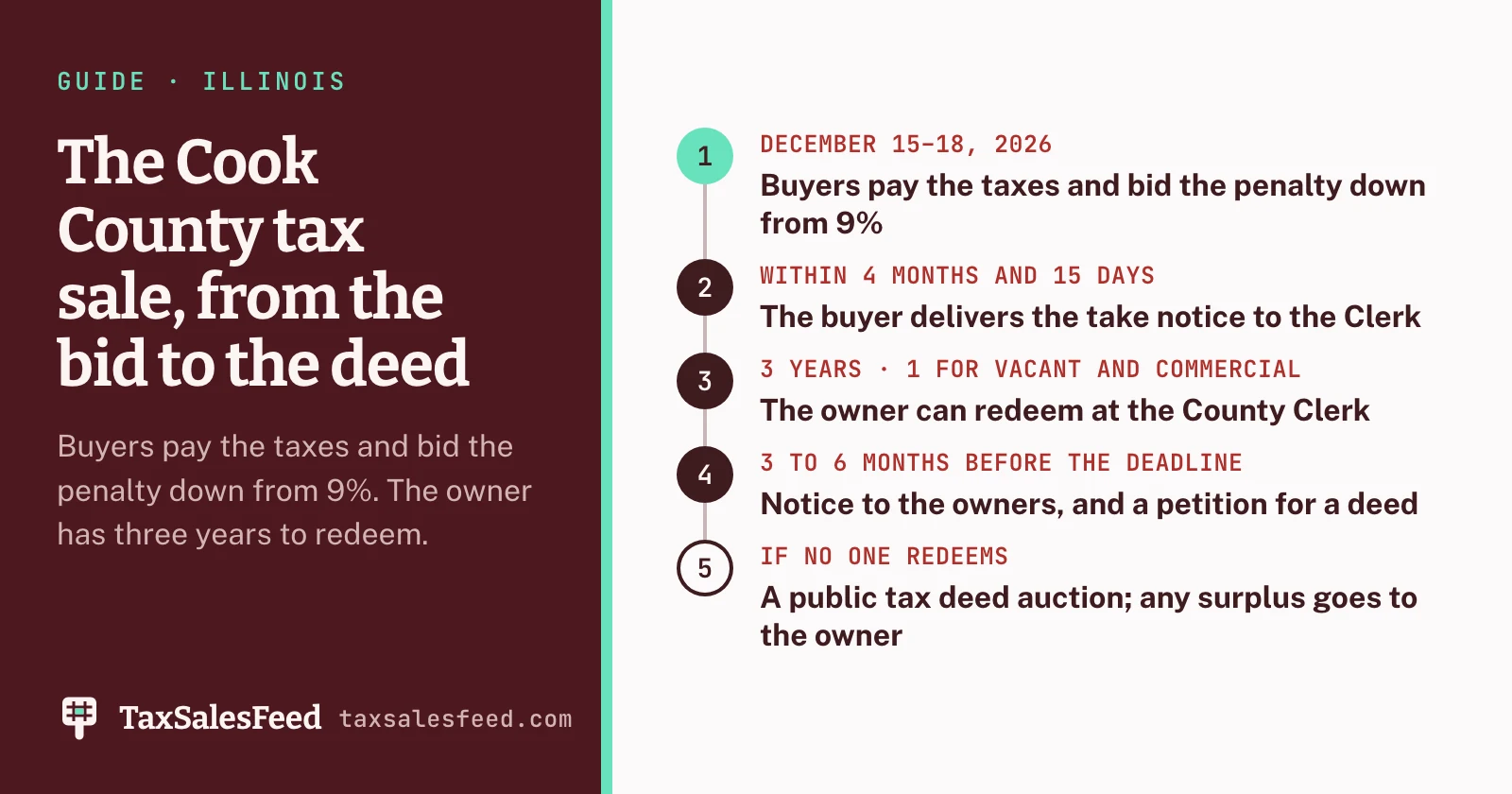
Cook County's annual tax sale opens on December 15, 2026: "The 2023 Annual Tax Sale has been scheduled to commence at 8:30 a.m. on December 15, 2026." [1] What is offered is not a house or a lot. Illinois defines a tax sale as "the transfer of a property tax lien or tax certificate" [2], and the rules for this one are newer than most of what is written about it. The General Assembly rewrote the tax sale sections of the Property Tax Code for certificates issued from 2024 [3] and again in Public Act 104-553, in effect since July 10, 2026 [4], which changed what a buyer may bid and what happens when an owner never redeems. This guide takes the sale as it stands for December, with the county's list beneath it.
The Cook County tax sale sells a lien, not the property
At the annual tax sale a buyer pays a property's delinquent taxes, interest and costs and receives a certificate of purchase. The owner keeps the property and can clear the lien by redeeming; only when no one redeems can the certificate lead to a tax deed.
Each annual sale offers one tax year that went unpaid. "The Annual Sale includes properties in Cook County eligible for sale due to delinquent Tax Year 2023 property taxes" [5], the bills that were payable in 2024 [6]. The buyer pays the amount charged on the property, and "The purchaser then shall be entitled to a certificate of purchase." [7] That certificate is a lien. It earns a penalty when the owner pays it off, and it can ripen into a deed only years later, by a court's order. Illinois is a tax lien state, closer to Florida's certificate sales than to the deed sales of Texas or Georgia.
December 15 to 18, 2026, and registration by December 4
The Tax Year 2023 sale runs December 15 to 18, 2026, from 8:30 a.m. to 5 p.m., one range of volume numbers a day, with a re-offer on December 21. Buyers register online between November 6 and December 4 and must have the collateral deposit in by 5 p.m. on December 4.
The Treasurer sells the county in volume order, a day per range:
| Sale day | Volumes | Townships |
|---|---|---|
| December 15, 2026 | 001 to 147 | Barrington, Berwyn, Bloom, Bremen, Calumet, Cicero, Elk Grove, Evanston, Hanover, Lemont, Leyden, Lyons, Maine, New Trier, Niles, Northfield, Norwood Park, Oak Park, Orland |
| December 16, 2026 | 148 to 270 | Palatine, Palos, Proviso, Rich, River Forest, Riverside, Schaumburg, Stickney, Thornton, Wheeling, Worth, Hyde Park |
| December 17, 2026 | 271 to 464 | Hyde Park, Jefferson, Lake |
| December 18, 2026 | 465 to 601 | Lake, Lake View, North Chicago, Rogers Park, South Chicago, West Chicago |
| December 21, 2026 | Re-offer | Taxes not sold on their day |
"The Annual Sale will be conducted from 8:30 a.m. to 5:00 p.m. each day of the sale schedule." [8] The last row of the Treasurer's schedule reads "December 21, 2026 Re-Offer" [9]. The eight Chicago townships (Hyde Park, Jefferson, Lake, Lake View, North Chicago, Rogers Park, South Chicago and West Chicago) make up the city, and they sell on the last three days.
"The 2023 Annual Tax Sale will be conducted as an online, internet-based sale" [10] at cooktaxsale.com, where buyers register, deposit collateral, store bids and pay for their certificates, but the bidding itself happens in one room: "However, the final placement of bids can only be made from computers located in the Cook County Treasurer's Sale Room on the days of the sale." [11] "The Sale Room will be located in Room 112 (Randolph Street entrance) of the Cook County Treasurer's Office, 118 N. Clark Street, Chicago, Illinois." [12] The Property Tax Code says the same in general terms: "All bidders are required to personally attend the tax sale" [13].
The deadline comes eleven days before the sale. "You may register at any time between November 6 and December 4, 2026." [14] Registration must be complete and "the requisite collateral deposit must be received by the Cook County Treasurer's Office no later than 5:00 p.m. (Chicago local time) on December 4, 2026." [15] Each buyer registers once. The Code requires that "each county collector in a county with 275,000 or more inhabitants shall adopt a single bidder rule sufficient to prohibit a tax purchaser from registering more than one related bidding entity at the tax sale." [16] And the fees come on top of the taxes. In Cook County "each person purchasing property at a sale under this Code shall pay to the County Collector a nonrefundable fee of $80 for each item purchased plus an additional sum equal to 5% of the taxes, interest, and penalties paid under Section 21-240." [17]
How bidding works: the penalty rate, bid down from 9%
Every bidder on a property offers to pay the same amount, the taxes due. What they compete on is the penalty the owner will owe on redemption: the lowest percentage wins, no bid above 9% is accepted, and the winning rate is charged again for each six months the certificate stays open.
The rule is short. "the person at the sale offering to pay the amount due on each property for the least penalty percentage shall be the purchaser of that property." [18] And "No bid shall be accepted for a penalty exceeding 9% of the amount of the tax or special assessment on property." [19] That is the section as Public Act 104-553 left it in July 2026 [20]. The bid is not an annual rate: it is a penalty multiplied by the six-month periods that have begun. An owner who redeems within six months pays "the certificate amount times the penalty bid at sale" [21]; between six and twelve months, "the certificate amount times 2 times the penalty bid at sale" [22]; and so on to the last six months of the third year, "the certificate amount times 6 times the penalty bid at sale" [23].
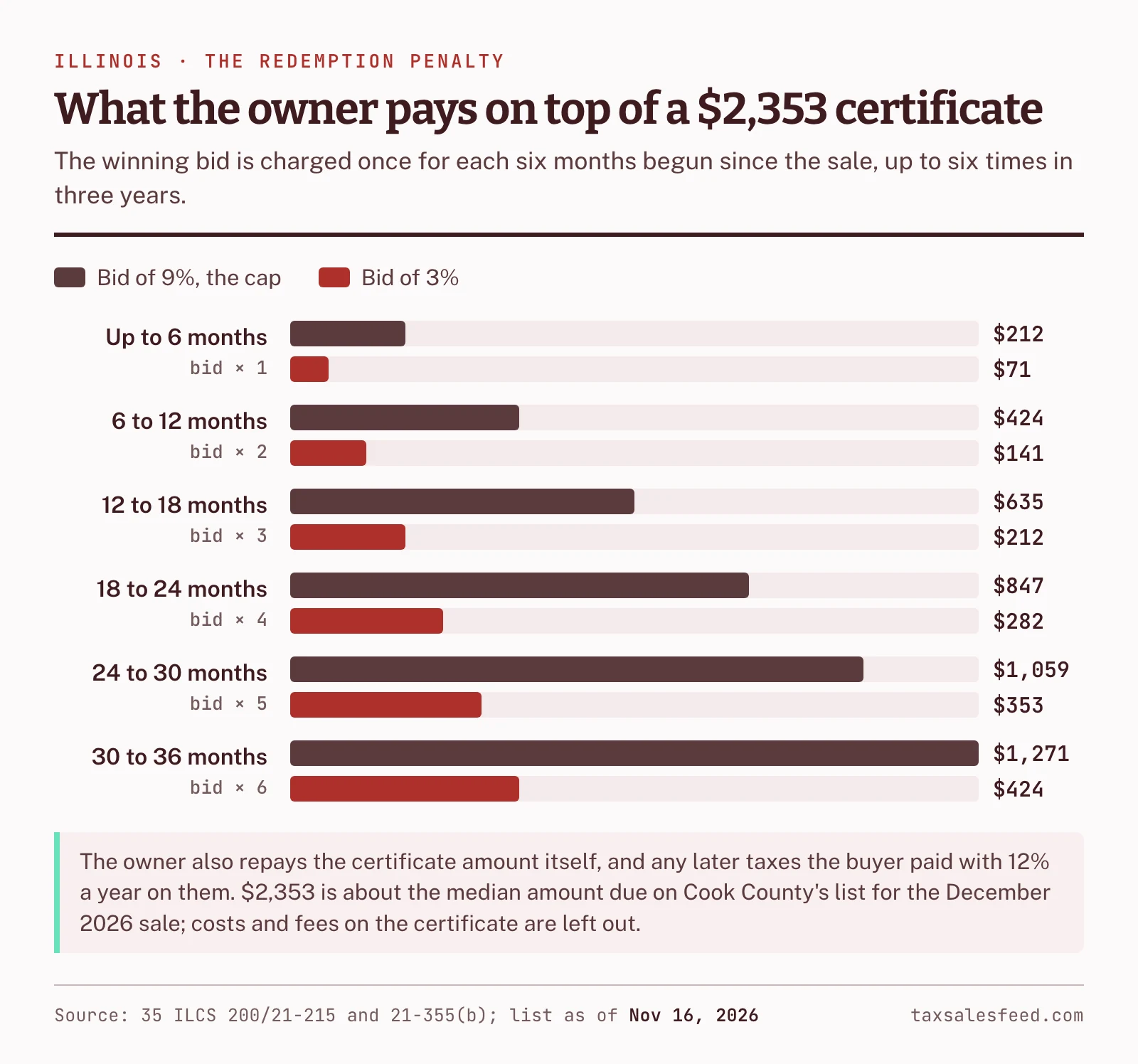
A certificate holder can also pay the taxes for later years, which the owner then has to repay too, "together with 12% penalty on each amount so paid for each year or portion thereof intervening between the date of that payment and the date of redemption" [24]. A buyer who pays them puts more money into the property, at 12% a year rather than the rate bid at the sale.
The Cook County delinquent property tax list
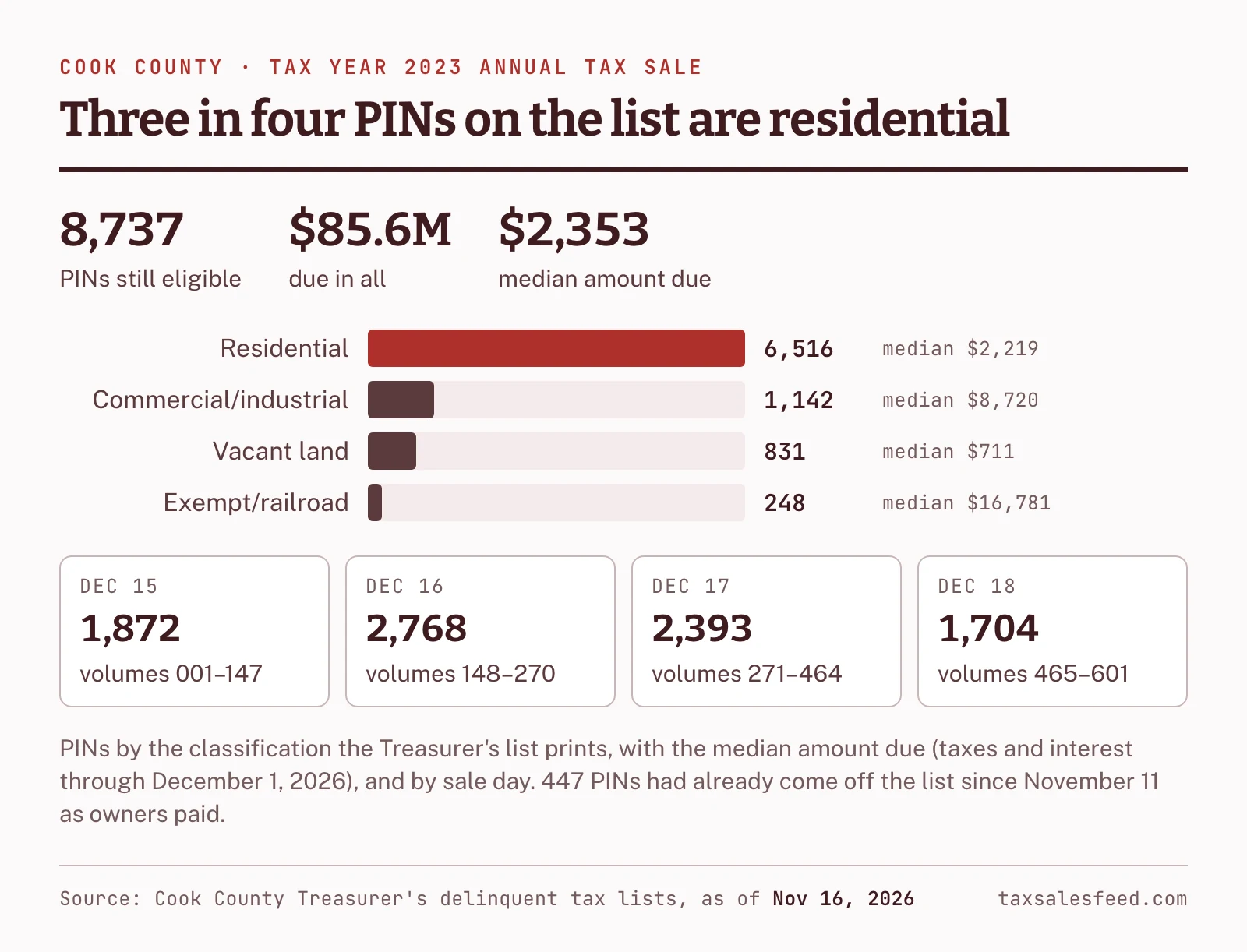
The Treasurer publishes the list of properties eligible for the sale in community newspapers by township, posts free lists on its website and sells the electronic file for $250. On every list the PIN, not the street address, is what identifies the taxes sold.
"A list of properties eligible for sale in the 2023 Annual Tax Sale was published in community newspapers by township on November 4 and November 5, 2026." [25] The Treasurer's website carries the same properties as free reports: "The properties are broken down by Chicago ward, municipality, township and commissioner district." [26] "The lists include: Property Index Number (PIN), taxpayer name, property address, mailing address, amount of taxes due, property classification and whether tax bills or notices were returned." [27] The data as one electronic file is sold at cooktaxsale.com: "Delinquent General Real Estate Tax List $250" [28].
Read any of them by PIN. "The subject parcel's PIN alone, and NOT the common street address, describes the delinquent taxes offered for sale." [29] The lists also shrink every day until the sale, as owners pay: of the 9,184 PINs we have read from the Treasurer's reports since November 11, 447 had already dropped off by November 16.
TaxSalesFeed reads the Treasurer's 17 commissioner-district reports every night, checks each against the total it prints, and keeps the county in one table: the PIN, the amount due, the classification, the volume and the sale day for every property still eligible. A PIN whose taxes are paid comes off the list the next morning.
Redemption: three years, paid at the County Clerk
An owner has three years from the sale to redeem, and one year for vacant non-farm land, commercial and industrial property and buildings of seven or more units. Redemption is paid to the Cook County Clerk, which works out the amount.
"Property sold at a tax sale under this Code may be redeemed at any time before the expiration of 3 years from the date of sale" [30], with one exception: "If on the date of sale the property is vacant non-farm property or property containing an improvement consisting of a structure or structures with 7 or more residential units or that is commercial or industrial property, it may be redeemed at any time before the expiration of 1 year from the date of the tax sale." [31] The buyer of a one-year certificate may stretch the period, "but only for a period that will expire not later than 3 years from the date of sale" [32].
The owner does not pay the buyer directly. "Any person desiring to redeem shall deposit an amount specified in this Section with the county clerk of the county in which the property is situated" [33], and the Clerk's office computes the figure: "If your unpaid taxes have been sold (at an annual tax sale, scavenger sale or over the counter), the Clerk's office can provide you with an Estimate of the Cost of Redemption, detailing the amount necessary to redeem (pay) your taxes and remove the threat of losing your property." [34]
A buyer's first obligation comes soon after the sale. To keep the right to a deed later, "within 4 months and 15 days after any tax sale held under this Code, the purchaser or his or her assignee, and the county for all tax liens or certificates it acquires pursuant to Section 21-90 of this Code, shall deliver to the county clerk a notice to be given to the party in whose name the taxes are last assessed" [35]. That is the take notice, which tells the owner the taxes were sold and when the right to redeem runs out.
From certificate to tax deed: the judicial tax deed auction
If the owner has not redeemed, the buyer serves notice, petitions the circuit court and, for certificates from this sale on, asks for an order authorizing a judicial tax deed auction. The property is then auctioned in public: the buyer is paid its credit bid if someone outbids it, takes the deed if no one does, and any surplus goes to the former owner.
The steps run backward from the end of the redemption period. A buyer may not ask for a deed unless, "not less than 3 months nor more than 6 months prior to the expiration of the period of redemption, he or she gives notice of the sale and the date of expiration of the period of redemption to the owners, occupants" [36] and the other parties with an interest, mortgage lenders among them. In the same window, "At any time within 6 months but not less than 3 months prior to the expiration of the redemption period" [37], the buyer "may file a petition in the circuit court in the same proceeding in which the judgment and order of sale were entered, asking that the court direct the county clerk to issue a tax deed if the property is not redeemed from the sale." [38]
What the court does next is what Public Act 104-553 changed. Once the period has run out unredeemed and the notices are proved, "the court shall find that the petitioner complied with those requirements and shall enter an order authorizing a judicial tax deed auction" [39], and the property "shall be offered for sale by public auction within 120 days after date of the order and sold to the highest bidder" [40]. "The selling officer shall start all bidding with a minimum bid equal to (1) the tax deed judgment amount plus interest at the rate of 0.75% per month" [41], plus the costs of publishing and conducting the sale. The judgment is the redemption amount plus the later taxes and costs the buyer paid, "plus a fee not to exceed 50% of the then-allowable foreclosure attorney fees for Illinois as published by Fannie Mae" [42], and the cost of publishing the auction. The officer bids that minimum for the buyer: "the person conducting the auction shall enter a bid in favor of the petitioner in the amount of the minimum bid set forth above." [43]
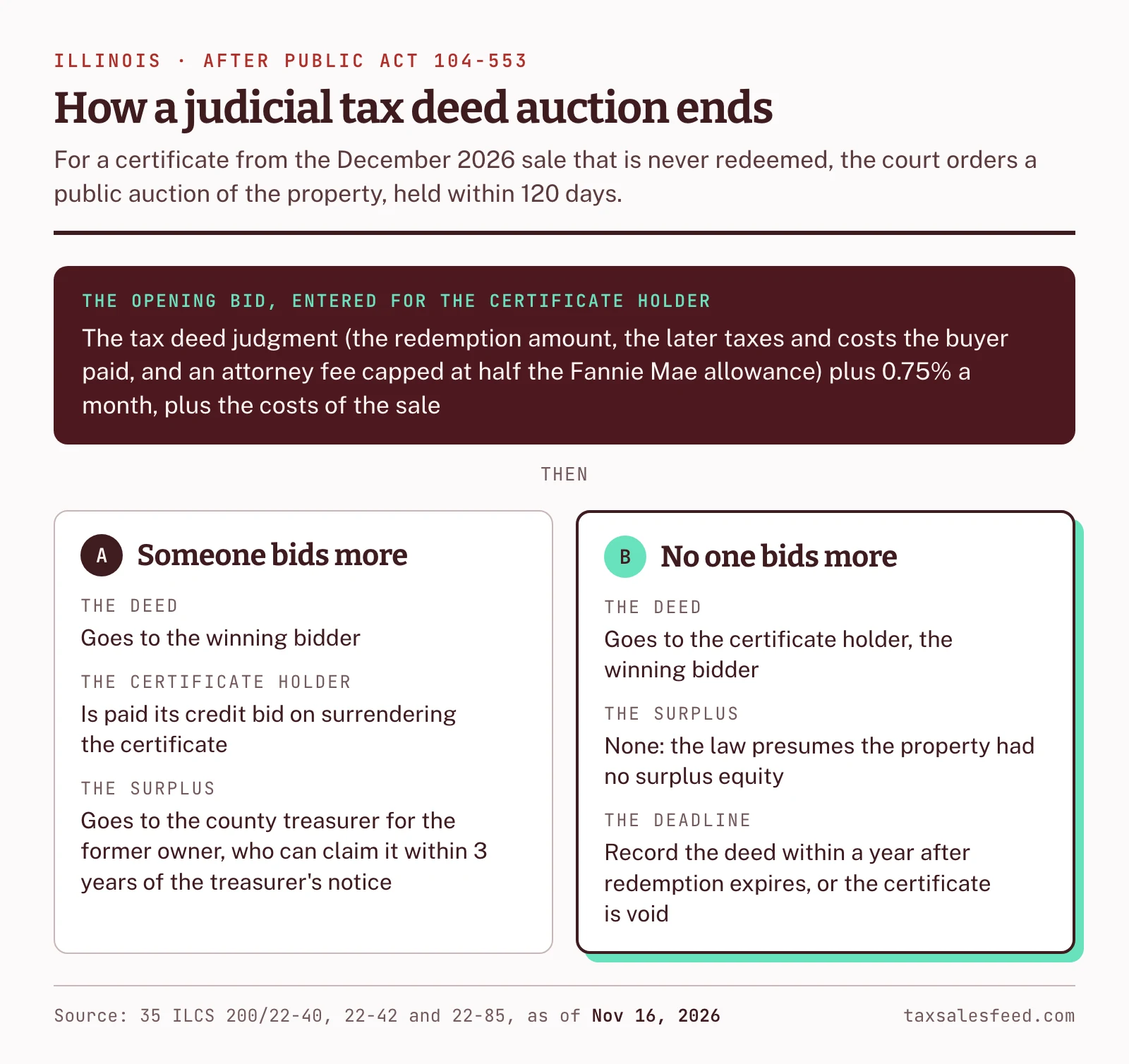
Either way the certificate holder recovers what it is owed. If a third party wins, the court's order directs the selling officer "to pay to the holder of the tax certificate the amount of the credit bid upon surrender of the tax certificate" [44], and the former owner "may submit a claim for the surplus funds to the county treasurer or the circuit court within 3 years of the date on the notice." [45] "If no bidder is willing to pay the minimum bid, the petitioner shall be the winning bidder and entitled to a tax deed, and it shall be conclusively presumed that there is no surplus equity in the property." [46] The point of the auction is the former owner's equity, the question the Supreme Court settled in Tyler v. Hennepin County.
These rules govern December's certificates: "The changes made to this Section by this amendatory Act of the 104th General Assembly apply to matters concerning tax certificates issued on or after the effective date of this amendatory Act of the 104th General Assembly." [47] In Cook County the clerk's fee for the deed is "accompanied by a $1,000 surplus equity fund fee in counties of 3,000,000 or more inhabitants" [48]. And the deadline at the end is strict: unless the holder takes out the deed and "records the same within one year from and after the time for redemption expires, the certificate or deed, and the sale on which it is based, shall, after the expiration of the one year period, be absolutely void with no right to reimbursement." [49]
After six more sales, the county buys the taxes itself
Public Act 104-553 hands Cook County's tax sale to the county over six sales. During them the county may take up to 100 low-tax homestead certificates a sale; from the seventh tax sale after July 10, 2026, the county must offer to buy every property offered, and its offer beats any other bid.
The law sets the end point plainly: "for the seventh tax sale conducted after the effective date of this amendatory Act of the 104th General Assembly and for all subsequent tax sales, the county shall exercise its authority under subsection (a) of Section 21-90 of this Code and offer to purchase or otherwise acquire for the total tax amount due all properties offered at a tax sale" [50]. Where it does, "If the county offers to purchase property for the amount due in accordance with subsections (b) and (c) of Section 21-190, the county shall be the purchaser of the property notwithstanding any other offer." [51] On those certificates "the penalty bid for any property purchased by a county in this manner shall be 0.75% per month." [52]
The December sale is one of the six before that. At it, a pilot program lets the county step in on a small scale: "Public Act 104-553 (effective July 10, 2026) created a Pilot Program under which Cook County may acquire up to 100 tax certificates at the 2023 Annual Tax Sale" [4] for homestead properties with the lowest tax bills, and the pilot runs for the first six sales: "This Section applies to the first 6 tax sales to occur in a county with 3,000,000 or more inhabitants on or after the effective date of this amendatory Act of the 104th General Assembly." [53] The Treasurer has posted the properties: "Please find the list of 100 properties that qualified for the Pilot Program associated with the 2023 Annual Tax Sale" [54]. Investors will still have a way in after the switch, at one remove: "The county may sell any property acquired with authority provided in this Section, or assign any tax certificate to any party" [55].
The scavenger sale
The scavenger sale offers, by court order, tax liens the county holds after they went unsold, to the highest cash bidder even below the taxes owed. A tax year can reach it only after its own annual sale.
The annual sale's leftovers go to the county, and the scavenger sale is how they come back to market: for that sale "the term delinquent also includes tax liens and certificates forfeited to the county as trustee and held pursuant to Section 21-90" [56]. "Under no circumstance may a tax year be offered at a scavenger sale prior to the annual tax sale for that tax year" [57]. The bidding is different too. The court orders the properties sold "to the highest bidder for cash, notwithstanding the bid may be less than the full amount of taxes, special taxes, special assessments, interest, penalties and costs for which judgment has been entered." [58] "The minimum bid for any property shall be $250 or one-half of the tax if the total liability is less than $500." [59] Scavenger properties are, by definition, ones the annual sale passed over: look at each one before you bid.
Sales in error and other risks
A certificate can be undone. The court declares a sale in error, and the buyer is refunded, when for example the taxes were already paid, the owner filed for bankruptcy after the sale or the buildings were destroyed. Everything is sold as is, and identified only by its PIN.
The Code lists the grounds. Among them, the court declares a sale in error when "the taxes or special assessments had been paid prior to the sale of the property" [60], and on the buyer's own application when "A voluntary or involuntary petition under the provisions of 11 U.S.C. Chapter 7, 11, 12, or 13 has been filed subsequent to the tax sale and prior to the issuance of the tax deed" [61] or "The improvements upon the property sold have been substantially destroyed subsequent to the tax sale and prior to the issuance of the tax deed" [62]. The refund is not always a good outcome. On most grounds, "Interest shall be awarded and paid to the tax purchaser at the rate of 1% per month from the date of sale to the date of payment, or in an amount equivalent to the penalty interest which would be recovered on a redemption at the time of payment pursuant to the order for sale in error, whichever is less." [63] But "Interest shall not be paid when the sale in error is made pursuant to Section 22-35, Section 22-50, subdivision (a)(5), (b)(1), (b)(2), or (b)(4) of Section 21-310" [64], which takes in the bankruptcy and destroyed-building cases above.
The Treasurer adds its own warnings: "It is the responsibility of each buyer to perform due diligence to determine the property location, classification, nature, and condition of any property or improvements." [65] And "ALL SALES ARE FINAL." [66]
Will, Lake and the rest of Illinois
The other 101 counties hold their own annual sales under the same Code, each run by its county treasurer, and some of the figures above apply only to Cook. Outside it, for one, the buyer pays "an indemnity fee set by the county collector of not more than $20 for each item purchased" [67] instead of Cook's $80 and 5%. Will County's sale is on December 1, 2026; Lake County's was held on November 13.
Our records hold 15,060 upcoming Illinois tax sales in 2 counties; the next is in Will County on December 1, 2026, with 6,675 parcels. The median opening bid across the Illinois sales we hold is $2,765.The Illinois counties with the most sales coming, from the same data as their pages:
| County | Upcoming | Next sale | Median opening bid |
|---|---|---|---|
| Cook County | 8,385 | Dec 15, 2026 | $2,353 |
| Will County | 6,675 | Dec 1, 2026 | $3,453 |
Before you bid in Cook County
- Register by December 4. Online at cooktaxsale.com, with the collateral deposit received by 5 p.m. Chicago time.
- Research the PIN, not the address. Check the classification, which sets the redemption period, and the property's condition, and ask the Clerk about earlier years that may also be unpaid or sold.
- Set your rate. The cap is 9% per six-month period begun; every point you bid down is a point less for each of those periods.
- Budget beyond the bid. The $80 and 5% fees, the take notice within 4 months and 15 days, the later taxes you may pay and, if no one redeems, the deed petition, notices and the $1,000 surplus fund fee.
- Expect an auction at the end, not a windfall. A certificate from this sale that is never redeemed ends in a public tax deed auction, and you are paid your credit bid if someone outbids you.
- Check the list on the day. Owners pay up to the sale, and a paid PIN is withdrawn.
The same steps for any state are in how to buy tax lien and tax deed properties. For the current lists, see the Cook County tax sale list, Illinois tax sales, or Will and Lake counties.
Sources
- [1]Cook County Treasurer, Tax Year 2023 Annual Tax Sale — Cook County Treasurer“The 2023 Annual Tax Sale has been scheduled to commence at 8:30 a.m. on December 15, 2026.”
- [2]35 ILCS 200/1-148 — Illinois General Assembly“"Tax sale" means the transfer of a property tax lien or tax certificate”
- [3]35 ILCS 200/21-350 — Illinois General Assembly“The changes made to this Section by Public Act 103-555 apply to matters concerning tax certificates issued on or after January 1, 2024.”
- [4]Cook County Treasurer, Tax Year 2023 Annual Tax Sale — Cook County Treasurer“Public Act 104-553 (effective July 10, 2026) created a Pilot Program under which Cook County may acquire up to 100 tax certificates at the 2023 Annual Tax Sale”
- [5]Cook County Treasurer, Tax Year 2023 Annual Tax Sale — Cook County Treasurer“The Annual Sale includes properties in Cook County eligible for sale due to delinquent Tax Year 2023 property taxes”
- [6]Cook County Treasurer, Lists of Properties with Delinquent Taxes — Cook County Treasurer“properties with delinquent taxes for Tax Year 2023 (payable in 2024)”
- [7]35 ILCS 200/21-240 — Illinois General Assembly“The purchaser then shall be entitled to a certificate of purchase.”
- [8]Cook County Treasurer, Tax Year 2023 Annual Tax Sale — Cook County Treasurer“The Annual Sale will be conducted from 8:30 a.m. to 5:00 p.m. each day of the sale schedule.”
- [9]Cook County Treasurer, Tax Year 2023 Annual Tax Sale — Cook County Treasurer“December 21, 2026 Re-Offer”
- [10]Cook County Treasurer, Tax Year 2023 Annual Tax Sale — Cook County Treasurer“The 2023 Annual Tax Sale will be conducted as an online, internet-based sale”
- [11]Cook County Treasurer, Tax Year 2023 Annual Tax Sale — Cook County Treasurer“However, the final placement of bids can only be made from computers located in the Cook County Treasurer's Sale Room on the days of the sale.”
- [12]Cook County Treasurer, Tax Year 2023 Annual Tax Sale — Cook County Treasurer“The Sale Room will be located in Room 112 (Randolph Street entrance) of the Cook County Treasurer's Office, 118 N. Clark Street, Chicago, Illinois.”
- [13]35 ILCS 200/21-205(b) — Illinois General Assembly“All bidders are required to personally attend the tax sale”
- [14]Cook County Treasurer, Tax Year 2023 Annual Tax Sale — Cook County Treasurer“You may register at any time between November 6 and December 4, 2026.”
- [15]Cook County Treasurer, Tax Year 2023 Annual Tax Sale — Cook County Treasurer“the requisite collateral deposit must be received by the Cook County Treasurer's Office no later than 5:00 p.m. (Chicago local time) on December 4, 2026.”
- [16]35 ILCS 200/21-205(b-5) — Illinois General Assembly“each county collector in a county with 275,000 or more inhabitants shall adopt a single bidder rule sufficient to prohibit a tax purchaser from registering more than one related bidding entity at the tax sale.”
- [17]35 ILCS 200/21-295(a-5) — Illinois General Assembly“each person purchasing property at a sale under this Code shall pay to the County Collector a nonrefundable fee of $80 for each item purchased plus an additional sum equal to 5% of the taxes, interest, and penalties paid under Section 21-240.”
- [18]35 ILCS 200/21-215(a) — Illinois General Assembly“the person at the sale offering to pay the amount due on each property for the least penalty percentage shall be the purchaser of that property.”
- [19]35 ILCS 200/21-215(a) — Illinois General Assembly“No bid shall be accepted for a penalty exceeding 9% of the amount of the tax or special assessment on property.”
- [20]35 ILCS 200/21-215 — Illinois General Assembly“(Source: P.A. 104-553, eff. 7-10-26.)”
- [21]35 ILCS 200/21-355(b)(1) — Illinois General Assembly“if the redemption occurs on or before the expiration of 6 months from the date of sale, the certificate amount times the penalty bid at sale”
- [22]35 ILCS 200/21-355(b)(2) — Illinois General Assembly“if the redemption occurs after 6 months from the date of sale, and on or before the expiration of 12 months from the date of sale, the certificate amount times 2 times the penalty bid at sale”
- [23]35 ILCS 200/21-355(b)(6) — Illinois General Assembly“if the redemption occurs after 30 months from the date of sale and on or before the expiration of 36 months from the date of sale, the certificate amount times 6 times the penalty bid at sale”
- [24]35 ILCS 200/21-355(c) — Illinois General Assembly“together with 12% penalty on each amount so paid for each year or portion thereof intervening between the date of that payment and the date of redemption”
- [25]Cook County Treasurer, Tax Year 2023 Annual Tax Sale — Cook County Treasurer“A list of properties eligible for sale in the 2023 Annual Tax Sale was published in community newspapers by township on November 4 and November 5, 2026.”
- [26]Cook County Treasurer, Lists of Properties with Delinquent Taxes — Cook County Treasurer“The properties are broken down by Chicago ward, municipality, township and commissioner district.”
- [27]Cook County Treasurer, Lists of Properties with Delinquent Taxes — Cook County Treasurer“The lists include: Property Index Number (PIN), taxpayer name, property address, mailing address, amount of taxes due, property classification and whether tax bills or notices were returned.”
- [28]Cook County Treasurer, Tax Year 2023 Annual Tax Sale — Cook County Treasurer“Delinquent General Real Estate Tax List $250”
- [29]Cook County Treasurer, Tax Year 2023 Annual Tax Sale — Cook County Treasurer“The subject parcel's PIN alone, and NOT the common street address, describes the delinquent taxes offered for sale.”
- [30]35 ILCS 200/21-350 — Illinois General Assembly“Property sold at a tax sale under this Code may be redeemed at any time before the expiration of 3 years from the date of sale”
- [31]35 ILCS 200/21-350(a) — Illinois General Assembly“If on the date of sale the property is vacant non-farm property or property containing an improvement consisting of a structure or structures with 7 or more residential units or that is commercial or industrial property, it may be redeemed at any time before the expiration of 1 year from the date of the tax sale.”
- [32]35 ILCS 200/21-385(c) — Illinois General Assembly“but only for a period that will expire not later than 3 years from the date of sale”
- [33]35 ILCS 200/21-355 — Illinois General Assembly“Any person desiring to redeem shall deposit an amount specified in this Section with the county clerk of the county in which the property is situated”
- [34]Cook County Clerk, Tax Redemption — Cook County Clerk“If your unpaid taxes have been sold (at an annual tax sale, scavenger sale or over the counter), the Clerk's office can provide you with an Estimate of the Cost of Redemption, detailing the amount necessary to redeem (pay) your taxes and remove the threat of losing your property.”
- [35]35 ILCS 200/22-5 — Illinois General Assembly“within 4 months and 15 days after any tax sale held under this Code, the purchaser or his or her assignee, and the county for all tax liens or certificates it acquires pursuant to Section 21-90 of this Code, shall deliver to the county clerk a notice to be given to the party in whose name the taxes are last assessed”
- [36]35 ILCS 200/22-10 — Illinois General Assembly“not less than 3 months nor more than 6 months prior to the expiration of the period of redemption, he or she gives notice of the sale and the date of expiration of the period of redemption to the owners, occupants”
- [37]35 ILCS 200/22-30 — Illinois General Assembly“At any time within 6 months but not less than 3 months prior to the expiration of the redemption period”
- [38]35 ILCS 200/22-30 — Illinois General Assembly“may file a petition in the circuit court in the same proceeding in which the judgment and order of sale were entered, asking that the court direct the county clerk to issue a tax deed if the property is not redeemed from the sale.”
- [39]35 ILCS 200/22-40(a) — Illinois General Assembly“the court shall find that the petitioner complied with those requirements and shall enter an order authorizing a judicial tax deed auction”
- [40]35 ILCS 200/22-40(g) — Illinois General Assembly“the property shall be offered for sale by public auction within 120 days after date of the order and sold to the highest bidder”
- [41]35 ILCS 200/22-42(b) — Illinois General Assembly“The selling officer shall start all bidding with a minimum bid equal to (1) the tax deed judgment amount plus interest at the rate of 0.75% per month”
- [42]35 ILCS 200/22-40(a) — Illinois General Assembly“plus a fee not to exceed 50% of the then-allowable foreclosure attorney fees for Illinois as published by Fannie Mae”
- [43]35 ILCS 200/22-42(c) — Illinois General Assembly“the person conducting the auction shall enter a bid in favor of the petitioner in the amount of the minimum bid set forth above.”
- [44]35 ILCS 200/22-42(g)(2) — Illinois General Assembly“directing the selling officer to pay to the holder of the tax certificate the amount of the credit bid upon surrender of the tax certificate”
- [45]35 ILCS 200/22-42(h) — Illinois General Assembly“may submit a claim for the surplus funds to the county treasurer or the circuit court within 3 years of the date on the notice.”
- [46]35 ILCS 200/22-42(b) — Illinois General Assembly“If no bidder is willing to pay the minimum bid, the petitioner shall be the winning bidder and entitled to a tax deed, and it shall be conclusively presumed that there is no surplus equity in the property.”
- [47]35 ILCS 200/22-40(h) — Illinois General Assembly“The changes made to this Section by this amendatory Act of the 104th General Assembly apply to matters concerning tax certificates issued on or after the effective date of this amendatory Act of the 104th General Assembly.”
- [48]35 ILCS 200/22-40(c) — Illinois General Assembly“accompanied by a $1,000 surplus equity fund fee in counties of 3,000,000 or more inhabitants”
- [49]35 ILCS 200/22-85 — Illinois General Assembly“records the same within one year from and after the time for redemption expires, the certificate or deed, and the sale on which it is based, shall, after the expiration of the one year period, be absolutely void with no right to reimbursement.”
- [50]35 ILCS 200/21-190(c) — Illinois General Assembly“for the seventh tax sale conducted after the effective date of this amendatory Act of the 104th General Assembly and for all subsequent tax sales, the county shall exercise its authority under subsection (a) of Section 21-90 of this Code and offer to purchase or otherwise acquire for the total tax amount due all properties offered at a tax sale”
- [51]35 ILCS 200/21-215(b) — Illinois General Assembly“If the county offers to purchase property for the amount due in accordance with subsections (b) and (c) of Section 21-190, the county shall be the purchaser of the property notwithstanding any other offer.”
- [52]35 ILCS 200/21-215(b) — Illinois General Assembly“the penalty bid for any property purchased by a county in this manner shall be 0.75% per month.”
- [53]35 ILCS 200/21-191(d) — Illinois General Assembly“This Section applies to the first 6 tax sales to occur in a county with 3,000,000 or more inhabitants on or after the effective date of this amendatory Act of the 104th General Assembly.”
- [54]Cook County Treasurer, Tax Year 2023 Annual Tax Sale — Cook County Treasurer“Please find the list of 100 properties that qualified for the Pilot Program associated with the 2023 Annual Tax Sale”
- [55]35 ILCS 200/21-90(c) — Illinois General Assembly“The county may sell any property acquired with authority provided in this Section, or assign any tax certificate to any party”
- [56]35 ILCS 200/21-145 — Illinois General Assembly“the term delinquent also includes tax liens and certificates forfeited to the county as trustee and held pursuant to Section 21-90”
- [57]35 ILCS 200/21-145 — Illinois General Assembly“Under no circumstance may a tax year be offered at a scavenger sale prior to the annual tax sale for that tax year”
- [58]35 ILCS 200/21-260 — Illinois General Assembly“to the highest bidder for cash, notwithstanding the bid may be less than the full amount of taxes, special taxes, special assessments, interest, penalties and costs for which judgment has been entered.”
- [59]35 ILCS 200/21-260(a) — Illinois General Assembly“The minimum bid for any property shall be $250 or one-half of the tax if the total liability is less than $500.”
- [60]35 ILCS 200/21-310(a)(2) — Illinois General Assembly“the taxes or special assessments had been paid prior to the sale of the property”
- [61]35 ILCS 200/21-310(b)(1) — Illinois General Assembly“A voluntary or involuntary petition under the provisions of 11 U.S.C. Chapter 7, 11, 12, or 13 has been filed subsequent to the tax sale and prior to the issuance of the tax deed”
- [62]35 ILCS 200/21-310(b)(2) — Illinois General Assembly“The improvements upon the property sold have been substantially destroyed subsequent to the tax sale and prior to the issuance of the tax deed”
- [63]35 ILCS 200/21-315(b) — Illinois General Assembly“Interest shall be awarded and paid to the tax purchaser at the rate of 1% per month from the date of sale to the date of payment, or in an amount equivalent to the penalty interest which would be recovered on a redemption at the time of payment pursuant to the order for sale in error, whichever is less.”
- [64]35 ILCS 200/21-315(b) — Illinois General Assembly“Interest shall not be paid when the sale in error is made pursuant to Section 22-35, Section 22-50, subdivision (a)(5), (b)(1), (b)(2), or (b)(4) of Section 21-310”
- [65]Cook County Treasurer, Tax Year 2023 Annual Tax Sale — Cook County Treasurer“It is the responsibility of each buyer to perform due diligence to determine the property location, classification, nature, and condition of any property or improvements.”
- [66]Cook County Treasurer, Tax Year 2023 Annual Tax Sale — Cook County Treasurer“ALL SALES ARE FINAL.”
- [67]35 ILCS 200/21-295(a) — Illinois General Assembly“an indemnity fee set by the county collector of not more than $20 for each item purchased”
Questions
When is the Cook County tax sale in 2026?
The Tax Year 2023 Annual Tax Sale begins at 8:30 a.m. on December 15, 2026 and runs through December 18, one range of the county's volume numbers a day, with a re-offer of unsold taxes on December 21. Tax buyers register online at cooktaxsale.com between November 6 and December 4, 2026; registration and the collateral deposit must be in by 5 p.m. Chicago time on December 4.
Is the Cook County tax sale a tax lien sale or a tax deed sale?
A tax lien sale. The buyer pays the delinquent taxes and receives a certificate of purchase; the property itself is not sold. If the owner does not redeem in time, the buyer can petition the circuit court for a tax deed, and for certificates bought at this sale the court then orders a public tax deed auction of the property.
What is the maximum interest rate at the Illinois tax sale?
The penalty bid is capped at 9%, and bidders bid it down: the lowest percentage wins. The rate is charged once for each six-month period begun since the sale, so a certificate bought at 9% and redeemed in the last six months of the third year earns 54% of the certificate amount. Later taxes the buyer pays on the property earn 12% a year.
How long is the redemption period after a Cook County tax sale?
Three years from the sale for most property. Vacant non-farm land, commercial and industrial property and buildings with seven or more residential units have one year, which the buyer may extend to as much as three years. The owner redeems by paying the Cook County Clerk, which prepares an estimate of the cost of redemption.
Where can I get the Cook County delinquent property tax list?
The Treasurer published the list in community newspapers by township on November 4 and 5, 2026, and posts free lists of the eligible properties on its website by Chicago ward, municipality, township and commissioner district. The electronic file costs $250 at cooktaxsale.com. TaxSalesFeed reads the Treasurer's lists every night and keeps the whole county in one table.
What is the Cook County scavenger sale?
A separate, court-ordered sale of tax liens the county holds after they went unsold, and a tax year can never be offered at one before its annual sale. Each property goes to the highest cash bidder even when the bid is below the taxes owed; the minimum bid is $250, or half the tax when the total is under $500.
Where next
- Florida tax deed sale calendarEvery county's upcoming sale days, with parcel counts and start times.
- Tax sale guidesHow to buy at a tax sale, which states sell deeds or liens, and Florida, Texas, Georgia, Pennsylvania and California step by step.
- Tax certificate holdersThe funds applying for tax deeds, with every county they are active in.
- Tax sale glossaryTax certificate, tax deed application, opening bid, redemption — every term a notice uses.
General information about Illinois procedure, not legal advice. Each county treasurer holds the annual tax sale on the terms it publishes, Cook County's among them, and statutes change; confirm with the county treasurer before bidding.